


What Bed Size Does a Patient Need? The Relationship Between Body Mass Index and Space Required to Turn in Bed
- PMID: 28968285
- PMCID: PMC5671795
- DOI: 10.1097/NNR.0000000000000242
What Bed Size Does a Patient Need? The Relationship Between Body Mass Index and Space Required to Turn in Bed
Abstract
Background: A bed that is too small to allow patients to turn from supine to side lying increases the difficulty of mobilizing patients, which can increase risk of musculoskeletal injury to caregivers, increase risk of pressure injuries to patients, and reduce patient comfort. Currently, no guidance is available for what patient sizes are accommodated by the standard 91cm (36 in.)-wide hospital bed, and no studies have evaluated the relationship between anthropometric attributes and space required to turn in bed.
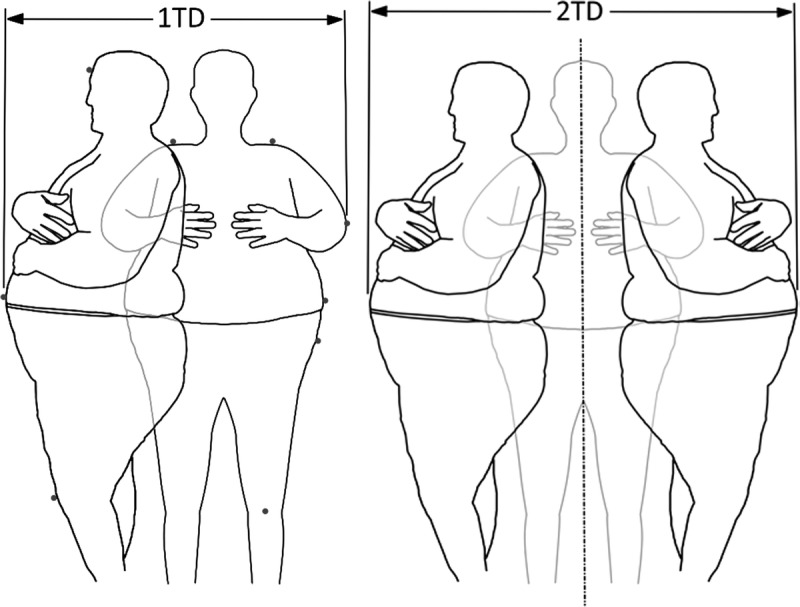
Objective: The purpose of this research was to determine how much space individuals occupy when turning from supine to side lying as predicted by their anthropometry (i.e., body dimensions) to establish guidance on selecting the appropriate bed size.
Methods: Forty-seven adult participants (24 female) with body mass index (BMI) from 20 to 76 kg/m participated in a laboratory study. Body dimensions were measured, and the envelope of space required to turn was determined using motion capture. Linear regressions estimated the relationship between anthropometric attributes and space occupied when turning.
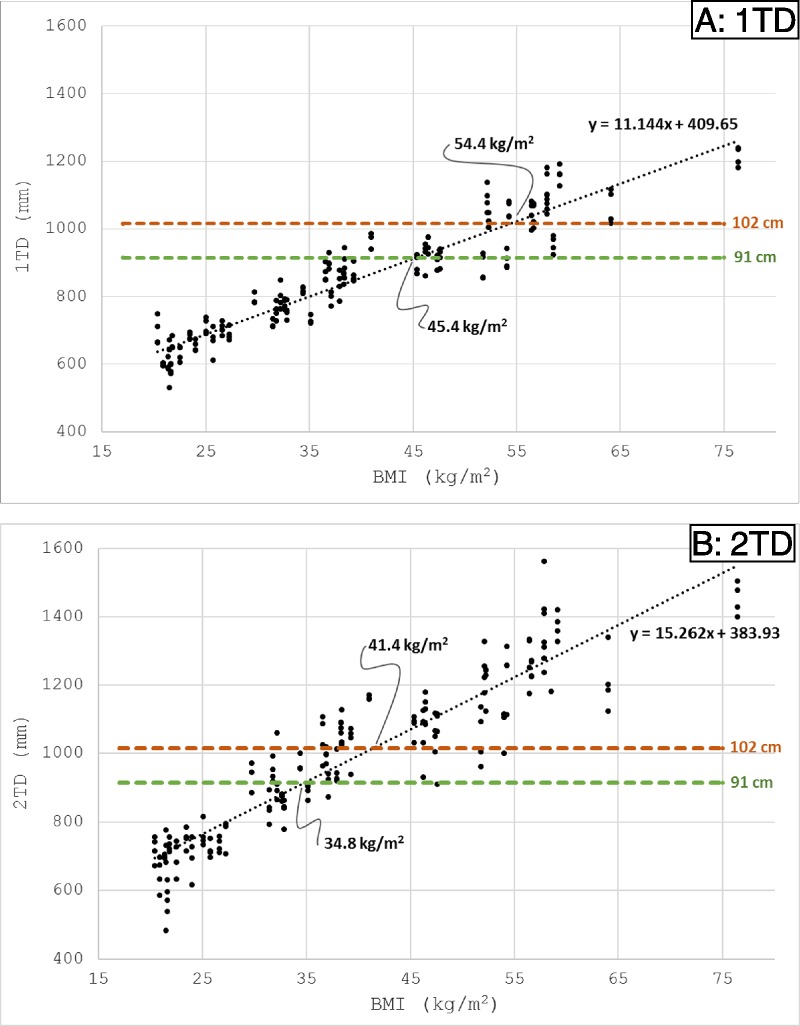
Results: BMI was strongly correlated (R = .88) with the space required to turn. Based on the linear regressions, individuals with BMI up to 35 kg/m could turn left and right within 91 cm and individuals with BMI up to 45 kg/m could turn one direction within 91 cm.
Discussion: BMI is a good predictor of the space required to turn from supine to lateral. Nurses should consider placing patients that are unable to laterally reposition themselves on a wider bed when BMI is greater than 35 kg/m and should consider placing all patients greater than 45 kg/m on a wider bed regardless of mobility. Hospital administrators can use historical demographic information about the BMI of their patient populations to plan facility-level equipment procurement for equipment that accommodates their patients.
Conflict of interest statement
Conflicts of interest: All authors are employees of Hill-Rom, a manufacturer of hospital beds. Kathryn Smith also owns stock in Hill-Rom.
Figures
Comment in
-
What Bed Size Does a Patient Need?: The Relationship Between Body Mass Index and Space Required to Turn in Bed.Nurs Res. 2018 Jul/Aug;67(4):273-274. doi: 10.1097/NNR.0000000000000294. Nurs Res. 2018. PMID: 29953042 No abstract available.
References
-
- Brindle C. T., Malhotra R., O'Rourke S., Currie L., Chadwik D., Falls P., … Creehan S. (2013). Turning and repositioning the critically ill patient with hemodynamic instability: A literature review and consensus recommendations. Journal of Wound Ostomy & Continence Nursing, 40, 254–267. doi:10.1097/WON.0b013e318290448f - PubMed
-
- Camden S. G. (2006). Nursing care of the bariatric patient. Bariatric Nursing and Surgical Patient Care, 1(1), 21–30. doi:10.1089/bar.2006.1.21
-
- Fragala G., Perry B., & Fragala M. (2012). Examining bed width as a contributor to risk of falls from bed in long-term care. Annals of Long-Term Care: Clinical Care and Aging, 20(6), 35–38.
-
- Gordon C. C., Churchill T., Clauser C. E., Bradtmiller B., McConville J. T., Tebbetts I., & Walker R. A. (1989). 1988 Anthropometric Survey of US Army Personnel: Methods and Summary Statistics. Tech Report Natick/TR-89/044 Natick, MA: U.S. Army Natick Research, Development, and Engineering Center.
-
- Gourash W., Rogula T., & Schauer P. R. (2007). Essential bariatric equipment: Making your facility more accommodating to bariatric surgical patients. In Schauer P. R., Schirmer B. D., Brethauer S. (Eds.), Minimally invasive bariatric surgery (pp. 37–49). New York, NY: Springer.
Publication types
MeSH terms
LinkOut - more resources
Full Text Sources
Other Literature Sources
Medical
