. 2017 Oct 2;15(1):199.
doi: 10.1186/s12967-017-1296-3.

Report on the first SLFN11 monothematic workshop: from function to role as a biomarker in cancer

Affiliations

Report on the first SLFN11 monothematic workshop: from function to role as a biomarker in cancer

Alberto Ballestrero et al. J Transl Med. .

Abstract

SLFN11 is a recently discovered protein with a putative DNA/RNA helicase function. First identified in association with the maturation of thymocytes, SLFN11 was later causally associated, by two independent groups, with the resistance to DNA damaging agents such as topoisomerase I and II inhibitors, platinum compounds, and other alkylators, making it an attractive molecule for biomarker development. Later, SLFN11 was linked to antiviral response in human cells and interferon production, establishing a potential bond between immunity and chemotherapy. Recently, we demonstrated the potential role of SLN11 as a biomarker to predict sensitivity to the carboplatin/taxol combination in ovarian cancer. The present manuscript reports on the first international monothematic workshop on SLFN11. Several researchers from around the world, directly and actively involved in the discovery, functional characterization, and study of SLFN11 for its biomarker and medicinal properties gathered to share their views on the current knowledge advances concerning SLFN11. The aim of the manuscript is to summarize the authors' interventions and the main take-home messages resulting from the workshop.

Keywords: Biomarker; Breast cancer; Chemotherapy; Colorectal cancer; DNA damage repair; Immune system; Ovarian cancer; Prediction; Prognosis; SLFN11.


Figures
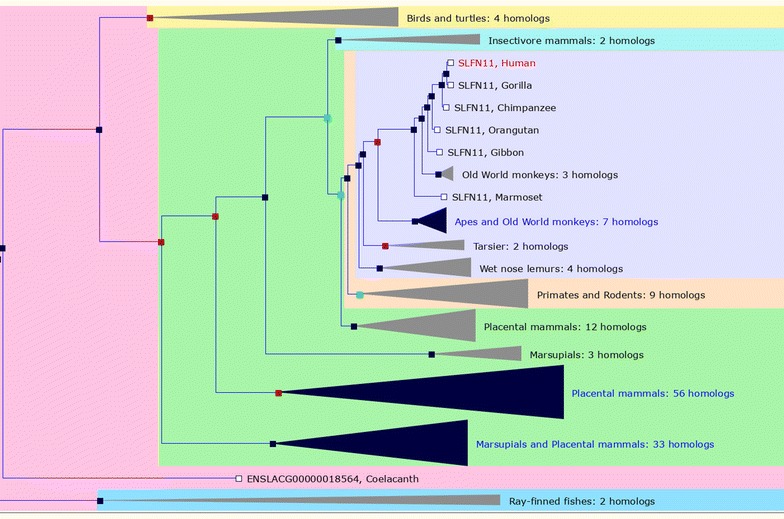
Fig. 1
Fig. 1
Conservation tree of SLFN11 across species. Constructed using the Ensembl! GeneTree tool, queried with the term “SLFN11” (last accessed 2017, June 19)
Fig. 2
Fig. 2
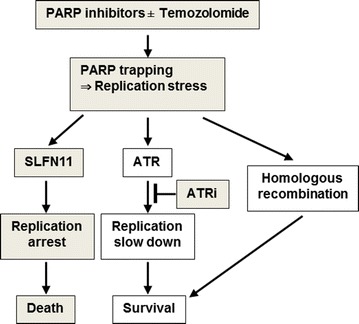
Summary scheme proposing the role of SLFN11 in parallel to ATR and homologous recombination [12]
Fig. 3
Fig. 3
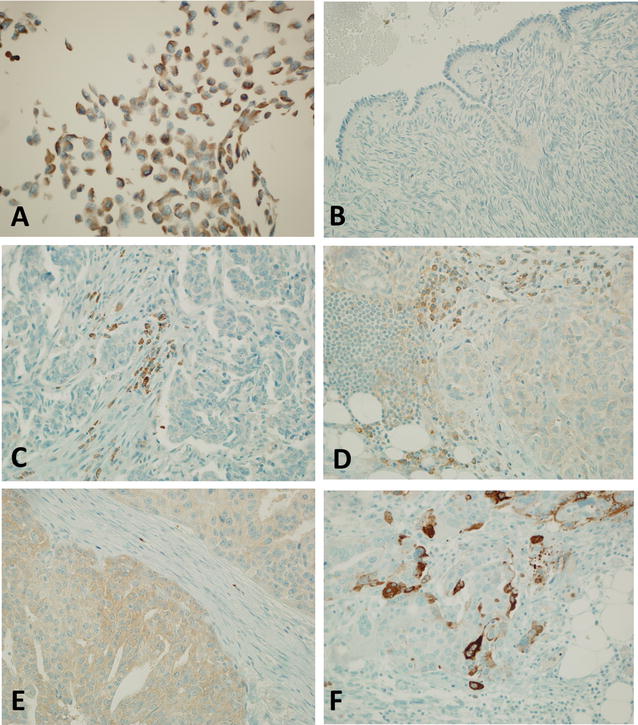
Immunohistochemistry staining for SLFN11: A (IHC; 400×) Positive external control constituted by SKOV-3 cell block culture. B (IHC; 400×) Negative external control constituded by normal menopausal ovary: no stain in both overian surface cells and stromal cells. C (IHC, 400×) SLFN negative HGSC: cancer cells show no stain, TILs show an intense stain representing a useful internal control. D (IHC, 400×) SLFN low HGSC (HS 2) with a faint (IS 1 +) inconstant (DS 2 +) pattern of stain. E (IHC, 400×) SLFN intermediate HGSC (HS4) with a moderate (IS 2 +) inconstant (DS 2 +) pattern of stain. F (IHC, 400×) SLFN high HGSC (HS 6) with an intense (IS 3 +) but inconstant (DS 2 +) pattern of stain
Fig. 4
Fig. 4
Overall survival in patients of the PETACC3 study according to SLFN11 levels and MSI status. a Overall survival in the 268 patients treated with LV5-FU2 regimen. b Overall survival in the 285 patients treated with FOLFIRI regimen

References

    1. Schwarz DA, Katayama CD, Hedrick SM. Schlafen, a new family of growth regulatory genes that affect thymocyte development. Immunity. 1998;9:657–668. doi: 10.1016/S1074-7613(00)80663-9. - DOI - PubMed
    1. Liu F, Zhou P, Wang Q, Zhang M, Li D. The Schlafen family: complex roles in different cell types and virus replication. Cell Biol Int. 2017 - PubMed
    1. Zoppoli G, Regairaz M, Leo E, Reinhold WC, Varma S, Ballestrero A, et al. Putative DNA/RNA helicase Schlafen-11 (SLFN11) sensitizes cancer cells to DNA-damaging agents. Proc Natl Acad Sci USA. 2012;109:15030–15035. doi: 10.1073/pnas.1205943109. - DOI - PMC - PubMed
    1. Barretina J, Caponigro G, Stransky N, Venkatesan K, Margolin AA, Kim S, et al. The cancer cell line encyclopedia enables predictive modelling of anticancer drug sensitivity. Nature. 2012;483:603–607. doi: 10.1038/nature11003. - DOI - PMC - PubMed
    1. Li M, Kao E, Gao X, Sandig H, Limmer K, Pavon-Eternod M, et al. Codon-usage-based inhibition of HIV protein synthesis by human schlafen 11. Nature. 2012;491:125–128. doi: 10.1038/nature11433. - DOI - PMC - PubMed

Publication types

LinkOut - more resources