


FLCN: The causative gene for Birt-Hogg-Dubé syndrome
- PMID: 28970150
- PMCID: PMC5682220
- DOI: 10.1016/j.gene.2017.09.044
FLCN: The causative gene for Birt-Hogg-Dubé syndrome
Abstract
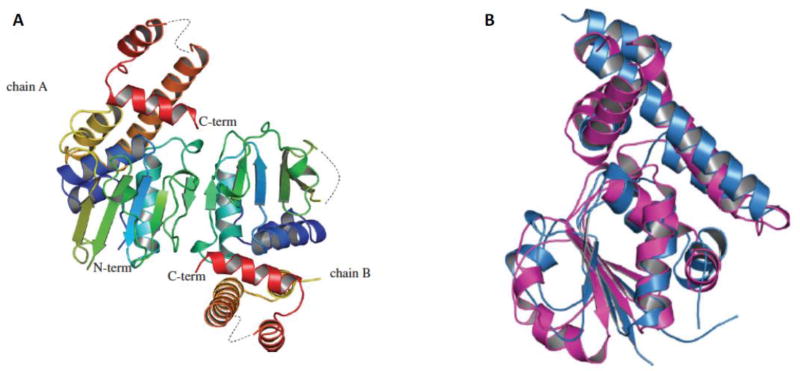
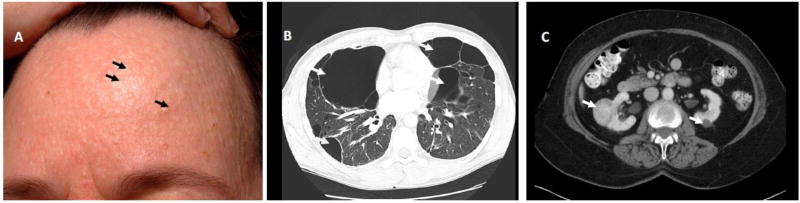
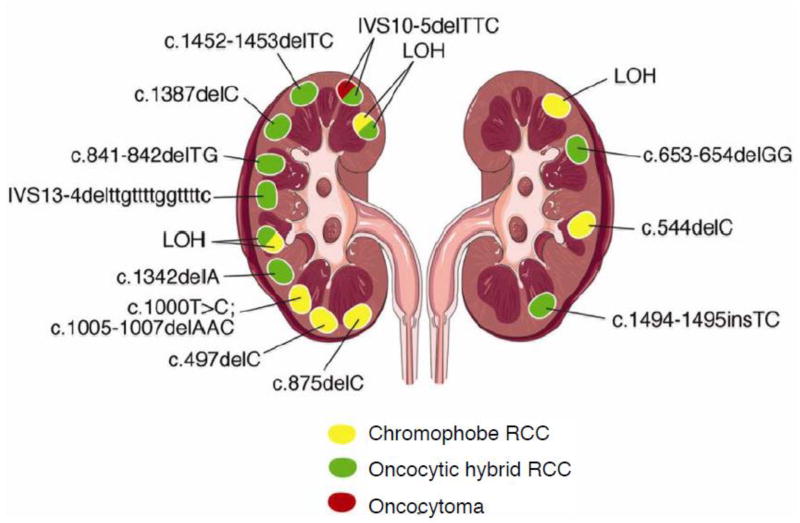
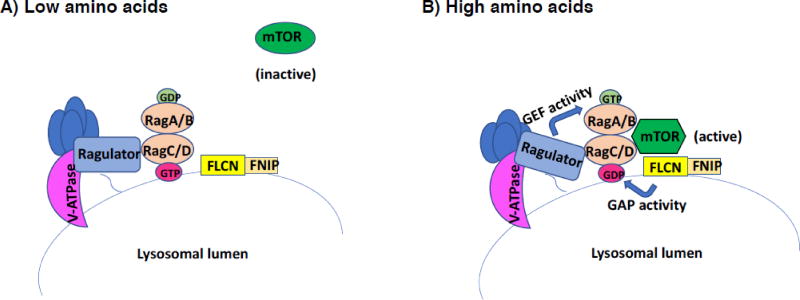
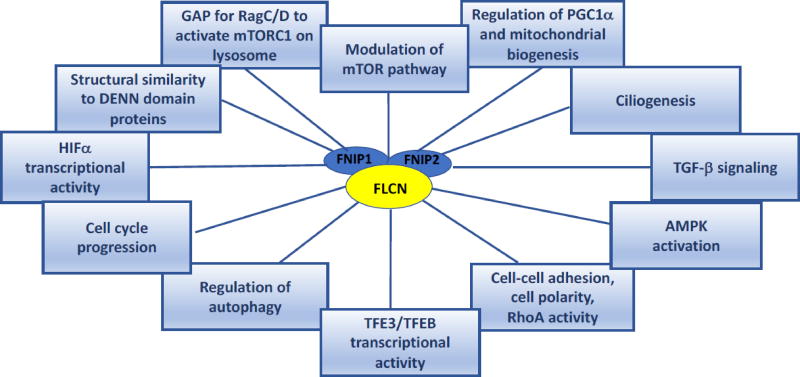
Germline mutations in the novel tumor suppressor gene FLCN are responsible for the autosomal dominant inherited disorder Birt-Hogg-Dubé (BHD) syndrome that predisposes to fibrofolliculomas, lung cysts and spontaneous pneumothorax, and an increased risk for developing kidney tumors. Although the encoded protein, folliculin (FLCN), has no sequence homology to known functional domains, x-ray crystallographic studies have shown that the C-terminus of FLCN has structural similarity to DENN (differentially expressed in normal cells and neoplasia) domain proteins that act as guanine nucleotide exchange factors (GEFs) for small Rab GTPases. FLCN forms a complex with folliculin interacting proteins 1 and 2 (FNIP1, FNIP2) and with 5' AMP-activated protein kinase (AMPK). This review summarizes FLCN functional studies which support a role for FLCN in diverse metabolic pathways and cellular processes that include modulation of the mTOR pathway, regulation of PGC1α and mitochondrial biogenesis, cell-cell adhesion and RhoA signaling, control of TFE3/TFEB transcriptional activity, amino acid-dependent activation of mTORC1 on lysosomes through Rag GTPases, and regulation of autophagy. Ongoing research efforts are focused on clarifying the primary FLCN-associated pathway(s) that drives the development of fibrofolliculomas, lung cysts and kidney tumors in BHD patients carrying germline FLCN mutations.
Keywords: AMPK; Birt-Hogg-Dubé syndrome; DENN domain; FLCN; FNIP1; FNIP2; Folliculin; Kidney tumor; PGC1α; mTOR.
Copyright © 2017 Elsevier B.V. All rights reserved.
Figures
References
-
- Argani P. MiT family translocation renal cell carcinoma. Semin Diagn Pathol. 2015;32:103–13. - PubMed
-
- Baba M, Furihata M, Hong SB, Tessarollo L, Haines DC, Southon E, Patel V, Igarashi P, Alvord WG, Leighty R, Yao M, Bernardo M, Ileva L, Choyke P, Warren MB, Zbar B, Linehan WM, Schmidt LS. Kidney-targeted Birt-Hogg-Dubé, gene inactivation in a mouse model: Erk1/2 and Akt-mTOR activation, cell hyperproliferation, and polycystic kidneys. Journal of the National Cancer Institute. 2008;100:140–154. - PMC - PubMed
-
- Baba M, Hong SB, Sharma N, Warren MB, Nickerson ML, Iwamatsu A, Esposito D, Gillette WK, Hopkins RF, III, Hartley JL, Furihata M, Oishi S, Zhen W, Burke TR, Jr, Linehan WM, Schmidt LS, Zbar B. Folliculin encoded by the BHD gene interacts with a binding protein, FNIP1, and AMPK, and is involved in AMPK and mTOR signaling. Proc Natl Acad Sci U S A. 2006;103:15552–15557. - PMC - PubMed
-
- Baba M, Keller JR, Sun HW, Resch W, Kuchen S, Suh HC, Hasumi H, Hasumi Y, Kieffer-Kwon KR, Gonzalez CG, Hughes RM, Klein ME, Oh HF, Bible P, Southon E, Tessarollo L, Schmidt LS, Linehan WM, Casellas R. The folliculin-FNIP1 pathway deleted in human Birt-Hogg-Dubé syndrome is required for murine B-cell development. Blood. 2012;120:1254–1261. - PMC - PubMed
Publication types
MeSH terms
Substances
Grants and funding
LinkOut - more resources
Full Text Sources
Other Literature Sources
Molecular Biology Databases
Miscellaneous
