


Positional stable isotope tracer analysis reveals carbon routes during ammonia metabolism of Aedes aegypti mosquitoes
- PMID: 28970248
- PMCID: PMC5731135
- DOI: 10.1096/fj.201700657R
Positional stable isotope tracer analysis reveals carbon routes during ammonia metabolism of Aedes aegypti mosquitoes
Abstract
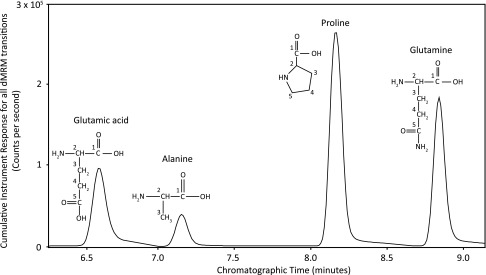
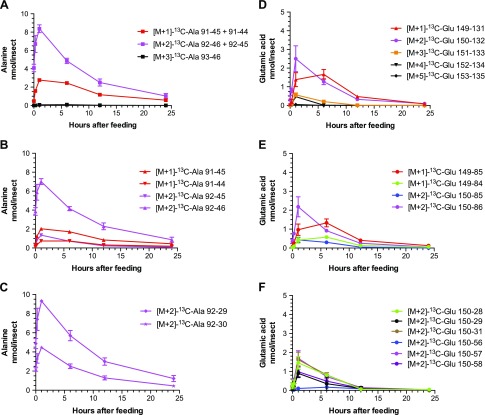
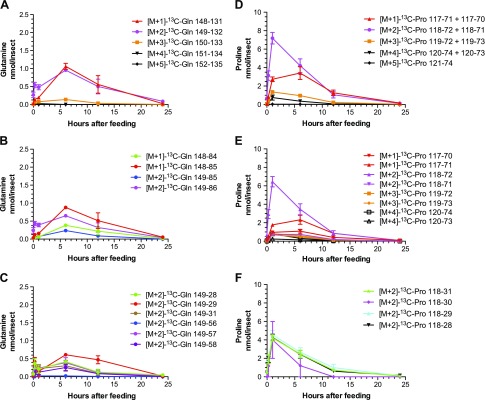
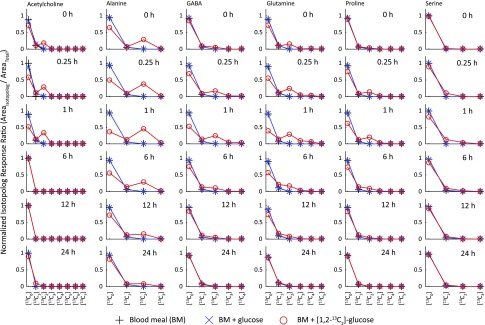
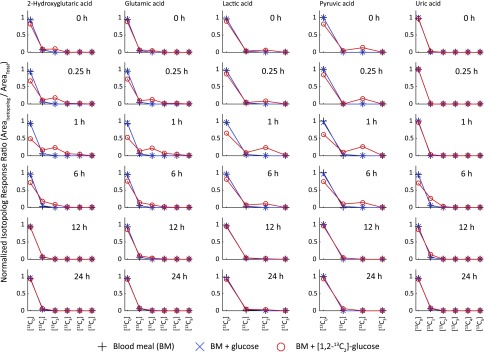
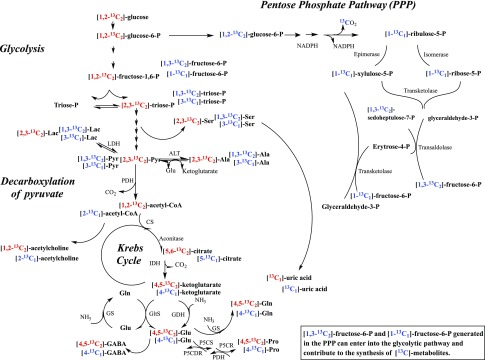
In Aedes aegypti females, the ammonia released during blood meal digestion is partially metabolized to facilitate the disposal of excess nitrogen. In this study, we used low- and high-resolution liquid chromatography-mass spectrometry (LC/MS) techniques to investigate the role of glucose during ammonia detoxification. Mosquitoes were fed a blood meal supplemented with [1,2-13C2]glucose, and downstream metabolites were measured for 24 h. Quantification of [13C] amino acids in the entire mosquito body was conducted without sample derivatization using selected reaction monitoring of mass transitions that are indicative of the structural position of [13C] atom incorporation. Identification of unlabeled and [13C] isotopologs of 43 compounds, including amino acids, amino acid derivatives, and organic acids, was performed by high-resolution LC/MS techniques. Blood-fed mosquitoes synthesized [13C] metabolites in mainly 2 carbon positions from [1,2-13C2]glucose. [13C2]Ala and [13C2]Pro were the most abundant and rapidly labeled amino acids synthesized. Additional [13C] amino acids, [13C] amino acid derivatives, and [13C] organic acids in 1 or 2 carbon positions were also identified. Two kinetic routes were proposed based on the incorporation of a [13C] atom at position 1 in specific amino acids. Our findings provide evidence that glucose is used for ammonia detoxification and [13C] uric acid synthesis through multiple metabolic pathways, uncovering a metabolic link at the carbon atomic level in ammonia metabolism of A. aegypti-Horvath, T. D., Dagan, S., Lorenzi, P. L., Hawke, D. H., Scaraffia, P. Y. Positional stable isotope tracer analysis reveals carbon routes during ammonia metabolism of Aedes aegypti mosquitoes.
Keywords: mass spectrometry; metabolomics; nitrogen waste.
© FASEB.
Figures
References
-
- Attar N. (2016) Zika virus circulates in new regions. Nat. Rev. Microbiol. 14, 62
-
- Ali S., Gugliemini O., Harber S., Harrison A., Houle L., Ivory J., Kersten S., Khan R., Kim J., LeBoa C., Nez-Whitfield E., O’Marr J., Rothenberg E., Segnitz R. M., Sila S., Verwillow A., Vogt M., Yang A., Mordecai E. A. (2017) Environmental and social change drive the explosive emergence of Zika virus in the Americas. PLoS Negl. Trop. Dis. 11, e0005135 - PMC - PubMed
-
- Zhou G., Flowers M., Friedrich K., Horton J., Pennington J., Wells M. A. (2004) Metabolic fate of [14C]-labeled meal protein amino acids in Aedes aegypti mosquitoes. J. Insect Physiol. 50, 337–349 - PubMed
Publication types
MeSH terms
Substances
Grants and funding
LinkOut - more resources
Full Text Sources
Other Literature Sources
