


Perceived Preparedness of Health Care Students for Providing Cardiovascular Disease Risk Assessment and Management
- PMID: 28970420
- PMCID: PMC5419389
- DOI: 10.3390/pharmacy5010009
Perceived Preparedness of Health Care Students for Providing Cardiovascular Disease Risk Assessment and Management
Abstract
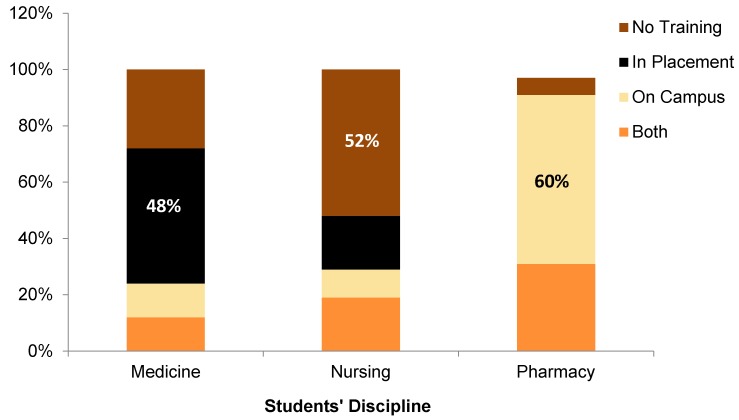
Early assessment and management of risk factors is known to have significant impact in preventing cardiovascular disease (CVD) and its associated burden. Cardiovascular disease risk assessment and management (CVDRAM) is best approached by teamwork across health care professionals. This study aimed at assessing health care students' (HCSs) knowledge about the parameters needed for estimating CVD risk, their self-assessed preparedness/confidence and perceived barriers for the provision of CVDRAM services through a survey administered to third and fourth year pharmacy, medical, and nursing students in Qatar. Although all student cohorts achieved similar knowledge scores, less than half (n = 38, 47%) were able to identify all of the six main risk factors necessary to estimate absolute CVD risk, and a third (32%) were unable to identify total cholesterol as an independent risk factor necessary to estimate CVD risk. Training on the use of CVD risk assessment tools differed among the three student cohorts. All student cohorts also perceived similar levels of preparedness in CVDRAM. However, pharmacy students reported the highest preparedness/confidence with the use of the latest CVDRAM guidelines. The majority of statements listed under the barriers scale were perceived by the students as being moderate (median score = 3). Poor public acceptance or unawareness of importance of estimating CVD risk was the only barrier perceived as a major by nursing students. Future integration of interprofessional educational (IPE) activities in the CVDRAM curricula of HCSs may be a suitable strategy to minimize barriers and foster collaborative practice for the provision of CVDRAM services in Qatar.
Keywords: cardiovascular disease; education; interprofessional; medical; nursing; pharmacy; risk assessment; students.
Conflict of interest statement
The authors declare no conflict of interest.
Figures
References
-
- World Health Organization: Fact Sheet about Cardiovascular Diseases (CVDs) [(accessed on 8 March 2016)]. Available online: http://www.who.int/mediacentre/factsheets/fs317/en/
-
- Yusuf S., Hawken S., Ôunpuu S., Dans T., Avezum A., Lanas F., McQueen M., Budaj A., Pais P., Varigos J., et al. On behalf of the INTERHEART Study Investigators. Effect of potentially modifiable risk factors associated with myocardial infarction in 52 countries (the INTERHEART study): Case-control study. Lancet. 2004;364:937–952. doi: 10.1016/S0140-6736(04)17018-9. - DOI - PubMed
-
- Cox J.L., Carr B., Vallis T.M., Szpilfogel C., O’Neill B.J. A novel approach to cardiovascular health by optimizing risk management (ANCHOR): A primary prevention initiative examining the impact of health risk factor assessment and management on cardiac wellness. Can. J. Cardiol. 2011;27:809–817. doi: 10.1016/j.cjca.2011.04.013. - DOI - PubMed
LinkOut - more resources
Full Text Sources
Other Literature Sources
