. 2017 Oct 2;7(1):12510.
doi: 10.1038/s41598-017-12679-8.

Detection of known and novel ALK fusion transcripts in lung cancer patients using next-generation sequencing approaches

Affiliations

Detection of known and novel ALK fusion transcripts in lung cancer patients using next-generation sequencing approaches

Julie A Vendrell et al. Sci Rep. .

Abstract

Rearrangements of the anaplastic lymphoma kinase (ALK) gene in non-small cell lung cancer (NSCLC) represent a novel molecular target in a small subset of tumors. Although ALK rearrangements are usually assessed by immunohistochemistry (IHC) and fluorescence in situ hybridization (FISH), molecular approaches have recently emerged as relevant alternatives in routine laboratories. Here, we evaluated the use of two different amplicon-based next-generation sequencing (NGS) methods (AmpliSeq and Archer®FusionPlex®) to detect ALK rearrangements, and compared these with IHC and FISH. A total of 1128 NSCLC specimens were screened using conventional analyses, and a subset of 37 (15 ALK-positive, and 22 ALK-negative) samples were selected for NGS assays. Although AmpliSeq correctly detected 25/37 (67.6%) samples, 1/37 (2.7%) and 11/37 (29.7%) specimens were discordant and uncertain, respectively, requiring further validation. In contrast, Archer®FusionPlex® accurately classified all samples and allowed the correct identification of one rare DCTN1-ALK fusion, one novel CLIP1-ALK fusion, and one novel GCC2-ALK transcript. Of particular interest, two out of three patients harboring these singular rearrangements were treated with and sensitive to crizotinib. These data show that Archer®FusionPlex® may provide an effective and accurate alternative to FISH testing for the detection of known and novel ALK rearrangements in clinical diagnostic settings.


Conflict of interest statement

The authors declare that they have no competing interests.

Figures
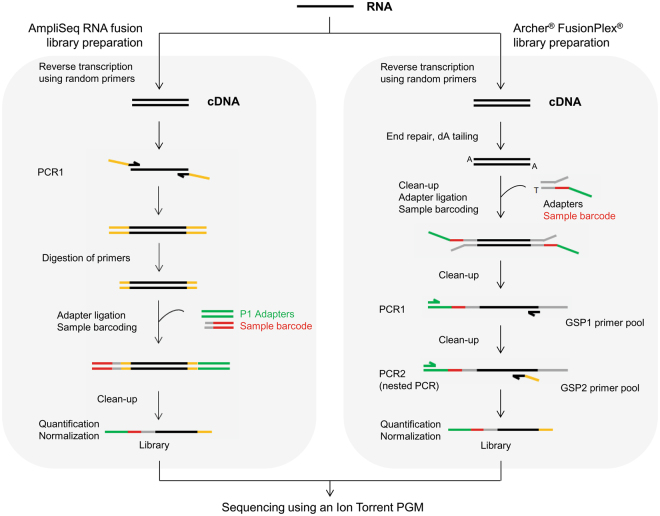
Figure 1
Figure 1
Schematic description of the library preparation workflow using the AmpliSeq RNA fusion kit or the Archer® FusionPlex® kit.
Figure 2
Figure 2
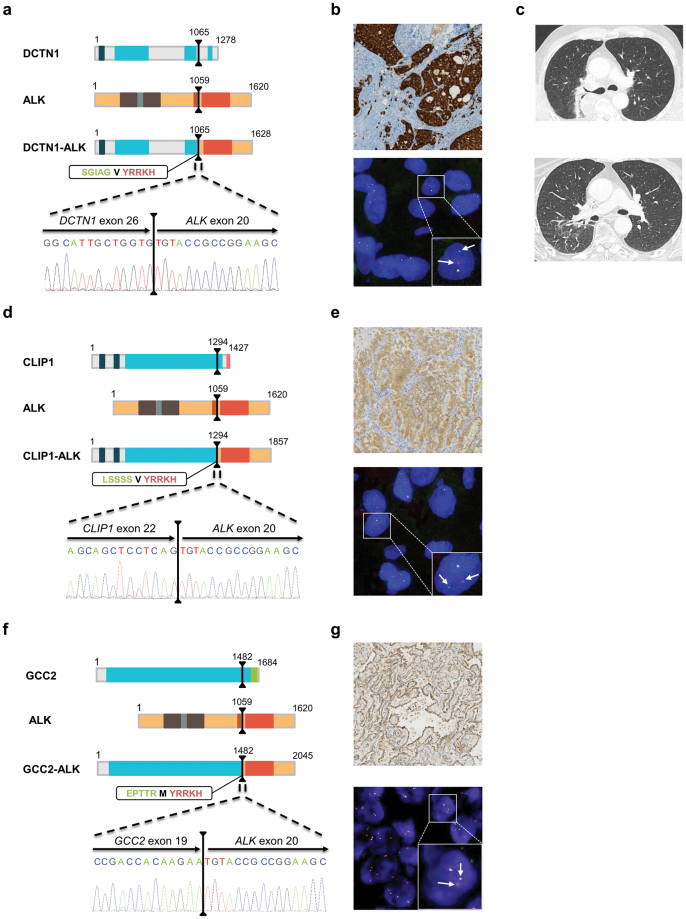
Detection of one rare DCTN1-ALK fusion transcript, one new CLIP1-ALK fusion, and one new GCC2-ALK rearrangement in patient samples. (a,d and f) Schematic representation of the main functional domains of the proteins. The black lines represent the breakpoints and the dashed lines zoom in on the transcript fusion points and the electropherogram of the validation test. The amino acid (aa) sequences at the fusion points are highlighted in a rectangle: the green bolded sequences correspond to the fusion partner, the red bolded sequence to the ALK sequence, and the black bolded aa to the aa generated by the fusion of the codon from the fusion partner and ALK. The protein functional domains are represented as colored boxes: deep blue box, Cytoskeleton-associated protein glycine-rich (CAP-Gly) domain; light blue box, coiled-coil domain; brown box, Meprin/A5-protein/PTPmu (MAM) domain; grey box, LDL-receptor class A domain; orange box, transmembrane domain; red box, kinase domain; pink box, zinc finger domain; green box, GRIP domain. (b,e and g) IHC and FISH images showing the presence of ALK rearrangements in patient samples. Top panel, IHC imaging showing an intense cytoplasmic staining. Bottom panel, representative image of a slide hybridized with a break-apart ALK FISH assay. In this given example, the box highlights one nucleus harboring a split (arrows) and a fused signal. (c) Thoracic CT scan of patient S36 before (top panel) and after (bottom panel) three months of crizotinib therapy. IHC, immunohistochemistry; FISH, fluorescence in situ hybridization; CT, computed tomography.

References

    1. Shaw AT, et al. Crizotinib versus chemotherapy in advanced ALK-positive lung cancer. N Engl J Med. 2013;368:2385–94. doi: 10.1056/NEJMoa1214886. - DOI - PubMed
    1. Network CGAR. Comprehensive molecular profiling of lung adenocarcinoma. Nature. 2014;511:543–50. doi: 10.1038/nature13385. - DOI - PMC - PubMed
    1. Kwak EL, et al. Anaplastic lymphoma kinase inhibition in non-small-cell lung cancer. N Engl J Med. 2010;363:1693–703. doi: 10.1056/NEJMoa1006448. - DOI - PMC - PubMed
    1. Kris MG, et al. Using multiplexed assays of oncogenic drivers in lung cancers to select targeted drugs. JAMA. 2014;311:1998–2006. doi: 10.1001/jama.2014.3741. - DOI - PMC - PubMed
    1. Hallberg B, Palmer RH. The role of the ALK receptor in cancer biology. Ann Oncol. 2016;27(Suppl 3):iii4–iii15. doi: 10.1093/annonc/mdw301. - DOI - PubMed

MeSH terms