


Genome-wide association mapping for root cone angle in rice
- PMID: 28971382
- PMCID: PMC5624858
- DOI: 10.1186/s12284-017-0184-z
Genome-wide association mapping for root cone angle in rice
Abstract
Background: Plant root systems play a major role in anchoring and in water and nutrient uptake from the soil. The root cone angle is an important parameter of the root system architecture because, combined with root depth, it helps to determine the volume of soil explored by the plant. Two genes, DRO1 and SOR1, and several QTLs for root cone angle have been discovered in the last 5 years.
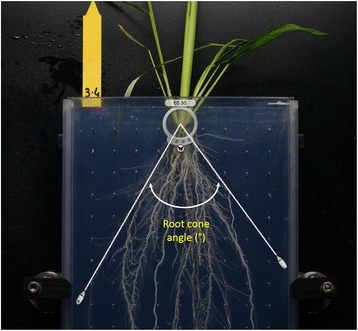
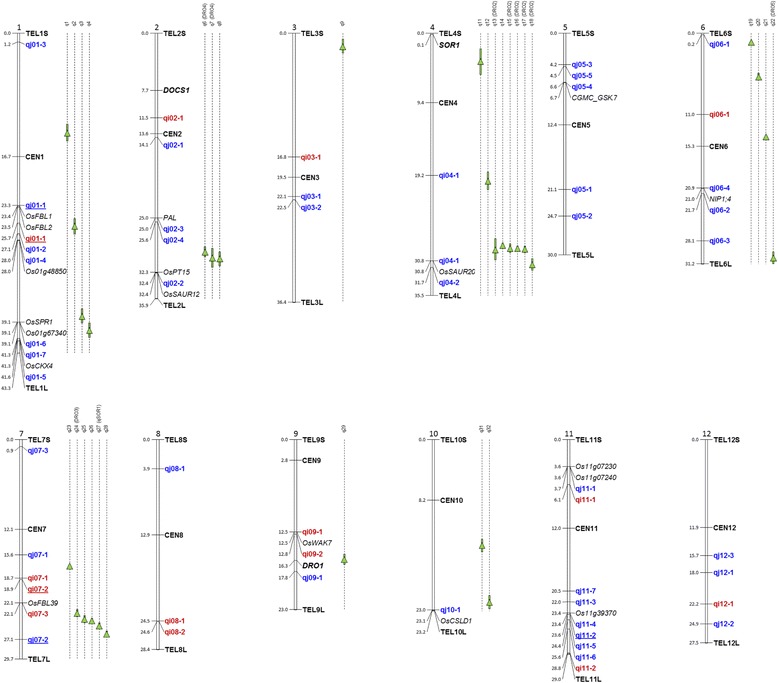
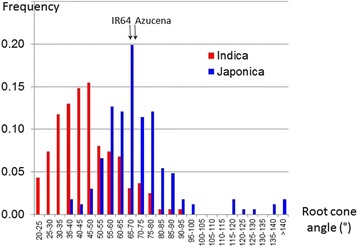
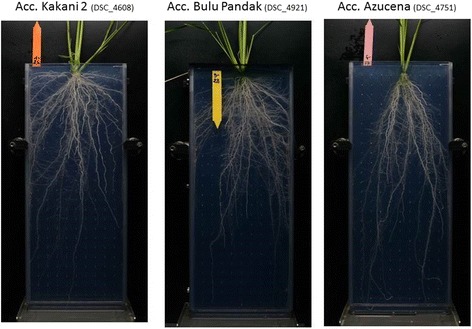
Results: To find other QTLs linked to root cone angle, a genome-wide association mapping study was conducted on two panels of 162 indica and 169 japonica rice accessions genotyped with two sets of SNP markers (genotyping-by-sequencing set with approximately 16,000 markers and high-density-rice-array set with approximately 300,000 markers). The root cone angle of all accessions was measured using a screen protractor on images taken after 1 month of plant growth in the Rhizoscope phenotyping system. The distribution of the root cone angle in the indica panel was Gaussian, but several accessions of the japonica panel (all the bulus from Indonesia and three temperate japonicas from Nepal or India) appeared as outliers with a very wide root cone angle. The data were submitted to association mapping using a mixed model with control of structure and kinship. A total of 15 QTLs for the indica panel and 40 QTLs for the japonica panel were detected. Genes underlying these QTLs (+/-50 kb from the significant markers) were analyzed. We focused our analysis on auxin-related genes, kinases, and genes involved in root developmental processes and identified 8 particularly interesting genes.
Conclusions: The present study identifies new sources of wide root cone angle in rice, proposes ways to bypass some drawbacks of association mapping to further understand the genetics of the trait and identifies candidate genes deserving further investigation.
Keywords: Rice, Oryza sativa, Indica, Japonica, root cone angle, hydroponics, association mapping, GWAS.
Conflict of interest statement
Competing interests
The authors declare that they have no competing interests.
Publisher’s Note
Springer Nature remains neutral with regard to jurisdictional claims in published maps and institutional affiliations.
Figures
References
-
- Abe J, Morita S. Growth direction of nodal roots in rice: its variation and contribution to root system formation. Plant Soil. 1994;165:333–337. doi: 10.1007/BF00008078. - DOI
-
- Ahmadi N, Audebert A, Bennett MJ, Bishopp A, de Oliveira AC, Courtois B, Diedhiou A, Dievart A, Gantet P, Ghesquiere A, Guiderdoni E, Henry A, Inukai Y, Kochian L, Laplaze L, Lucas M, Luu DT, Manneh B, Mo XR, Muthurajan R, Perin C, Price A, Robin S, Sentenac H, Sine B, Uga Y, Very AA, Wissuwa M, Wu P, Xu J. The roots of future rice harvests. Rice. 2014;7:29–38. doi: 10.1186/s12284-014-0029-y. - DOI - PMC - PubMed
-
- Bettembourg M. Caractérisation de récepteurs à activité kinase impliqués dans la mise en place de l'architecture racinaire chez le riz. France: PhD thesis, University of Montpellier-SupAgro; 2016. p. 275.
LinkOut - more resources
Full Text Sources
Other Literature Sources
