


doi: 10.1377/hlthaff.2017.0385.
Low-Cost, High-Volume Health Services Contribute The Most To Unnecessary Health Spending
Affiliations
- PMID: 28971913
- PMCID: PMC6727655
- DOI: 10.1377/hlthaff.2017.0385
Item in Clipboard
Low-Cost, High-Volume Health Services Contribute The Most To Unnecessary Health Spending
Health Aff (Millwood).
.
Abstract
An analysis of data for 2014 about forty-four low-value health services in the Virginia All Payer Claims Database revealed more than $586 million in unnecessary costs. Among these low-value services, those that were low and very low cost ($538 or less per service) were delivered far more frequently than services that were high and very high cost ($539 or more). The combined costs of the former group were nearly twice those of the latter (65 percent versus 35 percent).
Keywords: Cost of Health Care; Evidence-Based Medicine; Health Spending; Organization and Delivery of Care; Quality Of Care.
Project HOPE—The People-to-People Health Foundation, Inc.
Figures
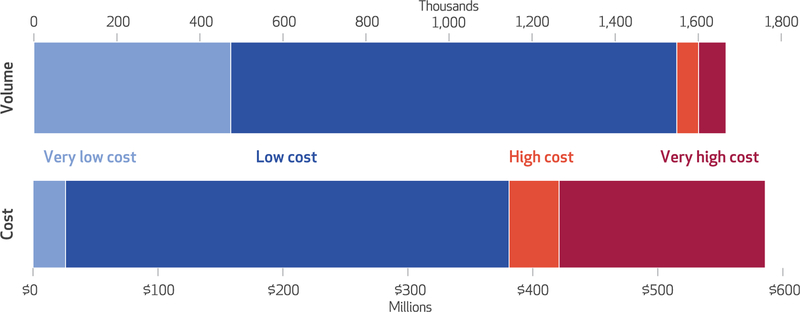
SOURCE Authors’ analysis of data for 2014 from the Virginia All Payer Claims Database. NOTES “Low-value services” refers to forty-four specific health services in specific clinical settings from which the patient is expected to receive no net benefit. The costs for the quartiles of low-value services are less than $100 per very-low-cost service, $100–$538 per low-cost service, $539–$1,315 per high-cost service, and more than $1,315 per very-high-cost service. Costs are the average (mean) amount of money per service paid to a health care provider across all payers, including patients’ out-of-pocket spending, multiplied by the frequency of that service.
References
-
- Institute of Medicine. Best care at lower cost: the path to continuously learning health care in America Washington (DC): National Academies Press; 2012. - PubMed
-
- Brook RH. Redefining health care systems [Internet] Santa Monica (CA): RAND Corporation; 2015. [cited 2017 Jul 20]. Available from: https://www.rand.org/content/dam/rand/pubs/corporate_pubs/CP700/CP788/RA...
-
- Fisher ES, Wennberg DE, Stukel TA, Gottlieb DJ, Lucas FL, Pinder EL. The implications of regional variations in Medicare spending. Part 1: the content, quality, and accessibility of care. Ann Intern Med 2003;138(4): 273–87. - PubMed
Publication types
MeSH terms
Grants and funding
LinkOut - more resources
Full Text Sources
Other Literature Sources
Medical
