


Effects Of State Insurance Mandates On Health Care Use And Spending For Autism Spectrum Disorder
- PMID: 28971920
- PMCID: PMC7011707
- DOI: 10.1377/hlthaff.2017.0515
Effects Of State Insurance Mandates On Health Care Use And Spending For Autism Spectrum Disorder
Abstract
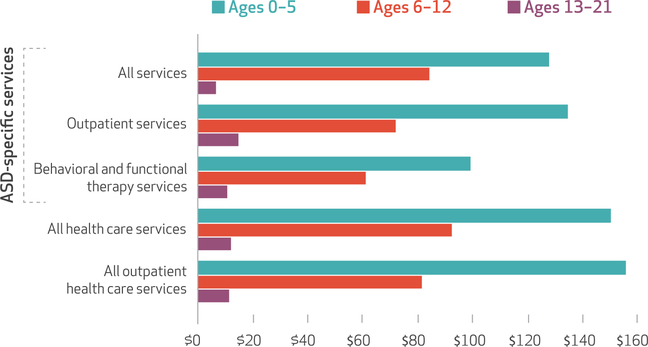
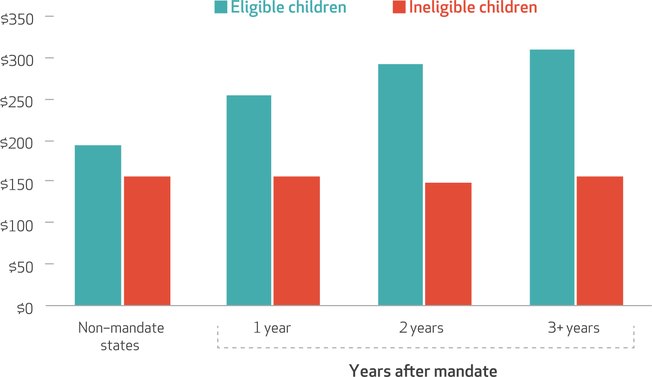
Forty-six states and the District of Columbia have enacted insurance mandates that require commercial insurers to cover treatment for children with autism spectrum disorder (ASD). This study examined whether implementing autism mandates altered service use or spending among commercially insured children with ASD. We compared children age twenty-one or younger who were eligible for mandates to children not subject to mandates using 2008-12 claims data from three national insurers. Increases in service use and spending attributable to state mandates were detected for all outcomes. Mandates were associated with a 3.4-percentage-point increase in monthly use and a $77 increase in monthly spending on ASD-specific services. Effects were larger for younger children and increased with the number of years since mandate implementation. These increases suggest that state mandates are an effective tool for broadening access to autism treatment under commercial insurance.
Keywords: Children’s Health; Insurance; Mental Health/Substance Abuse; Special Populations.
Project HOPE—The People-to-People Health Foundation, Inc.
Figures
References
-
- American Psychiatric Association. Diagnostic and statistical manual of mental disorders. 5th ed. Washington (DC): APA; 2013.
-
- Centers for Disease Control and Prevention. Prevalence of autism spectrum disorders among children aged 8 years—Autism and Developmental Disabilities Monitoring Network, 11 sites, United States, 2010. MMWR Surveill Summ. 2014;63: 1–21. - PubMed
-
- Myers SM, Johnson CP. Management of children with autism spectrum disorders. Pediatrics. 2007; 120(5):1162–82. - PubMed
-
- Behavior Analyst Certification Board. Applied behavior analysis treatment of autism spectrum disorder: practice guidelines for healthcare funders and managers. 2nd ed. [Internet]. Littleton (CO): The Board; 2014. [cited 2017 Aug 30]. Available from: https://bacb.com/wp-content/uploads/2016/08/ABA_Guidelines_for_ASD.pdf
-
- Howlin P Autism and Asperger syndrome: preparing for adulthood. New York (NY): Routledge; 2004.
Publication types
MeSH terms
Grants and funding
LinkOut - more resources
Full Text Sources
Other Literature Sources
Medical
