Review
. 2018 Apr 6;293(14):5044-5052.
doi: 10.1074/jbc.R117.815886. Epub 2017 Oct 2.

Cyanobacteria: Promising biocatalysts for sustainable chemical production

Affiliations
Review

Cyanobacteria: Promising biocatalysts for sustainable chemical production

Cory J Knoot et al. J Biol Chem. .

Abstract

Cyanobacteria are photosynthetic prokaryotes showing great promise as biocatalysts for the direct conversion of CO2 into fuels, chemicals, and other value-added products. Introduction of just a few heterologous genes can endow cyanobacteria with the ability to transform specific central metabolites into many end products. Recent engineering efforts have centered around harnessing the potential of these microbial biofactories for sustainable production of chemicals conventionally produced from fossil fuels. Here, we present an overview of the unique chemistry that cyanobacteria have been co-opted to perform. We highlight key lessons learned from these engineering efforts and discuss advantages and disadvantages of various approaches.

Keywords: biofuel; cyanobacteria; metabolic engineering; natural product; photosynthesis.


Conflict of interest statement

The authors declare that they have no conflicts of interest with the contents of this article

Figures
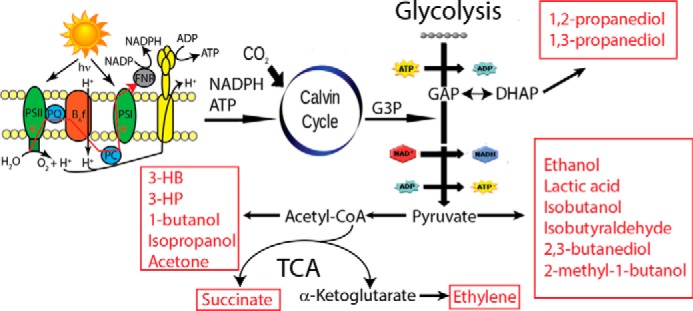
Figure 1.
Figure 1.
Overview of photosynthetic metabolism and production of green chemicals in cyanobacteria. Energy and reducing equivalents are generated by photosynthetic and respiratory complexes in the thylakoid membrane (cartoon top left). ATP, NADPH, and CO2 feed into the Calvin-Benson cycle and glycolysis. Target chemicals produced in cyanobacteria either through native metabolism or engineering are shown in the red boxes. G3P, 3-phosphoglycerate; PSI, photosystem I; PSII, photosystem II.
Figure 2.
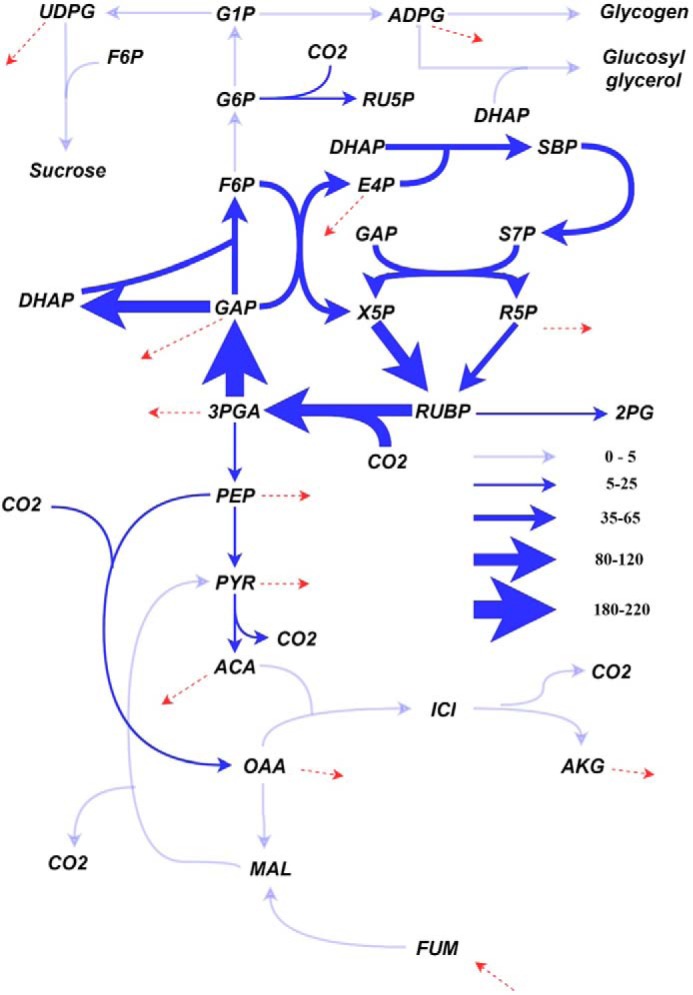
Figure 2.
Generalized flux map for cyanobacterial photoautotrophic metabolism. The arrow thicknesses are proportional to the flux through the reactions. The flux values shown here are normalized to a CO2 uptake rate of 100 mmol/gDW/h and are averages of two studies involving 13C metabolic flux analysis performed on Synechocystis sp. PCC 6803 (33) and Synechococcus sp. PCC 7002 (35). The dotted arrows indicate drawdown of carbon for biomass synthesis. 2PG, 2-phosphoglycerate; 3PGA, 3-phosphoglycerate; ACA, acetyl-CoA; ADPG, ADP-glucose; AKG, α-ketoglutarate; E4P, erythrose-4-phosphate; F6P, fructose-6-phosphate; FUM, fumarate; G1P, glucose-1-phosphate; G6P, glucose-6-phosphate; ICI, isocitrate; MAL, malate; OAA, oxaloacetate; PEP, phosphoenolpyruvate; PYR, pyruvate; R5P, ribose-5-phosphate; RU5P, ribulose-5-phosphate; RUBP, ribulose-1,5 bisphosphate; S7P, sedoheptulose-7-phosphate; SBP, sedoheptulose-1,7-bisphosphate; UDPG, UDP-glucose; X5P, xylulose-5-phosphate.
Figure 3.
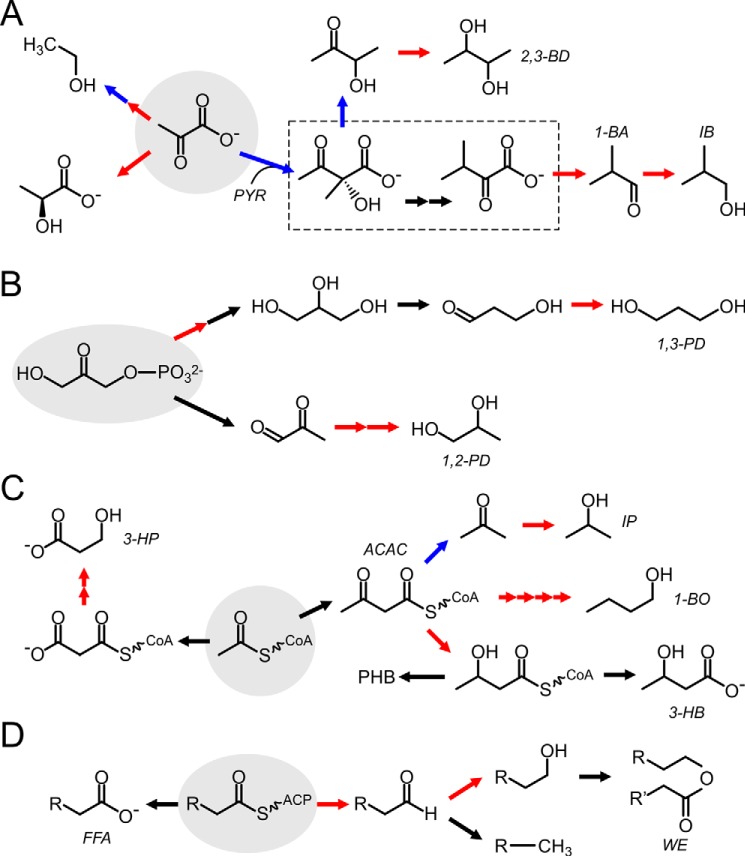
Figure 3.
Representative engineered and native production pathways for chemicals in cyanobacteria. Panels show bioproduction pathways derived from pyruvate (A), dihydroxyacetone phosphate (B), acetyl-CoA (C), and fatty acyl-ACPs (D). Red arrows indicate NAD(P)H-dependent oxidation or reduction steps. Blue arrows indicate decarboxylation steps. Black arrows are other types of enzymatic steps. A, branched-chain amino acid pathway is boxed. Starting metabolites are in gray circles. ACAC, acetoacetate; 1-BA, 1-butyraldehyde; 1-BO, 1-butanol; IB, isobutanol; IP, isopropanol; PYR, pyruvate; WE, wax ester.

References

    1. Anastas P. T., and Warner J. C. (1998) Green Chemistry: Theory and Practice, Oxford University Press, Oxford, UK
    1. Whitton B. A., and Potts M. (2002) in The Ecology of Cyanobacteria: Their Diversity in Time and Space (Whitton B. A., and Potts M., eds) pp. 1–11, Springer, Dordrecht, the Netherlands
    1. Hamilton T. L., Bryant D. A., and Macalady J. L. (2016) The role of biology in planetary evolution: cyanobacterial primary production in low-oxygen proterozoic oceans. Environ. Microbiol. 18, 325–340 10.1111/1462-2920.13118 - DOI - PMC - PubMed
    1. Flombaum P., Gallegos J. L., Gordillo R. A., Rincón J., Zabala L. L., Jiao N., Karl D. M., Li W. K., Lomas M. W., Veneziano D., Vera C. S., Vrugt J. A., and Martiny A. C. (2013) Present and future global distributions of the marine cyanobacteria Prochlorococcus and Synechococcus. Proc. Natl. Acad. Sci. U.S.A. 110, 9824–9829 10.1073/pnas.1307701110 - DOI - PMC - PubMed
    1. Bullerjahn G. S., and Post A. F. (2014) Physiology and molecular biology of aquatic cyanobacteria. Front. Microbiol. 5, 359 - PMC - PubMed

Publication types

MeSH terms

LinkOut - more resources