. 2017:240:284-302.

Engaging Patients in Decision-Making and Behavior Change to Promote Prevention

Affiliations

Engaging Patients in Decision-Making and Behavior Change to Promote Prevention

Alex H Krist et al. Stud Health Technol Inform. 2017.

Abstract

Effectively engaging patients in their care is essential to improve health outcomes, improve satisfaction with the care experience, reduce costs, and even benefit the clinician experience. This chapter will address the topic of patient engagement directly and review the relationships between health literacy and patient engagement. While there are many ways to define patient and family engagement, this chapter will consider engagement as "patients, families, their representatives, and health professionals working in active partnership at various levels across the health care system - direct care, organizational design and governance, and policy making - to improve health and health care [1]." We will specifically focus on the patient engagement and health literacy needs for three scenarios (1) decision-making, (2) health behavior change, and (3) chronic disease management; we will include the theoretical underpinnings of engagement, the systems required to better support patient engagement, how social determinants of health influence patient engagement, and practical examples to demonstrate approaches to better engage patients in their health and wellbeing. We will close by describing the future of patient engagement, which extends beyond the traditional domains of decision-making and self-care to describe how patient engagement can influence the design of the healthcare delivery system; local, state, and national health policies; and future research relevant to the needs and experiences of patients.

Keywords: Patient engagement; delivery of healthcare; health literacy; patient activation; patient education; shared decision making; social determinants of health.


Figures
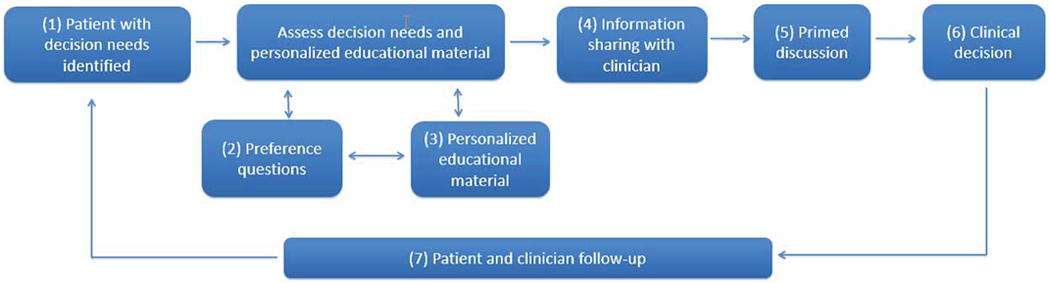
Fig. 1.
Fig. 1.
A workflow to better engage patients throughout their decision-making journeys. To better engage patients in their decisions, this workflow, which several practices programmed into their patient portal and electronic health record, guides patients and clinicians through a series of seven steps: (1) based on electronic health record data, patients with decision needs are identified, and the patient portal reaches contacts patients outside the confines of an office visit to start considering decision options; (2) the patient portal walks patients through an intake that assesses personal preferences, knowledge, needs, and readiness to make a decision; (3) the portal provides personalized educational material tailored to the patient’s stated preferences and decision stage; (4) the portal allows the patient to share their preferences and decision needs with their clinician; (5) the clinician reviews the information prior to a visit, priming the discussion so the clinician is aware of the patient’s needs; (6) the patient and clinicians are able to make a more informed and shared decision; and (7) the electronic health record and patient portal can follow-up with both the clinician and patient to make sure the decision is acted upon consistent with the patient’s wishes (modified from [43]).
Fig. 2.
Fig. 2.
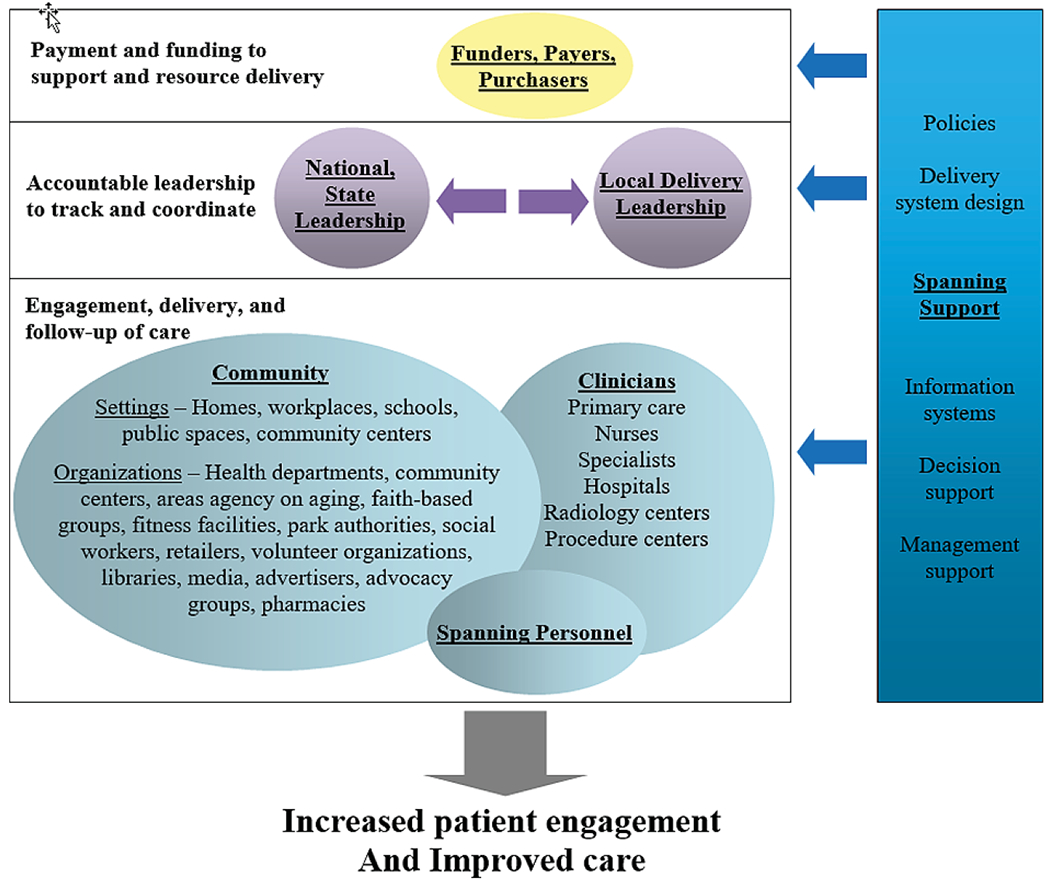
A Framework for How Clinical Practices and Community Programs Can Partner to Better Engage Patients in Care. A framework depicting how funders, policy makers, communities, and clinicians can work together with the support of personnel and infrastructure to link the care delivery systems. Funders, payers, and purchasers are tasked with financing the infrastructure needed to support integrating the clinical and community care systems. National and state leadership are empowered with the authority, resources, and responsibility to foster integrations across regions. Local leaders are the regional organizations that step forward to oversee and support local tailoring and integration activities. Community is the setting where individuals live work, and play and where the stakeholders who serve them are located. Community organizations are care providers that deliver the community elements of a clinical-community integration. Clinicians are care providers that deliver the clinical elements of a clinical-community integration. Spanning personnel are staff who specialize in helping people traverse the clinical and community settings to obtain care. Spanning support (which includes policies, delivery system design, information systems, decision support, and management support) are essential ingredients to support integrations at all levels depicted in the framework (modified from [41]).
Fig. 3.
Fig. 3.
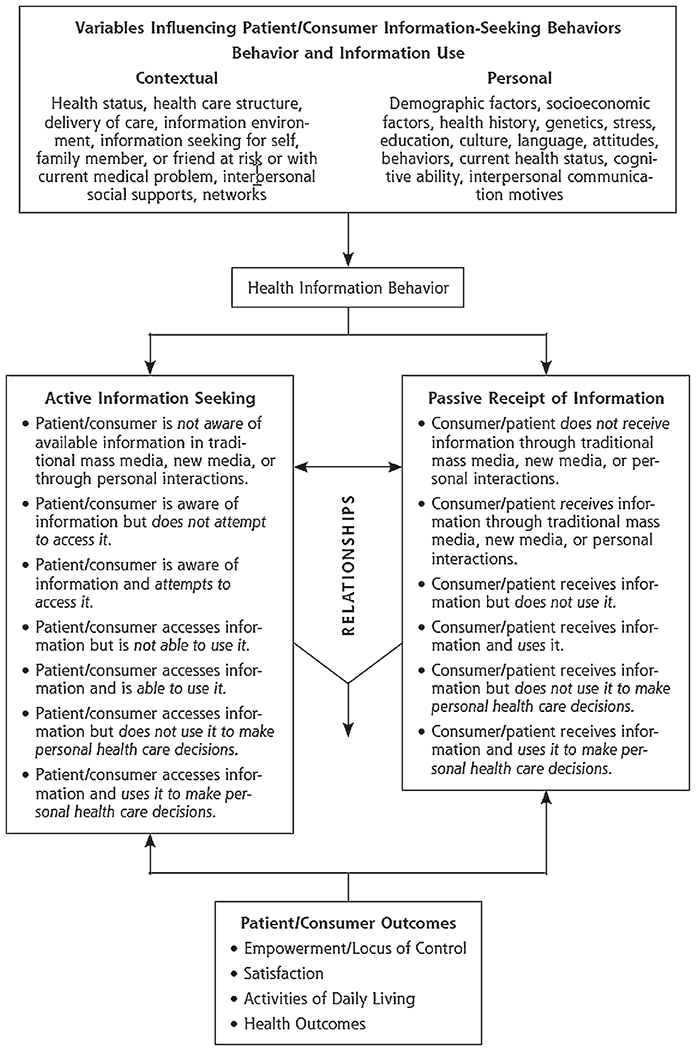
A Model to Describe Patient’s Health Information Seeking Behaviors (Reproduced with permission from Health Information Seeking, Receipt, and Use in Diabetes Self-Management, July/August, 2010, Vol 8, No 4, issue of Annals of Family Medicine Copyright©2010 American Academy of Family Physicians. All Rights Reserved.)

References

    1. Agency for Healthcare Research and Quality, Five major steps, to intervention (The “5 A’s”). 2012. [cited 2016 Oct]. Available from: http://www.ahrq.gov/professionals/clinicians-providers/guidelines-recomm....
    1. Annas GJ, Informed consent, Annual Review of Medicine 29 (1978), 9–14, Epub 1978/01/01. doi: 10.1146/annurev.me.29.020178.000301. - DOI - PubMed
    1. Annas GJ and Miller FH, The empire of death: How culture and economics affect informed consent, in the US, the UK, and Japan, American Journal of Law & Medicine 20(4) (1994), 357–394, Epub 1994/01/01. - PubMed
    1. Arora NK, Weaver KE, Clayman ML, Oakley-Girvan I and Potosky AL, Physicians’ decision-making style and psychosocial outcomes among cancer survivors, Patient Educ Couns. 77(3) (2009), 404–412, Epub 2009/11/07. doi: 10.1016/j.pec.2009.10.004. - DOI - PMC - PubMed
    1. Barello S, Triberti S, Graffigna G, Libreri C, Serino S, Hibbard J et al. , EHealth for patient engagement: A systematic review, Frontiers in psychology 6 (2015), 2013, Epub 2016/01/19. - PMC - PubMed

LinkOut - more resources