


Ex vivo metabolic fingerprinting identifies biomarkers predictive of prostate cancer recurrence following radical prostatectomy
- PMID: 28972967
- PMCID: PMC5729443
- DOI: 10.1038/bjc.2017.346
Ex vivo metabolic fingerprinting identifies biomarkers predictive of prostate cancer recurrence following radical prostatectomy
Erratum in
-
Ex vivo metabolic fingerprinting identifies biomarkers predictive of prostate cancer recurrence following radical prostatectomy.Br J Cancer. 2018 Mar 20;118(6):e11. doi: 10.1038/bjc.2017.470. Epub 2018 Feb 20. Br J Cancer. 2018. PMID: 29462127 Free PMC article.
Abstract
Background: Robust biomarkers that identify prostate cancer patients with high risk of recurrence will improve personalised cancer care. In this study, we investigated whether tissue metabolites detectable by high-resolution magic angle spinning magnetic resonance spectroscopy (HR-MAS MRS) were associated with recurrence following radical prostatectomy.
Methods: We performed a retrospective ex vivo study using HR-MAS MRS on tissue samples from 110 radical prostatectomy specimens obtained from three different Norwegian cohorts collected between 2002 and 2010. At the time of analysis, 50 patients had experienced prostate cancer recurrence. Associations between metabolites, clinicopathological variables, and recurrence-free survival were evaluated using Cox proportional hazards regression modelling, Kaplan-Meier survival analyses and concordance index (C-index).
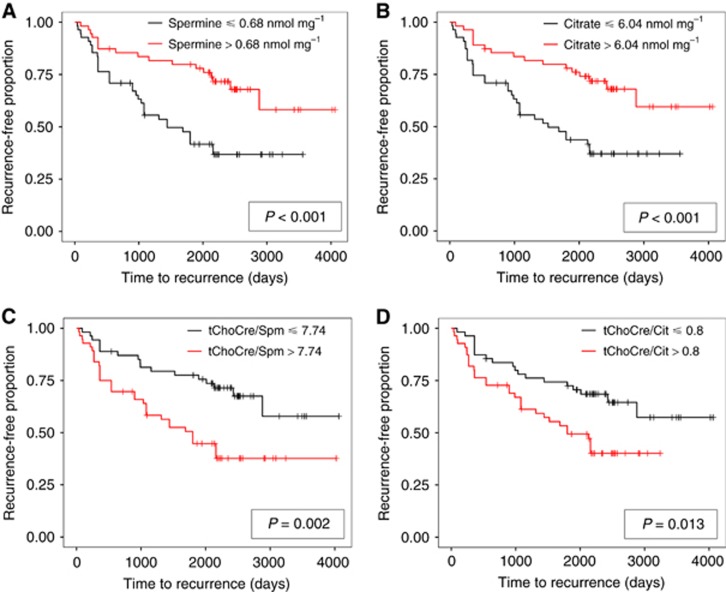
Results: High intratumoural spermine and citrate concentrations were associated with longer recurrence-free survival, whereas high (total-choline+creatine)/spermine (tChoCre/Spm) and higher (total-choline+creatine)/citrate (tChoCre/Cit) ratios were associated with shorter time to recurrence. Spermine concentration and tChoCre/Spm were independently associated with recurrence in multivariate Cox proportional hazards modelling after adjusting for clinically relevant risk factors (C-index: 0.769; HR: 0.72; P=0.016 and C-index: 0.765; HR: 1.43; P=0.014, respectively).
Conclusions: Spermine concentration and tChoCre/Spm ratio in prostatectomy specimens were independent prognostic markers of recurrence. These metabolites can be noninvasively measured in vivo and may thus offer predictive value to establish preoperative risk assessment nomograms.
Conflict of interest statement
The authors declare no conflict of interest.
Figures

References
-
- Benjamini Y, Hochberg Y (1995) Controlling the false discovery rate – a practical and powerful approach to multiple testing. J R Stat Soc Ser B 57: 289–300.
-
- Bertilsson H, Angelsen A, Viset T, Skogseth H, Tessem MB, Halgunset J (2011) A new method to provide a fresh frozen prostate slice suitable for gene expression study and MR spectroscopy. Prostate 71: 461–469. - PubMed
-
- Bertilsson H, Tessem MB, Flatberg A, Viset T, Gribbestad I, Angelsen A, Halgunset J (2012) Changes in gene transcription underlying the aberrant citrate and choline metabolism in human prostate cancer samples. Clin Cancer Res 18: 3261–3269. - PubMed
-
- Bishoff JT, Freedland SJ, Gerber L, Tennstedt P, Reid J, Welbourn W, Graefen M, Sangale Z, Tikishvili E, Park J, Younus A, Gutin A, Lanchbury JS, Sauter G, Brawer M, Stone S, Schlomm T (2014) Prognostic utility of the cell cycle progression score generated from biopsy in men treated with prostatectomy. J Urol 192: 409–414. - PubMed
MeSH terms
Substances
LinkOut - more resources
Full Text Sources
Other Literature Sources
Medical
