Automated Grading of Age-Related Macular Degeneration From Color Fundus Images Using Deep Convolutional Neural Networks
- PMID: 28973096
- PMCID: PMC5710387
- DOI: 10.1001/jamaophthalmol.2017.3782
Automated Grading of Age-Related Macular Degeneration From Color Fundus Images Using Deep Convolutional Neural Networks
Abstract
Importance: Age-related macular degeneration (AMD) affects millions of people throughout the world. The intermediate stage may go undetected, as it typically is asymptomatic. However, the preferred practice patterns for AMD recommend identifying individuals with this stage of the disease to educate how to monitor for the early detection of the choroidal neovascular stage before substantial vision loss has occurred and to consider dietary supplements that might reduce the risk of the disease progressing from the intermediate to the advanced stage. Identification, though, can be time-intensive and requires expertly trained individuals.
Objective: To develop methods for automatically detecting AMD from fundus images using a novel application of deep learning methods to the automated assessment of these images and to leverage artificial intelligence advances.
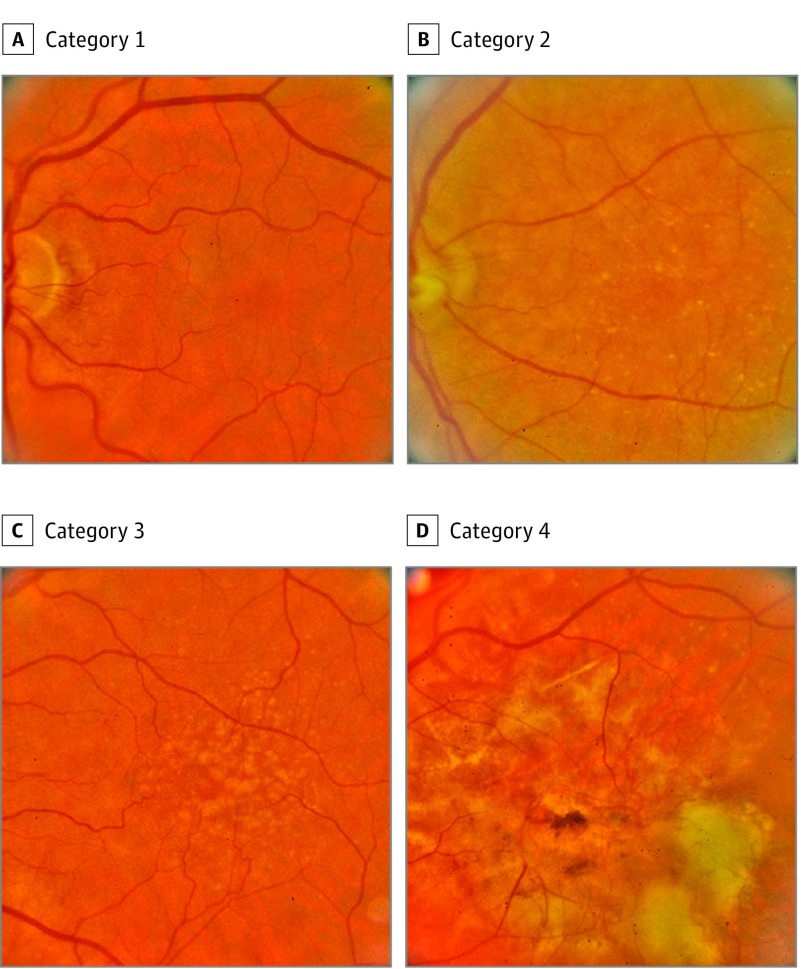
Design, setting, and participants: Deep convolutional neural networks that are explicitly trained for performing automated AMD grading were compared with an alternate deep learning method that used transfer learning and universal features and with a trained clinical grader. Age-related macular degeneration automated detection was applied to a 2-class classification problem in which the task was to distinguish the disease-free/early stages from the referable intermediate/advanced stages. Using several experiments that entailed different data partitioning, the performance of the machine algorithms and human graders in evaluating over 130 000 images that were deidentified with respect to age, sex, and race/ethnicity from 4613 patients against a gold standard included in the National Institutes of Health Age-related Eye Disease Study data set was evaluated.
Main outcomes and measures: Accuracy, receiver operating characteristics and area under the curve, and kappa score.
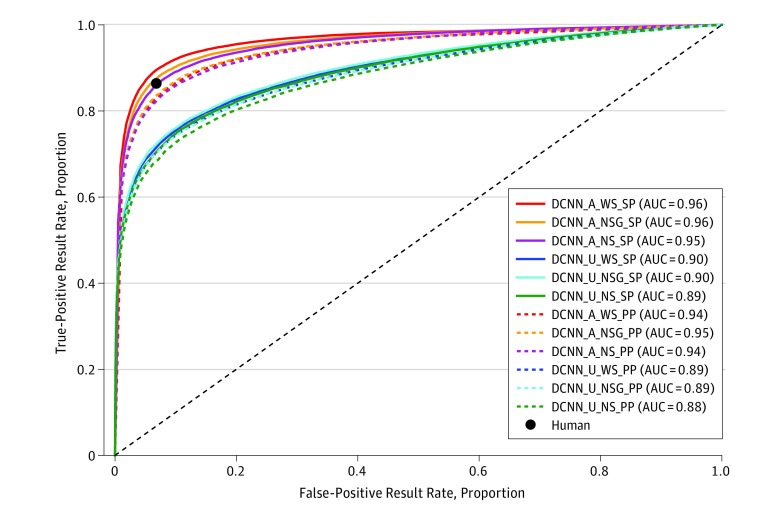
Results: The deep convolutional neural network method yielded accuracy (SD) that ranged between 88.4% (0.5%) and 91.6% (0.1%), the area under the receiver operating characteristic curve was between 0.94 and 0.96, and kappa coefficient (SD) between 0.764 (0.010) and 0.829 (0.003), which indicated a substantial agreement with the gold standard Age-related Eye Disease Study data set.
Conclusions and relevance: Applying a deep learning-based automated assessment of AMD from fundus images can produce results that are similar to human performance levels. This study demonstrates that automated algorithms could play a role that is independent of expert human graders in the current management of AMD and could address the costs of screening or monitoring, access to health care, and the assessment of novel treatments that address the development or progression of AMD.
Conflict of interest statement
Figures
References
-
- Age-Related Eye Disease Study Research Group The Age-Related Eye Disease Study system for classifying age-related macular degeneration from stereoscopic color fundus photographs: the Age-Related Eye Disease Study Report Number 6. Am J Ophthalmol. 2001;132(5):668-681. - PubMed
-
- Bird AC, Bressler NM, Bressler SB, et al. ; The International ARM Epidemiological Study Group . An international classification and grading system for age-related maculopathy and age-related macular degeneration. Surv Ophthalmol. 1995;39(5):367-374. - PubMed
-
- Bressler NM. Age-related macular degeneration is the leading cause of blindness.... JAMA. 2004;291(15):1900-1901. - PubMed
-
- Macular Photocoagulation Study Group Subfoveal neovascular lesions in age-related macular degeneration. guidelines for evaluation and treatment in the macular photocoagulation study. Arch Ophthalmol. 1991;109(9):1242-1257. - PubMed
Publication types
MeSH terms
LinkOut - more resources
Full Text Sources
Other Literature Sources