Association of Krouse Classification for Sinonasal Inverted Papilloma With Recurrence: A Systematic Review and Meta-analysis
- PMID: 28973390
- PMCID: PMC5710354
- DOI: 10.1001/jamaoto.2017.1686
Association of Krouse Classification for Sinonasal Inverted Papilloma With Recurrence: A Systematic Review and Meta-analysis
Abstract
Importance: The risk factors for the recurrence of sinonasal inverted papilloma are still unclear.
Objective: To investigate the potential association between the Krouse classification and the recurrence rates of sinonasal inverted papilloma.
Data sources: The EMBASE and MEDLINE databases were searched for the period January 1, 1964, through September 30, 2016, using the following search strategy: (paranasal sinuses [Medical Subject Headings (MeSH) terms] OR sinonasal [all fields]) AND (inverted papilloma [MeSH terms] OR (inverted [all fields] AND papilloma [all fields]).
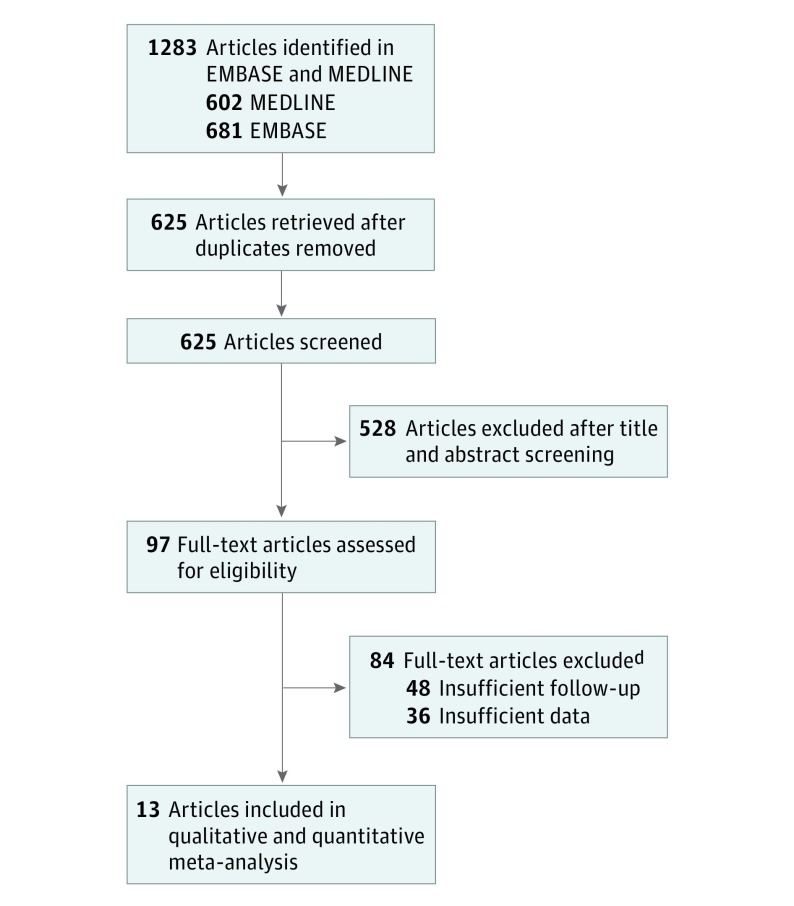
Study selection: The inclusion criteria were (1) studies including sinonasal inverted papilloma only and no other forms of papillomas, such as oncocytic papilloma; (2) minimum follow-up of 1 year after the surgery; and (3) clear report of cases (recurrence) and controls according to the Krouse classification system or deducible from the full-text article. Literature search was performed by 2 reviewers. Of the 625 articles retrieved in the literature, 97 full-text articles were reviewed. Observational cohort studies or randomized controlled trials were included, and the following variables were extracted from full-text articles: authors of the study, publication year, follow-up data, and number of cases (recurrence) and controls (no recurrence) in each of the 4 stages of the Krouse classification system.
Data extraction and synthesis: The Meta-analysis of Observational Studies in Epidemiology (MOOSE) guidelines were followed. Odds ratios (ORs) and 95% CIs were estimated, and data of included studies were pooled using a random-effects model.
Main outcomes and measures: The main outcome was recurrence after surgical removal of sinonasal inverted papilloma according to each stage of the Krouse classification system.
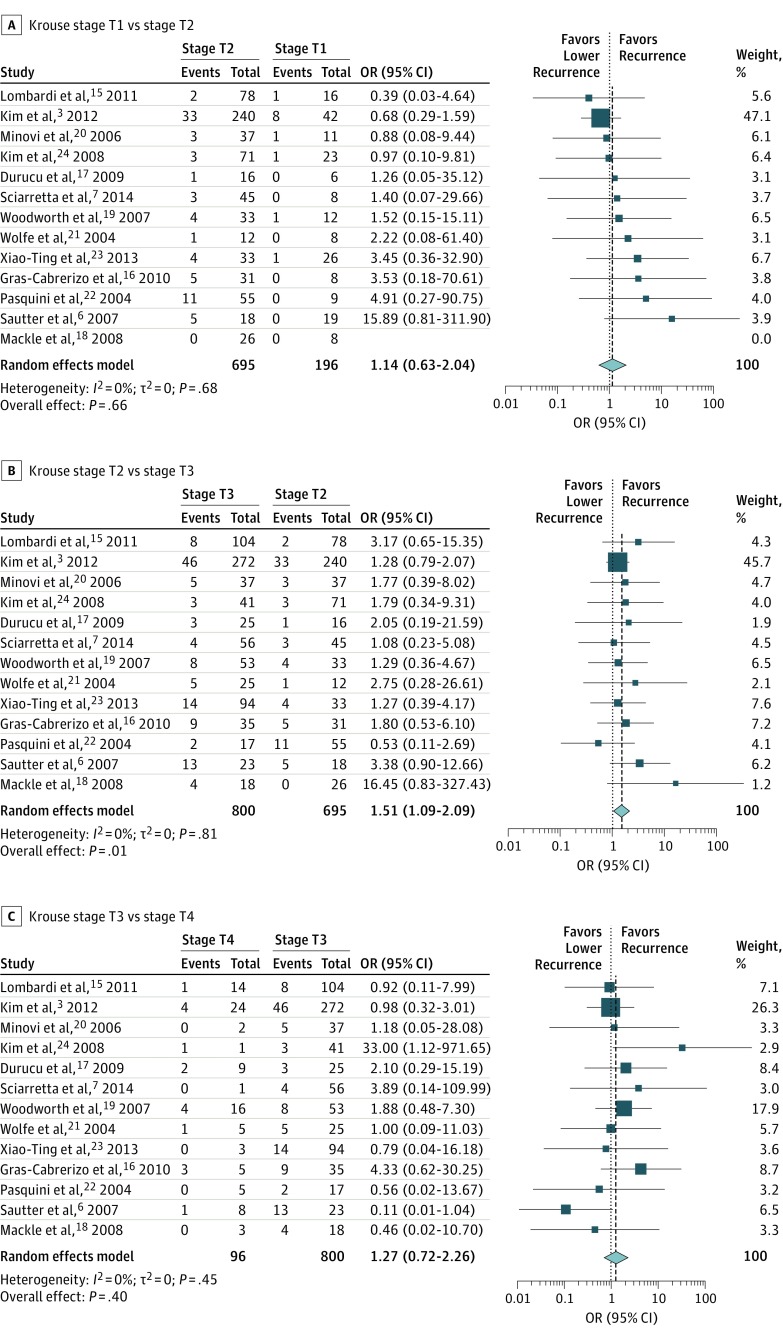
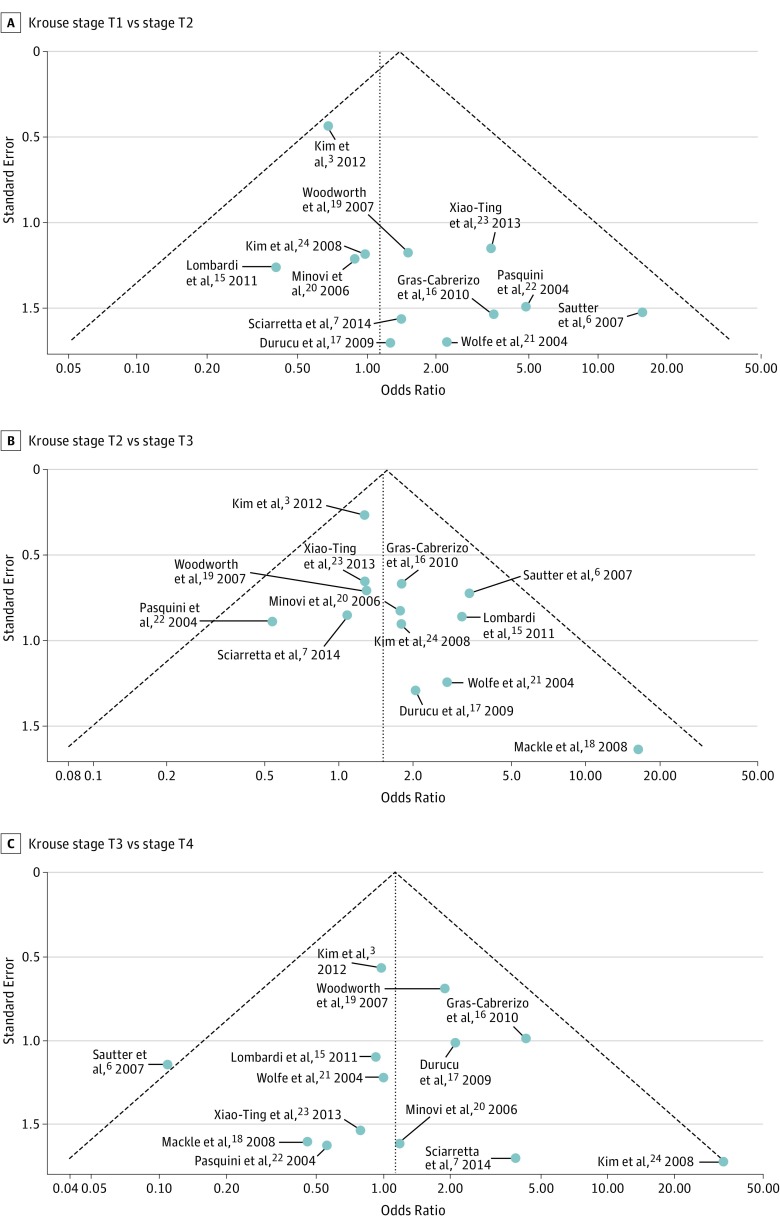
Results: Thirteen studies comprising 1787 patients were analyzed. A significant increased risk of recurrence (51%) was highlighted for Krouse stage T3 disease when compared with stage T2 (pooled OR, 1.51; 95% CI, 1.09-2.09). No significant difference in risk of recurrence was found between Krouse stages T1 and T2 disease (pooled OR, 1.14; 95% CI, 0.63-2.04) or between stages T3 and T4 (pooled OR, 1.27; 95% CI, 0.72-2.26).
Conclusions and relevance: Inverted papillomas classified as stage T3 according to the Krouse classification system presented a 51% higher likelihood of recurrence. Head and neck surgeons must be aware of this higher likelihood of recurrence when planning and performing surgery for sinonasal inverted papilloma.
Conflict of interest statement
Figures
References
-
- Busquets JM, Hwang PH. Endoscopic resection of sinonasal inverted papilloma: a meta-analysis. Otolaryngol Head Neck Surg. 2006;134(3):476-482. - PubMed
-
- Mirza S, Bradley PJ, Acharya A, Stacey M, Jones NS. Sinonasal inverted papillomas: recurrence, and synchronous and metachronous malignancy. J Laryngol Otol. 2007;121(9):857-864. - PubMed
-
- Kim D-Y, Hong S-L, Lee CH, et al. Inverted papilloma of the nasal cavity and paranasal sinuses: a Korean multicenter study. Laryngoscope. 2012;122(3):487-494. - PubMed
-
- Jurado-Ramos A, Jodas JG, Romero FR, et al. Endoscopic medial maxillectomy as a procedure of choice to treat inverted papillomas. Acta Otolaryngol. 2009;129(9):1018-1025. - PubMed
Publication types
MeSH terms
LinkOut - more resources
Full Text Sources
Other Literature Sources