


Barriers and enablers of kangaroo mother care implementation from a health systems perspective: a systematic review
- PMID: 28973515
- PMCID: PMC5886293
- DOI: 10.1093/heapol/czx098
Barriers and enablers of kangaroo mother care implementation from a health systems perspective: a systematic review
Abstract
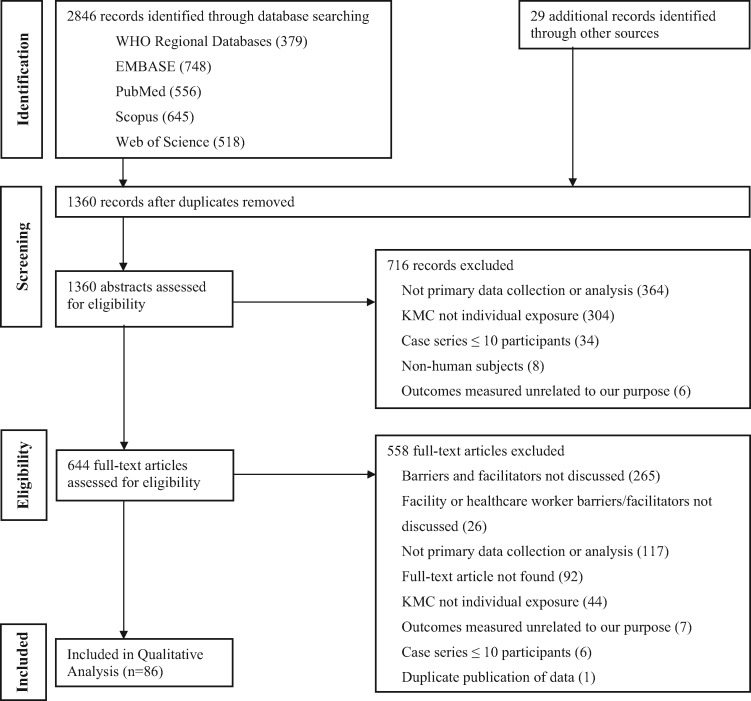
Kangaroo Mother Care (KMC) is an evidence-based intervention that reduces neonatal morbidity and mortality. However, adoption among health systems has varied. Understanding the interaction between health system functions-leadership, financing, healthcare workers (HCWs), technologies, information and research, and service delivery-and KMC is essential to understanding KMC adoption. We present a systematic review of the barriers and enablers of KMC implementation from the perspective of health systems, with a focus on HCWs and health facilities. Using the search terms 'kangaroo mother care', 'skin to skin (STS) care' and 'kangaroo care', we searched Embase, Scopus, Web of Science, Pubmed, and World Health Organization Regional Databases. Reports and hand searched references from publications were also included. Screening and data abstraction were conducted by two independent reviewers using standardized forms. A conceptual model to assess KMC adoption themes was developed using NVivo software. Our search strategy yielded 2875 studies. We included 86 studies with qualitative data on KMC implementation from the perspective of HCWs and/or facilities. Six themes emerged on barriers and enablers to KMC adoption: buy-in and bonding; social support; time; medical concerns; training; and cultural norms. Analysis of interactions between HCWs and facilities yielded further barriers and enablers in the areas of training, communication, and support. HCWs and health facilities serve as two important adopters of Kangaroo Mother Care within a health system. The complex components of KMC lead to multifaceted barriers and enablers to integration, which inform facility, regional, and country-level recommendations for increasing adoption. Further research of methods to promote context-specific adoption of KMC at the health systems level is needed.
Keywords: Health systems; health facilities; health professionals.
© The Author 2017. Published by Oxford University Press in association with The London School of Hygiene and Tropical Medicine.
References
-
- Atun R, De Jongh T, Secci F, Ohiri K, Adeyi O.. 2010. Integration of targeted health interventions into health systems: a conceptual framework for analysis. Health Policy and Planning 25: 104–11. - PubMed
-
- Bergh A-M, Banda L, Lipato T, et al. 2012a. Evaluation of Kangaroo Mother Care Services in Malawi. Washington, DC: Save the Children and the Maternal and Child Health Integrated Program.
-
- Bergh A-M, Davy K, Otai CD.. et al. 2012b. Evaluation of Kangaroo Mother Care Services in Uganda. Washington DC and Kampala: Save the Children.
-
- Bergh A-M, Lydia B, Lipato T, Ngwira G, Luhanga R, Ligowe R.. 2012e. Evaluation of Kangaroo Mother Care Services in Malawi. Washington, DC: Save the Children and the Maternal and Child Health Integrated Program.
Publication types
MeSH terms
LinkOut - more resources
Full Text Sources
Other Literature Sources
Medical
