Effect of Promoting High-Quality Staff Interactions on Fall Prevention in Nursing Homes: A Cluster-Randomized Trial
- PMID: 28973516
- PMCID: PMC5710274
- DOI: 10.1001/jamainternmed.2017.5073
Effect of Promoting High-Quality Staff Interactions on Fall Prevention in Nursing Homes: A Cluster-Randomized Trial
Abstract
Importance: New approaches are needed to enhance implementation of complex interventions for geriatric syndromes such as falls.
Objective: To test whether a complexity science-based staff training intervention (CONNECT) promoting high-quality staff interactions improves the impact of an evidence-based falls quality improvement program (FALLS).
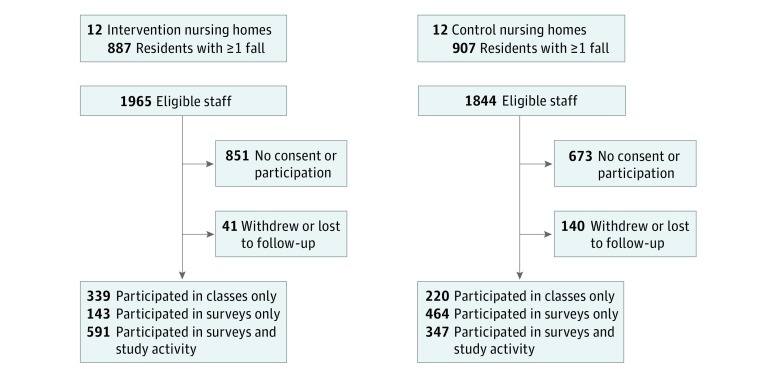
Design, setting, and participants: Cluster-randomized trial in 24 nursing homes receiving either CONNECT followed by FALLS (intervention), or FALLS alone (control). Nursing home staff in all positions were asked to complete surveys at baseline, 3, 6, and 9 months. Medical records of residents with at least 1 fall in the 6-month pre- and postintervention windows (n = 1794) were abstracted for fall risk reduction measures, falls, and injurious falls.
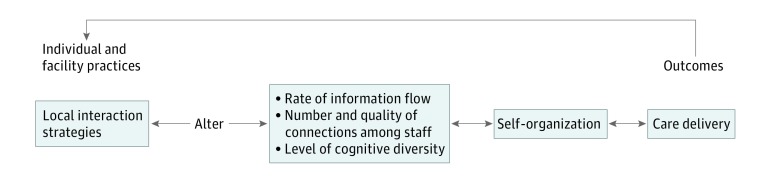
Interventions: CONNECT taught staff to improve their connections with coworkers, increase information flow, and use cognitive diversity in problem solving. Intervention components included 2 classroom sessions, relationship mapping, and self-monitoring. FALLS provided instruction in the Agency for Healthcare Research and Quality's Falls Management Program.
Main outcomes and measures: Primary outcomes were (1) mean number of fall risk reduction activities documented within 30 days of falls and (2) median fall rates among residents with at least 1 fall during the study period. In addition, validated scales measured staff communication quality, frequency, timeliness, and safety climate.
Results: Surveys were completed by 1545 staff members, representing 734 (37%) and 811 (44%) of eligible staff in intervention and control facilities, respectively; 511 (33%) respondents were hands-on care workers. Neither the CONNECT nor the FALLS-only facilities improved the mean count of fall risk reduction activities following FALLS (3.3 [1.6] vs 3.2 [1.5] of 10); furthermore, adjusted median recurrent fall rates did not differ between the groups (4.06 [interquartile range {IQR}, 2.03-8.11] vs 4.06 [IQR, 2.04-8.11] falls/resident/y). A modest improvement in staff communication measures was observed overall (mean, 0.03 [SE, 0.01] points on a 5-point scale; P = .03) and for communication timeliness (mean, 0.8 [SE, 0.03] points on a 5-point scale; P = .02). There was wide variation across facilities in intervention penetration.
Conclusions and relevance: An intervention targeting gaps in staff communication and coordination did not improve the impact of a falls quality improvement program. New approaches to implementing evidence-based care for complex conditions in the nursing home are urgently needed.
Trial registration: clinicaltrials.gov Identifier: NCT00636675.
Conflict of interest statement
Figures
References
-
- Tinetti ME, Inouye SK, Gill TM, Doucette JT. Shared risk factors for falls, incontinence, and functional dependence: unifying the approach to geriatric syndromes. JAMA. 1995;273(17):1348-1353. - PubMed
-
- Becker C, Kron M, Lindemann U, et al. Effectiveness of a multifaceted intervention on falls in nursing home residents. J Am Geriatr Soc. 2003;51(3):306-313. - PubMed
-
- Dyer CAE, Taylor GJ, Reed M, Dyer CA, Robertson DR, Harrington R. Falls prevention in residential care homes: a randomised controlled trial. Age Ageing. 2004;33(6):596-602. - PubMed
-
- Jensen J, Lundin-Olsson L, Nyberg L, Gustafson Y. Fall and injury prevention in older people living in residential care facilities.: a cluster randomized trial. Ann Intern Med. 2002;136(10):733-741. - PubMed
Publication types
MeSH terms
Associated data
Grants and funding
LinkOut - more resources
Full Text Sources
Other Literature Sources
Medical