Effect of Genotype-Guided Warfarin Dosing on Clinical Events and Anticoagulation Control Among Patients Undergoing Hip or Knee Arthroplasty: The GIFT Randomized Clinical Trial
- PMID: 28973620
- PMCID: PMC5818817
- DOI: 10.1001/jama.2017.11469
Effect of Genotype-Guided Warfarin Dosing on Clinical Events and Anticoagulation Control Among Patients Undergoing Hip or Knee Arthroplasty: The GIFT Randomized Clinical Trial
Erratum in
-
Table and Figure Errors.JAMA. 2018 Mar 27;319(12):1281. doi: 10.1001/jama.2018.2301. JAMA. 2018. PMID: 29584822 Free PMC article. No abstract available.
Abstract
Importance: Warfarin use accounts for more medication-related emergency department visits among older patients than any other drug. Whether genotype-guided warfarin dosing can prevent these adverse events is unknown.
Objective: To determine whether genotype-guided dosing improves the safety of warfarin initiation.
Design, setting, and patients: The randomized clinical Genetic Informatics Trial (GIFT) of Warfarin to Prevent Deep Vein Thrombosis included patients aged 65 years or older initiating warfarin for elective hip or knee arthroplasty and was conducted at 6 US medical centers. Enrollment began in April 2011 and follow-up concluded in October 2016.
Interventions: Patients were genotyped for the following polymorphisms: VKORC1-1639G>A, CYP2C9*2, CYP2C9*3, and CYP4F2 V433M. In a 2 × 2 factorial design, patients were randomized to genotype-guided (n = 831) or clinically guided (n = 819) warfarin dosing on days 1 through 11 of therapy and to a target international normalized ratio (INR) of either 1.8 or 2.5. The recommended doses of warfarin were open label, but the patients and clinicians were blinded to study group assignment.
Main outcomes and measures: The primary end point was the composite of major bleeding, INR of 4 or greater, venous thromboembolism, or death. Patients underwent a screening lower-extremity duplex ultrasound approximately 1 month after arthroplasty.
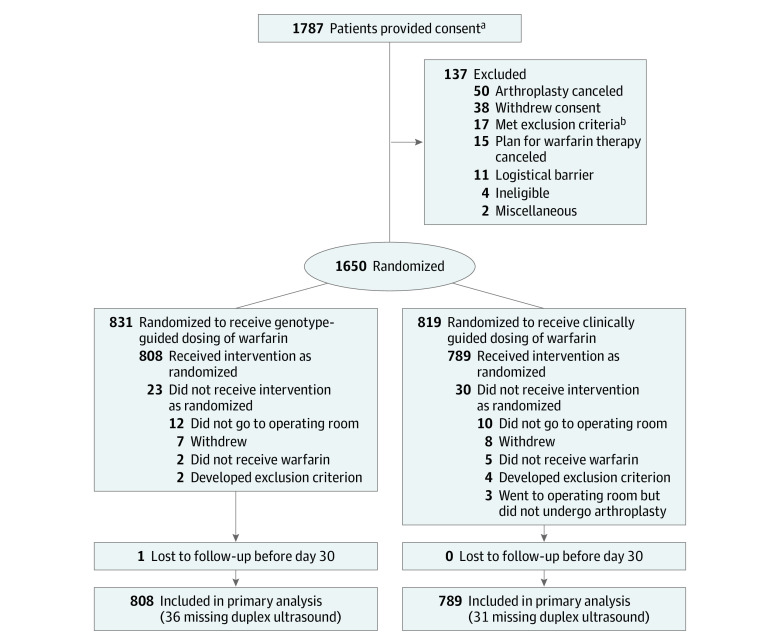
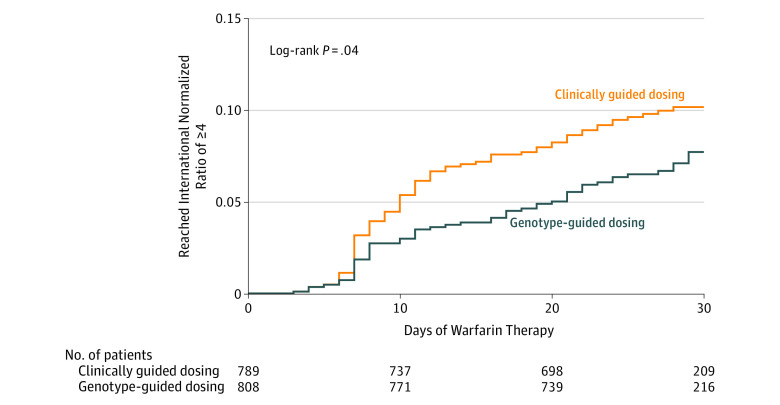
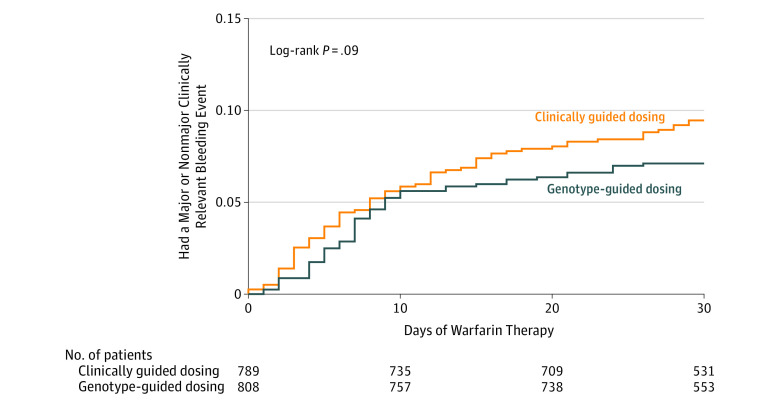
Results: Among 1650 randomized patients (mean age, 72.1 years [SD, 5.4 years]; 63.6% women; 91.0% white), 1597 (96.8%) received at least 1 dose of warfarin therapy and completed the trial (n = 808 in genotype-guided group vs n = 789 in clinically guided group). A total of 87 patients (10.8%) in the genotype-guided group vs 116 patients (14.7%) in the clinically guided warfarin dosing group met at least 1 of the end points (absolute difference, 3.9% [95% CI, 0.7%-7.2%], P = .02; relative rate [RR], 0.73 [95% CI, 0.56-0.95]). The numbers of individual events in the genotype-guided group vs the clinically guided group were 2 vs 8 for major bleeding (RR, 0.24; 95% CI, 0.05-1.15), 56 vs 77 for INR of 4 or greater (RR, 0.71; 95% CI, 0.51-0.99), 33 vs 38 for venous thromboembolism (RR, 0.85; 95% CI, 0.54-1.34), and there were no deaths.
Conclusions and relevance: Among patients undergoing elective hip or knee arthroplasty and treated with perioperative warfarin, genotype-guided warfarin dosing, compared with clinically guided dosing, reduced the combined risk of major bleeding, INR of 4 or greater, venous thromboembolism, or death. Further research is needed to determine the cost-effectiveness of personalized warfarin dosing.
Trial registration: clinicaltrials.gov Identifier: NCT01006733.
Conflict of interest statement
Figures
Comment in
-
Pharmacogenomic Testing and Warfarin: What Evidence Has the GIFT Trial Provided?JAMA. 2017 Sep 26;318(12):1110-1112. doi: 10.1001/jama.2017.11465. JAMA. 2017. PMID: 28973596 No abstract available.
-
Genotype vs Clinically Guided Dosing of Warfarin to Prevent Adverse Events.JAMA. 2018 Mar 27;319(12):1278-1279. doi: 10.1001/jama.2018.0189. JAMA. 2018. PMID: 29584834 No abstract available.
References
-
- Budnitz DS, Lovegrove MC, Shehab N, Richards CL. Emergency hospitalizations for adverse drug events in older Americans. N Engl J Med. 2011;365(21):2002-2012. - PubMed
-
- Rieder MJ, Reiner AP, Gage BF, et al. Effect of VKORC1 haplotypes on transcriptional regulation and warfarin dose. N Engl J Med. 2005;352(22):2285-2293. - PubMed
-
- Coumadin package insert: 2016. https://www.accessdata.fda.gov/drugsatfda_docs/label/2016/009218s116lbl.pdf. Accessed February 2, 2017.
Publication types
MeSH terms
Substances
Associated data
Grants and funding
LinkOut - more resources
Full Text Sources
Other Literature Sources
Medical
Molecular Biology Databases
Miscellaneous