Review
. 2017 Oct 1;144(19):3405-3416.
doi: 10.1242/dev.139063.

The PAR proteins: from molecular circuits to dynamic self-stabilizing cell polarity

Affiliations
Review

The PAR proteins: from molecular circuits to dynamic self-stabilizing cell polarity

Charles F Lang et al. Development. .

Abstract

PAR proteins constitute a highly conserved network of scaffolding proteins, adaptors and enzymes that form and stabilize cortical asymmetries in response to diverse inputs. They function throughout development and across the metazoa to regulate cell polarity. In recent years, traditional approaches to identifying and characterizing molecular players and interactions in the PAR network have begun to merge with biophysical, theoretical and computational efforts to understand the network as a pattern-forming biochemical circuit. Here, we summarize recent progress in the field, focusing on recent studies that have characterized the core molecular circuitry, circuit design and spatiotemporal dynamics. We also consider some of the ways in which the PAR network has evolved to polarize cells in different contexts and in response to different cues and functional constraints.

Keywords: C. elegans; Drosophila; PAR; Polarity.


Conflict of interest statement

Competing interestsThe authors declare no competing or financial interests.

Figures
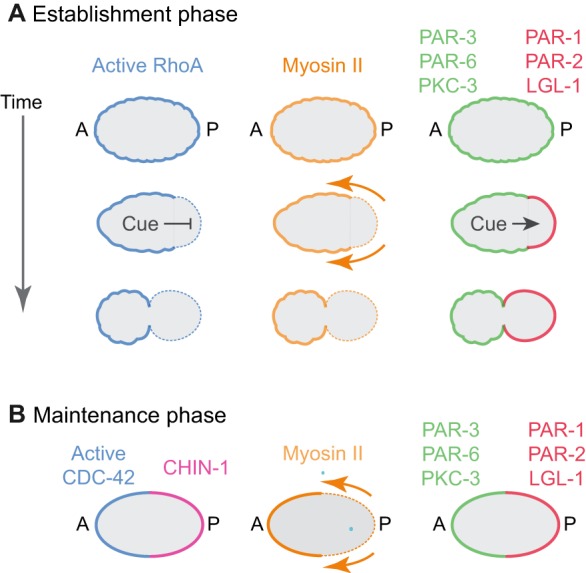
Fig. 1.
Fig. 1.
Overview of polarization in the C. elegans zygote. Polarization of the C. elegans zygote involves two distinct phases: establishment phase (A) and maintenance phase (B). (A) Before polarity establishment, anterior PAR proteins (green), active RhoA and Myosin II are uniformly enriched at the cell cortex. During polarity establishment, a transient sperm-derived cue acts locally to inhibit RhoA activity and induce actomyosin-based cortical flows that segregate anterior PAR proteins towards the anterior pole, and to promote local accumulation of posterior PAR proteins (red) on the posterior cortex where they act to inhibit local accumulation of anterior PAR proteins. (B) During maintenance phase, complementary distributions of anterior PAR proteins and posterior PAR proteins are maintained in the absence of a cue. RhoA activity is low, and CDC-42 activity becomes enriched at the anterior cortex, while the CDC-42 GAP CHIN-1 becomes enriched on the posterior cortex. CDC-42 acts through the kinase MRCK-1 to activate Myosin II on the anterior cortex, leading to persistent cortical flows.
Fig. 2.
Fig. 2.
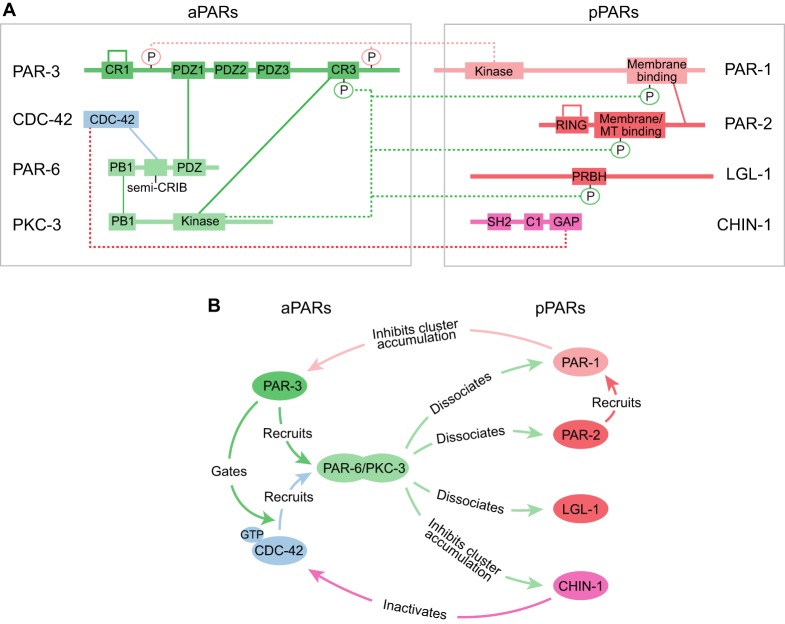
Core molecular interactions that underlie the dynamic stabilization of PAR asymmetries. (A) A schematic view of the PAR network indicating key domains and phosphorylation sites involved in protein-protein interactions. Solid lines indicate direct binding interactions, whereas dotted lines terminating in circles represent enzymatic action, either phosphorylation or GAP activity. In the case of PAR-3 and PAR-2, self-connecting loops indicate oligomerization. (B) A functional view of the same circuit emphasizing the consequences of protein-protein interactions. For clarity, some interactions documented in other contexts (e.g. inhibition of aPKC by LGL or by PAR-3) have been omitted here.
Fig. 3.
Fig. 3.
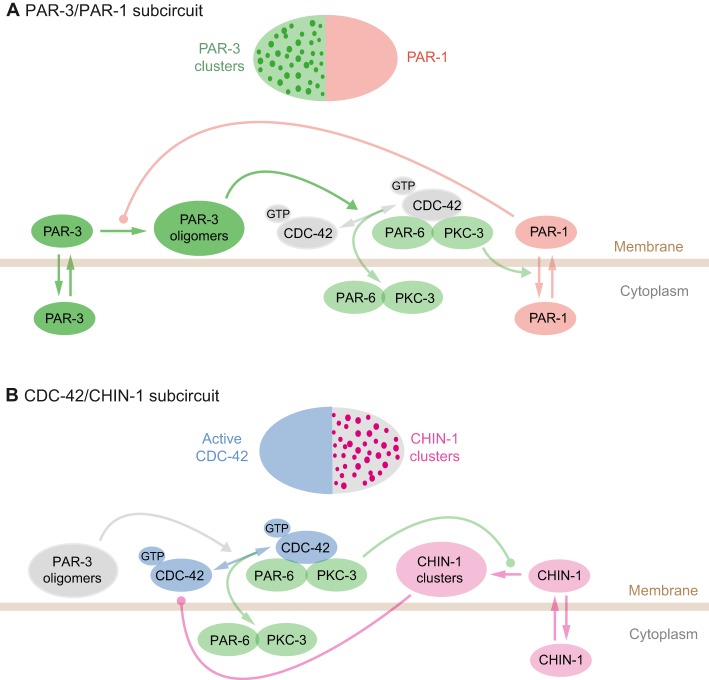
Decomposition of the PAR network into two smaller, mutually inhibitory subcircuits. (A) The PAR-3/PAR-1 subcircuit involves mutual antagonism between PAR-3 oligomers and PAR-1. PAR-3 promotes local association of PAR-6/PKC-3 with active CDC-42; PKC-3 phosphorylates and inhibits membrane association of PAR-1; PAR-1 phosphorylates PAR-3 and inhibits membrane association and/or oligomerization. (B) The CDC-42/CHIN-1 subcircuit involves mutual antagonism between active CDC-42 and clustered CHIN-1. Active CDC-42 binds PAR-6/PKC-3 in the presence of PAR-3; PAR-6/PKC-3 inhibits local growth and accumulation of CHIN-1 clusters; CHIN-1 inactivates CDC-42.

References

    1. Aceto D., Beers M. and Kemphues K. J. (2006). Interaction of PAR-6 with CDC-42 is required for maintenance but not establishment of PAR asymmetry in C. elegans. Dev. Biol. 299, 386-397. 10.1016/j.ydbio.2006.08.002 - DOI - PMC - PubMed
    1. Achilleos A., Wehman A. M. and Nance J. (2010). PAR-3 mediates the initial clustering and apical localization of junction and polarity proteins during C. elegans intestinal epithelial cell polarization. Development 137, 1833-1842. 10.1242/dev.047647 - DOI - PMC - PubMed
    1. Anderson D. C., Gill J. S., Cinalli R. M. and Nance J. (2008). Polarization of the C. elegans embryo by RhoGAP-mediated exclusion of PAR-6 from cell contacts. Science 320, 1771-1774. 10.1126/science.1156063 - DOI - PMC - PubMed
    1. Arata Y., Lee J.-Y., Goldstein B. and Sawa H. (2010). Extracellular control of PAR protein localization during asymmetric cell division in the C. elegans embryo. Development 137, 3337-3345. 10.1242/dev.054742 - DOI - PMC - PubMed
    1. Arata Y., Hiroshima M., Pack C.-G., Ramanujam R., Motegi F., Nakazato K., Shindo Y., Wiseman P. W., Sawa H., Kobayashi T. J. et al. (2016). Cortical polarity of the RING protein PAR-2 is maintained by exchange rate kinetics at the cortical-cytoplasmic boundary. Cell Rep. 16, 2156-2168. 10.1016/j.celrep.2016.07.047 - DOI - PubMed

Publication types

MeSH terms

Substances

LinkOut - more resources