


doi: 10.1002/mds.27176.
Epub 2017 Oct 4.
The Cats-and-Dogs test: A tool to identify visuoperceptual deficits in Parkinson's disease
Affiliations
- PMID: 28976019
- PMCID: PMC5765443
- DOI: 10.1002/mds.27176
Item in Clipboard
The Cats-and-Dogs test: A tool to identify visuoperceptual deficits in Parkinson's disease
Mov Disord.
2017 Dec.
No abstract available
Keywords: Parkinson's disease; biomarker; cognition; dementia; vision.
Figures
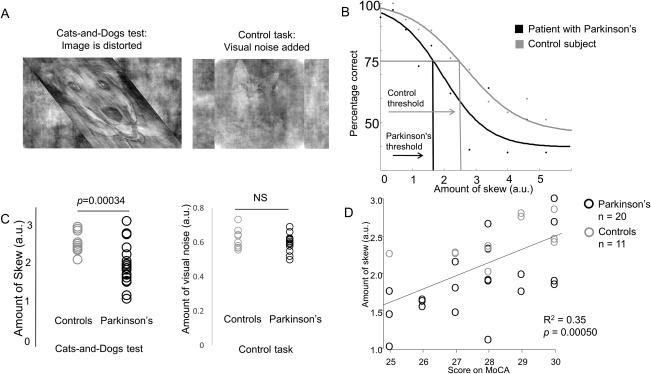
(A) Left: Cats‐and‐Dogs test, example skewed image. A dog is shown. Images in this task varied in the amount of skew, and performance at each level of skew was recorded. Right: control task, example image with added visual noise. A cat is shown. Images in this task varied in the amount of visual noise, and performance at each level of noise was recorded. (B) Method for determining performance in the Cats‐and‐Dogs test; psychophysical curves for 2 example participants are shown, one with PD (black), one without (gray). Percentage correct is shown for each level of skew. Performance is defined as the skew level corresponding to 75% (midway between perfect 100% and guess at 50%) and is marked for each of the participants. The same method was used to determine performance in the control task, with amount of noise plotted against percentage correct. (arbitrary units [a.u.]). (C) Left: performance in the Cats‐and‐Dogs test in patients with Parkinson's disease and controls. Patients with Parkinson's disease performed worse than healthy controls, with lower thresholds to correctly identify skewed images. Wider variation in performance was also seen in patients with Parkinson's disease. Right: performance in the control test in patients with Parkinson's disease and controls. There was no significant difference in performance in this task between patients with Parkinson's disease and healthy controls. (a.u.). (D) Relationship between performance in the Cats‐and‐Dogs test and overall cognition (Montreal Cognitive Assessment).
References
-
- Williams‐Gray CH, Mason SL, Evans JR, et al. The CamPaIGN study of Parkinson's disease: 10‐year outlook in an incident population‐based cohort. J Neurol Neurosurg Psychiatry 2013;84(11):1258‐1264. - PubMed
-
- Hipp G, Diederich NJ, Pieria V, Vaillant M. Primary vision and facial emotion recognition in early Parkinson's disease. J Neurol Sci 2014;338(1‐2):178‐182. - PubMed
-
- von AL, Maurer B, McMillen C, Abraham D, Blum M. reCAPTCHA: human‐based character recognition via Web security measures. Science 2008;321(5895):1465‐1468. - PubMed
Publication types
MeSH terms
Grants and funding
LinkOut - more resources
Full Text Sources
Other Literature Sources
Medical
Miscellaneous
