Multicenter Study
. 2018 Sep;28(5):674-683.
doi: 10.1111/bpa.12563. Epub 2017 Nov 21.

Diffuse gliomas with FGFR3-TACC3 fusion have characteristic histopathological and molecular features

Affiliations
Multicenter Study

Diffuse gliomas with FGFR3-TACC3 fusion have characteristic histopathological and molecular features

Franck Bielle et al. Brain Pathol. 2018 Sep.

Abstract

Adult glioblastomas, IDH-wildtype represent a heterogeneous group of diseases. They are resistant to conventional treatment by concomitant radiochemotherapy and carry a dismal prognosis. The discovery of oncogenic gene fusions in these tumors has led to prospective targeted treatments, but identification of these rare alterations in practice is challenging. Here, we report a series of 30 adult diffuse gliomas with an in frame FGFR3-TACC3 oncogenic fusion (n = 27 WHO grade IV and n = 3 WHO grade II) as well as their histological and molecular features. We observed recurrent morphological features (monomorphous ovoid nuclei, nuclear palisading and thin parallel cytoplasmic processes, endocrinoid network of thin capillaries) associated with frequent microcalcifications and desmoplasia. We report a constant immunoreactivity for FGFR3, which is a valuable method for screening for the FGFR3-TACC3 fusion with 100% sensitivity and 92% specificity. We confirmed the associated molecular features (typical genetic alterations of glioblastoma, except the absence of EGFR amplification, and an increased frequency of CDK4 and MDM2 amplifications). FGFR3 immunopositivity is a valuable tool to identify gliomas that are likely to harbor the FGFR3-TACC3 fusion for inclusion in targeted therapeutic trials.

Keywords: CD34; FGFR3; IDH-wildtype; TACC3; fusion; glioblastoma.


Conflict of interest statement

The authors declare that they have no conflict of interest.

Figures
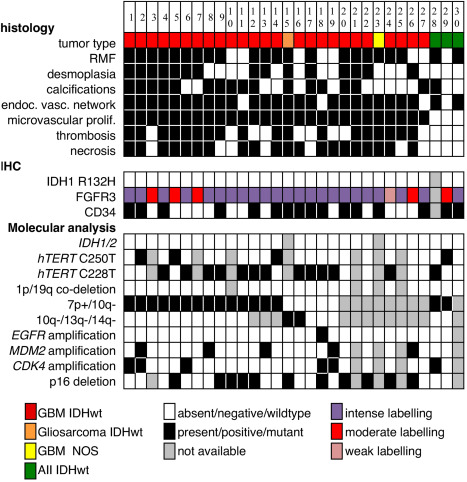
Figure 1
Figure 1
Histological, immunohistochemical and molecular features of gliomas with FGFR3‐TACC3 fusion Abbreviations: AII IDHwt = diffuse astrocytoma, IDH‐wildtype grade II; endoc. vasc. network, endocrinoid vascular network; GBM IDHwt = glioblastoma IDH‐wildtype; microvascular prolif. = microvascular proliferation; RMF = recurrent morphological features (monomorphous ovoid nuclei, endocrinoid network of thin capillaries, nuclear palisading, attachment of tumor cells to vessels by equidistant thin parallel cytoplasmic processes producing vague pseudorosettes).
Figure 2
Figure 2
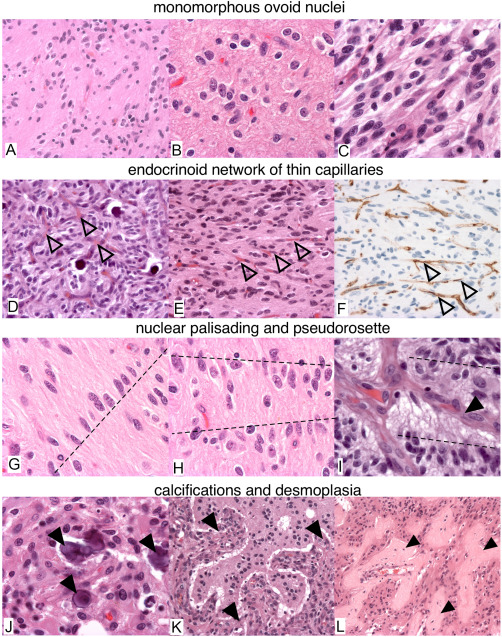
Histological features of gliomas with FGFR3‐TACC3 fusion. (A–E,G–L) H&E. F. CD34 immunostaining. (A,D,E,F,K,L) 100X. (B,C,G–J) 400X. Recurrent morphological features are: monomorphous ovoid nuclei (A–C), endocrinoid network of thin capillaries (open arrowhead in D–F), nuclear palisading (dash lines in G,H). Tumor cells form pseudorosettes with aligned nuclei (dash line in I) and presence of thin cytoplasmic cell processes between tumor nuclei and vessels (arrowhead in I). J. Microcalcifications (arrowheads). (K,L) Desmoplasia (arrowheads).
Figure 3
Figure 3
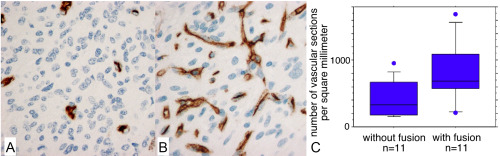
Quantification of vascular density. (A,B). CD34 immunolabeling of a glioblastoma, IDH‐wildtype without FGFR3‐TACC3 fusion (A) or with FGFR3‐TACC3 fusion (B). C. Quantification of the number of CD34 immunopositive vascular sections per square millimeter. Glioblastomas, IDH‐wildtype with FGFR3‐TACC3 fusion had significantly higher vascular density than glioblastomas, IDH‐wildtype without FGFR3‐TACC3 fusion (meanwith fusion=817 sections/mm2, meanwithout fusion=423 sections/mm2, P = 0.045, Mann‐Whitney test).
Figure 4
Figure 4
Immunohistochemical features of gliomas with FGFR3‐TACC3 fusion. (A–F,J–L). 200X. (G,H) 100x. (I) 1000X. (M–O) 20X. A. positive Olig2 immunolabeling. B. positive GFAP immunolabeling. C. P53 intense immunolabeling inferior to the threshold of ten percent of tumor cells. D. stellate extravascular CD34 immunolabeling. E. extravascular CD34 immunolabeling as membrane frames. F. positive ramified EMA immunolabeling. G. Ki67 in a grade II tumor. H. Ki67 in a grade IV tumor. I. chromogenic in situ hybridization for centromere of chromosome 12 (red) and MDM2 (black) showed high copy number amplification in case #8. J. intense FGFR3 immunolabeling. K. moderate FGFR3 immunolabeling. L. weak FGFR3 immunolabeling. M. Diffuse intense FGFR3 immunolabeling. N. Diffuse FGFR3 immunolabeling with heterogeneous intensity from weak to intense. O. Focal FGFR3 immunolabeling and negative areas.

References

    1. Aldape K, Zadeh G, Mansouri S, Reifenberger G, von Deimling A (2015) Glioblastoma: pathology, molecular mechanisms and markers. Acta Neuropathol 129:829–848. - PubMed
    1. Cloughesy TF, Cavenee WK, Mischel PS (2014) Glioblastoma: from molecular pathology to targeted treatment. Annu Rev Pathol 9:1–25. - PubMed
    1. Costa R, Carneiro BA, Taxter T, Tavora FA, Kalyan A, Pai SA et al (2016) FGFR3‐TACC3 fusion in solid tumors: mini review. Oncotarget 7:55924–55938. - PMC - PubMed
    1. Di Stefano AL, Fucci A, Frattini V, Labussiere M, Mokhtari K, Zoppoli P et al (2015) Detection, characterization, and inhibition of FGFR‐TACC fusions in IDH wild‐type glioma. Clin Cancer Res 21:3307–3317. - PMC - PubMed
    1. Gaber ZB, Butler SJ, Novitch BG, Polleux F (2013) PLZF regulates fibroblast growth factor responsiveness and maintenance of neural progenitors. PLoS Biol 11:e1001676. - PMC - PubMed

Publication types

Substances