


Vitamin D and methylarginines in chronic kidney disease (CKD)
- PMID: 28976989
- PMCID: PMC5627906
- DOI: 10.1371/journal.pone.0185449
Vitamin D and methylarginines in chronic kidney disease (CKD)
Abstract
Background: Vitamin D associates with the plasma concentration of the endogenous inhibitor of the nitric oxide system asymmetric dimethyl arginine (ADMA) and cross-sectional studies in CKD patients treated with the vitamin D receptor activator paricalcitol show that plasma ADMA is substantially less than in those not receiving this drug.
Methods: In the frame of a randomized, double-blind, placebo controlled trial, the Paracalcitol and ENdothelial fuNction in chronic kidneY disease (PENNY), we investigated whether vitamin D receptor activation by paricalcitol (2 μg/day x 12 weeks) affects the plasma concentration of ADMA and symmetric dimethyl arginine (SDMA) in 88 patients with stage 3 to 4 CKD.
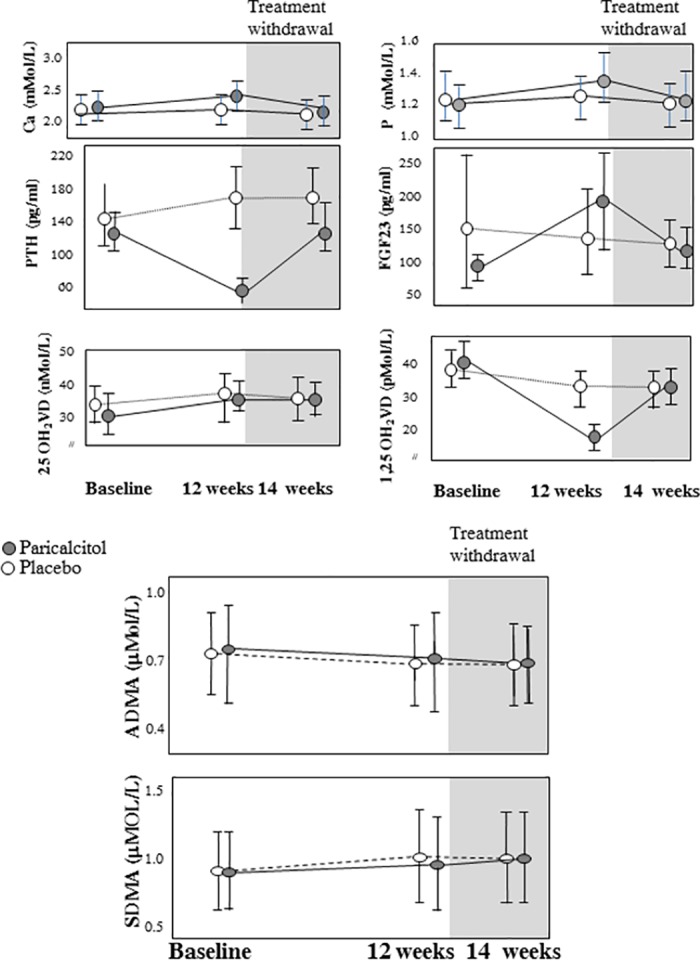
Results: Paricalcitol produced the expected small rise in serum calcium and phosphate and a marked PTH suppression. However, ADMA [Paricalcitol: baseline 0.75 μMol/L (95%CI: 0.70-0.81), 12 week 0.72 μMol/L (95%CI: 0.66-0.78); Placebo: baseline 0.75 μMol/L (95%CI: 0.70-0.90) 12 weeks 0.70 μMol/L (95%CI: 0.66-0.74)] and SDMA [Paricalcitol: baseline 0.91 μMol/L (95%CI: 0.82-1.00), 12 week 0.94 μMol/L (95%CI: 0.82-0.1.06); Placebo: baseline 0.91 μMol/L (95%CI: 0.82-1.06) 12 weeks 0.99 μMol/L (95%CI: 0.88-1.10)] remained unchanged during the trial and 2 weeks after stopping these treatments.
Conclusions: Paricalcitol does not modify plasma ADMA and SDMA in patients with stage 3-4 CKD. The apparent beneficial effects of paricalcitol on ADMA registered in cross-sectional studies is likely attributable to confounding by indication rather than to a true effect of this drug on ADMA metabolism.
Conflict of interest statement
Figures
References
-
- Böger RH, Maas R, Schulze F, Schwedhelm E. Asymmetric dimethylarginine (ADMA) as a prospective marker of cardiovascular disease and mortality—An update on patient populations with a wide range of cardiovascular risk. Pharmacol Res. 2009;60: 481–487. doi: 10.1016/j.phrs.2009.07.001 - DOI - PubMed
-
- Schwedhelm E, Böger RH. The role of asymmetric and symmetric dimethylarginines in renal disease. Nat Rev Nephrol. Nature Publishing Group; 2011;7: 275–85. doi: 10.1038/nrneph.2011.31 - DOI - PubMed
-
- Selley ML. Increased concentrations of homocysteine and asymmetric dimethylarginine and decreased concentrations of nitric oxide in the plasma of patients with Alzheimer’s disease. Neurobiol Aging. 2003;24: 903–907. doi: 10.1016/S0197-4580(03)00007-1 - DOI - PubMed
-
- Stühlinger MC, Abbasi F, Chu JW, Lamendola C, McLaughlin TL, Cooke JP, et al. Relationship between insulin resistance and an endogenous nitric oxide synthase inhibitor. JAMA. 2002;287: 1420–6. - PubMed
-
- Hermenegildo C, Medina P, Peiró M, Segarra G, Vila JM, Ortega J, et al. Plasma concentration of asymmetric dimethylarginine, an endogenous inhibitor of nitric oxide synthase, is elevated in hyperthyroid patients. J Clin Endocrinol Metab. 2002;87: 5636–5640. doi: 10.1210/jc.2002-020905 - DOI - PubMed
Publication types
MeSH terms
Substances
LinkOut - more resources
Full Text Sources
Other Literature Sources
Medical
