Review
. 2018 Oct 10;29(11):1023-1040.
doi: 10.1089/ars.2017.7310. Epub 2017 Nov 21.

Epigenetics and Trained Immunity

Affiliations
Review

Epigenetics and Trained Immunity

Charlotte D C C van der Heijden et al. Antioxid Redox Signal. .

Abstract

Significance: A growing body of clinical and experimental evidence has challenged the traditional understanding that only the adaptive immune system can mount immunological memory. Recent findings describe the adaptive characteristics of the innate immune system, underscored by its ability to remember antecedent foreign encounters and respond in a nonspecific sensitized manner to reinfection. This has been termed trained innate immunity. Although beneficial in the context of recurrent infections, this might actually contribute to chronic immune-mediated diseases, such as atherosclerosis. Recent Advances: In line with its proposed role in sustaining cellular memories, epigenetic reprogramming has emerged as a critical determinant of trained immunity. Recent technological and computational advances that improve unbiased acquisition of epigenomic profiles have significantly enhanced our appreciation for the complexities of chromatin architecture in the contexts of diverse immunological challenges.

Critical issues: Key to resolving the distinct chromatin signatures of innate immune memory is a comprehensive understanding of the precise physiological targets of regulatory proteins that recognize, deposit, and remove chemical modifications from chromatin as well as other gene-regulating factors. Drawing from a rapidly expanding compendium of experimental and clinical studies, this review details a current perspective of the epigenetic pathways that support the adapted phenotypes of monocytes and macrophages.

Future directions: We explore future strategies that are aimed at exploiting the mechanism of trained immunity to improve the prevention and treatment of infections and immune-mediated chronic disorders.

Keywords: epigenetics; innate immunity; macrophage; memory; monocyte; trained immunity.


Figures
<b>FIG. 1.</b>
FIG. 1.
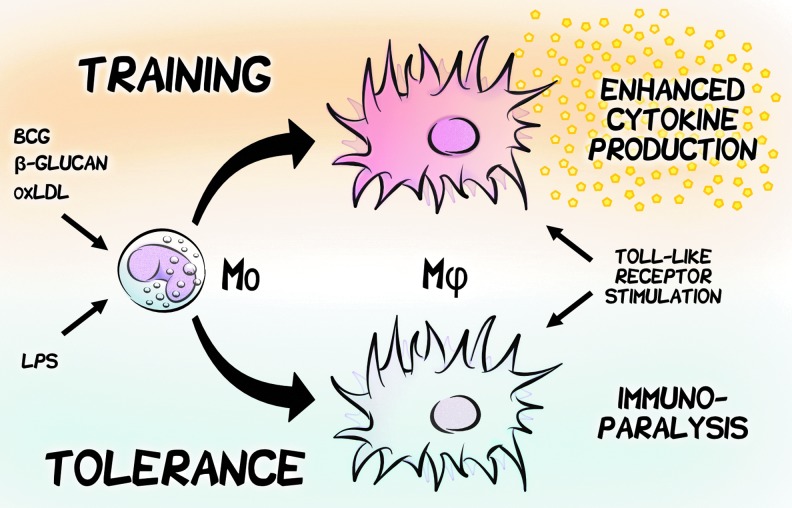
Innate immune memory underlies a spectrum of adaptive characteristics that are acquired in response to diverse immunological challenges. Monocyte (Mo) memories of past encounters with microbial and nonmicrobial products can elicit vastly different responses to future exposures on differentiation to macrophages (Mφ). Trained immunity, induced by BCG, β-glucan, or oxLDL, defines an immunological memory that calibrates an enhanced non-specific response to subsequent infections by enhancing the inflammatory and antimicrobial properties of innate immune cells. In contrast, primary stimulation with LPS induces a persistent refractory state known as tolerance, with a markedly reduced capacity to respond to restimulation. β-glucan, β-1,3-(d)-glucan; BCG, Bacillus Calmette–Guérin; LPS, lipopolysaccharide; oxLDL, oxidized low-density lipoprotein.
<b>FIG. 2.</b>
FIG. 2.
post-translational chemical modifications distinguish between chromatin architecture and transcriptional competency. As the repeating structural unit of chromatin, the nucleosome consists of ∼147 bp of DNA wrapped around an octamer of the core histone proteins H2A, H2B, H3, and H4. Unstructured N-terminal histone tails are substrate for a variety of posttranslational modifications, which are dynamically written to and erased from specific amino acid residues by specialized enzymes. Shown here are lysine modifications that occur on the tails of H3 and H4 histones. Histone lysine acetylation (orange hexagons) is ubiquitously associated with transcriptional competency and is regulated by the competing activities of HAT and deacetylase (HDAC) enzymes. By contrast, the extent of modification and the position of the modified residue within the histone tail determine the functional readout of histone lysine methylation (purple hexagons). The influence of histone modifications on higher order chromatin accessibility is predominantly facilitated by establishing high-affinity binding sites for the recruitment of protein complexes that actively remodel chromatin. HAT, histone acetyltransferase; HDAC, histone deacetylase; K, lysine; KDM, lysine demethylase; KMT, lysine methyltransferase.
<b>FIG. 3.</b>
FIG. 3.
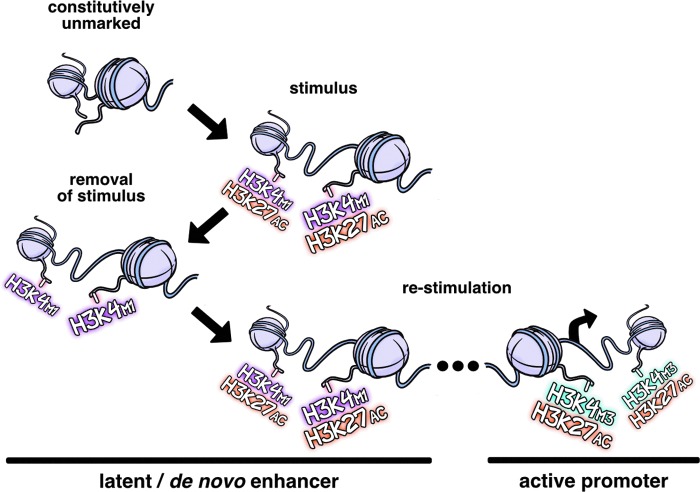
Latent enhancers prime a transcriptional memory in macrophages. Constitutively unmarked distal regulatory elements acquire signature epigenetic features of enhancers such as an open chromatin architecture marked by H3K4m1 and H3K27ac in response to specific stimuli. On removal of the activating stimulus, regions that retain the H3K4m1 enrichment mediate a faster and more robust response to restimulation, supporting a role for this specific modification in the epigenetic memory of macrophages. H3K27ac, H3 histone-lysine-27 acetylation; H3K4m1, H3 histone-lysine-4 monomethylation.
<b>FIG. 4.</b>
FIG. 4.
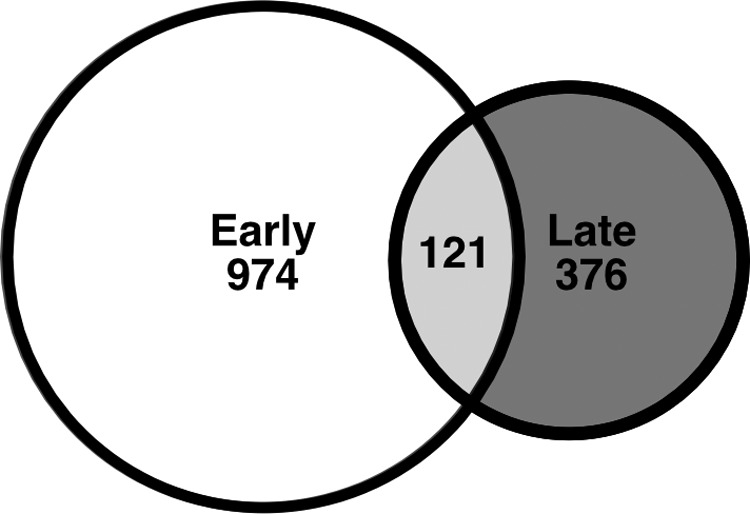
Training with β-glucan induces a program of persistent transcriptional memory. Persistent transcriptional memory is characterized by transcriptional activity that is sustained beyond removal of the activating stimulus. Intersection of transcriptome data derived from macrophages at early (24 h) and late (6 days) time points post β-glucan stimulation described by Novakovic et al. (97) (GSE85246) reveals a cluster of 121 genes whose transcriptional response is maintained for the duration of the experiment.
<b>FIG. 5.</b>
FIG. 5.
Chromatin modifications unite immunometabolism and gene expression. The activities of many chromatin-modifying enzymes are regulated in part by concentrations of intermediates of energy metabolism. Repurposing of the TCA cycle modulates the epigenome of trained immunity. Members of the sirtuin family of HDAC enzymes are sensitive to intracellular NAD+/NADH ratios. Acetyl-CoA is the essential acetyl group donor to lysine acetylation (by HATs), linking intermediary carbon metabolism with chromatin dynamics and transcription. Histone lysine demethylating events are influenced by the elevated levels of succinate and fumarate that are associated with metabolic rewiring of trained macrophages. In particular, fumarate inhibits KDMs, thereby elevating the enrichment of H3K4m3 at the promoters of genes encoding proinflammatory cytokines. H3K4m3, H3 histone-lysine-4 trimethylation; TCA, tricarboxylic acid.
<b>FIG. 6.</b>
FIG. 6.
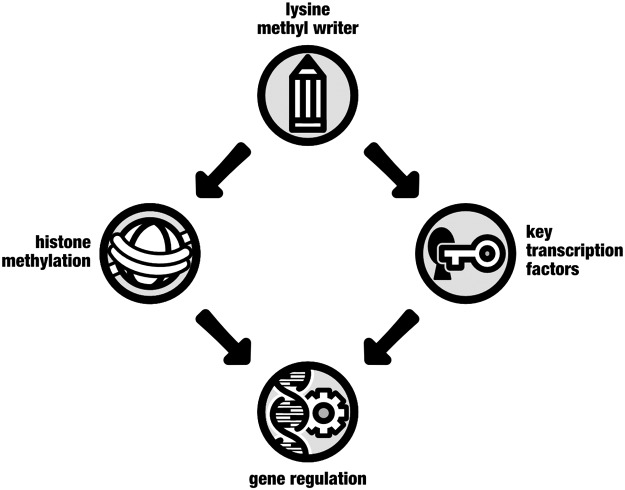
Lysine methylation regulates gene expression by chromatin-dependent and chromatin-independent mechanisms. In addition to chromatinized histone substrates, epigenetic lysine methyl writers can exert their influence on gene expression by specific methylation of amino acid residues on the surface of non-histone proteins. The functional consequences for substrates such as key transcription factors include changes in protein stability and activity that modulate downstream transcriptional outcomes.

References

    1. Aaby P, Roth A, Ravn H, Napirna BM, Rodrigues A, Lisse IM, Stensballe L, Diness BR, Lausch KR, Lund N, Biering-Sorensen S, Whittle H, and Benn CS. Randomized trial of BCG vaccination at birth to low-birth-weight children: beneficial nonspecific effects in the neonatal period? J Infect Dis 204: 245–252, 2011 - PubMed
    1. Alvarez-Errico D, Vento-Tormo R, Sieweke M, and Ballestar E. Epigenetic control of myeloid cell differentiation, identity and function. Nat Rev Immunol 15: 7–17, 2015 - PubMed
    1. Aronson JD. Protective vaccination against tuberculosis, with special reference to BCG vaccine. Minn Med 31: 1336, 1948 - PubMed
    1. Arts RJ, Carvalho A, La Rocca C, Palma C, Rodrigues F, Silvestre R, Kleinnijenhuis J, Lachmandas E, Goncalves LG, Belinha A, Cunha C, Oosting M, Joosten LA, Matarese G, van Crevel R, and Netea MG. Immunometabolic pathways in BCG-induced trained immunity. Cell Rep 17: 2562–2571, 2016 - PMC - PubMed
    1. Arts RJ, Novakovic B, Ter Horst R, Carvalho A, Bekkering S, Lachmandas E, Rodrigues F, Silvestre R, Cheng SC, Wang SY, Habibi E, Goncalves LG, Mesquita I, Cunha C, van Laarhoven A, van de Veerdonk FL, Williams DL, van der Meer JW, Logie C, O'Neill LA, Dinarello CA, Riksen NP, van Crevel R, Clish C, Notebaart RA, Joosten LA, Stunnenberg HG, Xavier RJ, and Netea MG. Glutaminolysis and fumarate accumulation integrate immunometabolic and epigenetic programs in trained immunity. Cell Metab 24: 807–819, 2016 - PMC - PubMed

Publication types

LinkOut - more resources