Review
. 2017 Oct;207(2):357-367.
doi: 10.1534/genetics.117.300095.

Emerging Properties and Functional Consequences of Noncoding Transcription

Affiliations
Review

Emerging Properties and Functional Consequences of Noncoding Transcription

Ryan Ard et al. Genetics. 2017 Oct.

Abstract

Eukaryotic genomes are rich in transcription units encoding "long noncoding RNAs" (lncRNAs). The purpose of all this transcription is unclear since most lncRNAs are quickly targeted for destruction during synthesis or shortly thereafter. As debates continue over the functional significance of many specific lncRNAs, support grows for the notion that the act of transcription rather than the RNA product itself is functionally important in many cases. Indeed, this alternative mechanism might better explain how low-abundance lncRNAs transcribed from noncoding DNA function in organisms. Here, we highlight some of the recently emerging features that distinguish coding from noncoding transcription and discuss how these differences might have important implications for the functional consequences of noncoding transcription.

Keywords: RNA Polymerase II transcription; chromatin; gene regulation; long noncoding RNA (lncRNA); nascent transcription; noncoding transcription; transcription cycle; transcriptional interference.


Figures

Figure 1
Figure 1
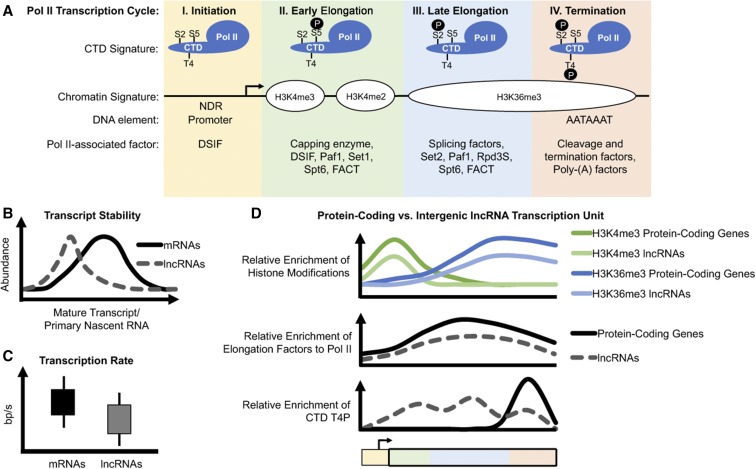
Emerging differences in RNAPII behaviors at protein-coding and lncRNA transcription units. (A) The RNAPII transcription cycle at protein-coding genes is defined by four distinct stages. These stages are characterized by the association of RNAPII with transcription elongation factors and RNA processing factors, many of which are recruited by different post-translational modifications to the RNAPII CTD and/or histones. Only some of these factors are listed here. Active promoters are NDRs, while terminators are generally enriched for the AATAAAT consensus motif. (B) In general, lncRNAs are much less abundant than mRNAs, as lncRNAs are predominantly localized in chromatin where they are rapidly degraded (Schlackow et al. 2017). (C) Metabolic labeling studies using 4sU or 4tU reveal that RNAPII transcription rates are on average slower for lncRNAs (Barrass et al. 2015; Eser et al. 2016; Mukherjee et al. 2017). (D) Many lncRNAs also exhibit reduced levels of transcription-coupled histone marks such as H3K4me3 and H3K36me3 (Sun et al. 2015), decreased recruitment of many common elongation factors (Battaglia et al. 2017; Fischl et al. 2017), inefficient processing (Eser et al. 2016; Mukherjee et al. 2017; Schlackow et al. 2017), and early termination (Milligan et al. 2016; Schlackow et al. 2017). 4sU, 4-thiouridine; 4tU, 4-thiouracil; CTD, C-terminal domain; H3K, histone H3 lysine; lncRNA, long noncoding RNA; NDR, nucleosome-depleted regions; RNAPII, RNA Polymerase II.
Figure 2
Figure 2
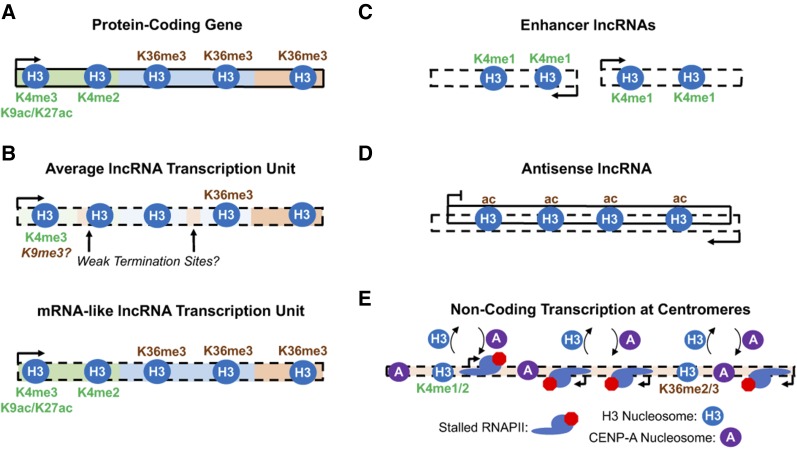
Chromatin signatures of coding and noncoding transcription. (A) Distribution of transcription-coupled histone modifications across active protein-coding genes. H3K4me3 and H3 acetylation at K9 and K27 are enriched at promoters while H3K4me2 and H3K36me3 accumulate over gene bodies (Corden 2013). (B) Intergenic lncRNAs on average display reduced levels of H3K4me3 and H3K36me3 (Sun et al. 2015) and exhibit premature termination and defective nascent transcript processing (Schlackow et al. 2017). H3K9me3, a mark generally characteristic of repressive heterochromatin, has been detected at active lncRNA promoters in human cells (Méle et al. 2017). Importantly, some lncRNA transcription units also have more mRNA-like patterns of CTD and histone modifications. (C) Chromatin marks typically associated with active promoters (H3K4me3 and H3 acetylation) are depleted from noncoding transcription units at enhancer elements in higher eukaryotes. Instead, enhancers are enriched in H3K4me1 (Li et al. 2016). (D) lncRNA transcription antisense to protein-coding genes has been observed to correspond with reduced H3K36me3 and other marks commonly associated with active transcription elongation and instead enriched for H3 acetylation (Murray et al. 2015). (E) Noncoding transcription in centromeres has been observed to correspond with an absence of H3K4me3 and H3 acetylation. Instead, centromeric nucleosomes containing canonical H3 are enriched in H3K4me1/2 and H3K36me2/3 (Sullivan and Karpen 2004; Bergmann et al. 2011). Frequent transcription stalling in fission yeast centromeres has also been found to stimulate the incorporation of nucleosomes containing the H3-variant CENP-A, which epigenetically specifies centromeres (Catania et al. 2015). CENP-A, centromere protein-A; CTD, C-terminal domain; H3K, histone H3 lysine; lncRNA, long noncoding RNA; RNAPII, RNA Polymerase II.
Figure 3
Figure 3
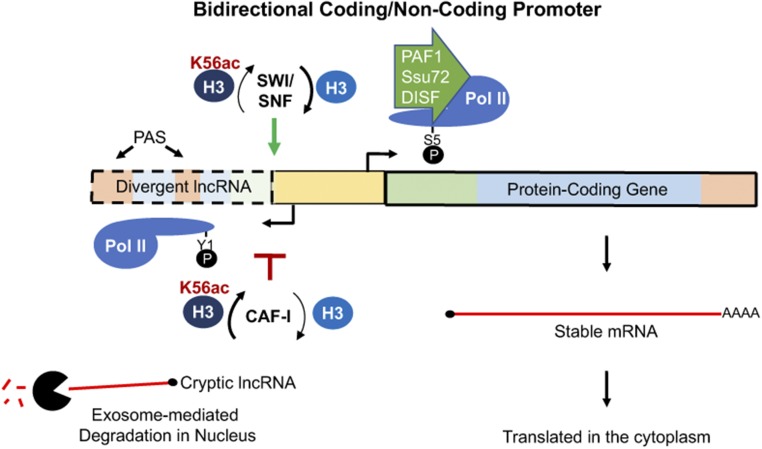
Bidirectional promoters. Although most promoters can initiate transcription in either direction, the sense orientation is generally favored. Several RNAPII-associated factors and chromatin changes appear to control directionality. For example, PAF1, DSIF, and Ssu72 appear to stimulate RNAPII transcription in the sense direction (Tan-Wong et al. 2012; Fischl et al. 2017; Shetty et al. 2017). Chromatin remodellers also compete to regulate divergent transcription. Notably, CAF-I suppresses divergent transcription by favoring the incorporation of nucleosomes with H3K56ac, while the SWI/SNF complex opposes this activity and thereby promotes divergent transcription (Marquardt et al. 2014). Divergent RNAPII transcription can also be enriched for Tyr1P (Y1P) (Descostes et al. 2014; Hsin et al. 2014). Finally, many divergent lncRNAs are enriched for promoter-proximal polyadenylation sites and targeted for early termination and exosome-mediated degradation in the nucleus (Preker et al. 2008; Almada et al. 2013; Ntini et al. 2013). In contrast, stable mature mRNAs are transported to the cytoplasm for protein synthesis. H3, histone H3; lncRNA, long noncoding RNA; poly-(A) site (PAS), ; RNAPII, RNA Polymerase II; switch/sucrose non-fermentable(SWI/SNF).
Figure 4
Figure 4
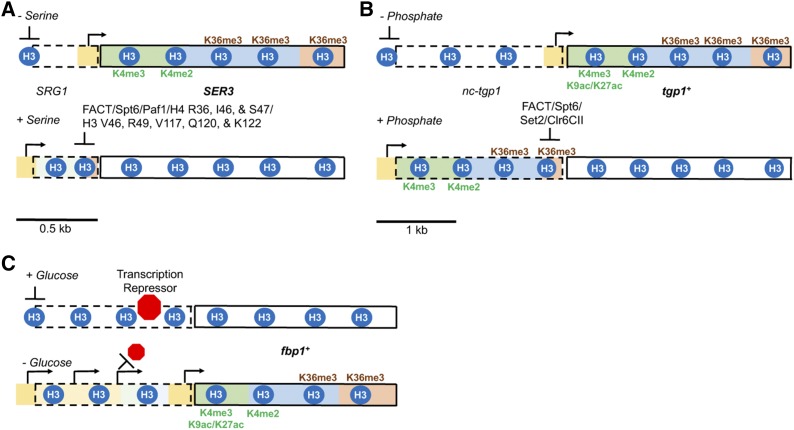
Distinct mechanisms of lncRNA transcription-mediated gene regulation. (A) Serine-starvation induces SER3 expression in S. cerevisiae. In presence of serine, SER3 is repressed by transcription of the SRG1 lncRNA, which is initiated from a promoter positioned roughly 0.5 kb upstream of the SER3 transcription start site (Martens et al. 2004, 2005). Repression in this instance requires cotranscriptional changes in nucleosome positions over the SER3 promoter mediated by histone chaperones FACT and Spt6 (Hainer et al. 2011). Efficient SRG1-mediated SER3 repression also requires the PAF1 complex (Pruneski et al. 2011). SRG1 is too short for transcription elongation to deposit significant levels of H3K4me2 or H3K36me3, which explains why Set1 and Set2 are not required for regulating SER3 expression (Hainer et al. 2011). In contrast, other less characterized histone tail residues are implicated in SER3 repression by SRG1 (e.g., H3V46, H3R49, H3V117, H3Q120, H3K122, H4R36, H4I46, and H4S47) (Hainer and Martens 2011) (B) In S. pombe, the 2 kb cryptic lncRNA nc-tgp1 represses the tgp1+ gene in response to phosphate availability (Ard et al. 2014). FACT and Spt6, along with Set2 and Clr6Rpd3S, all partially contribute to the suppression of tgp1+ by nc-tgp1 transcription (Ard and Allshire 2016). The role of the PAF1 complex in tgp1+ regulation has yet to be explored. Related mechanisms have been reported for lncRNA-mediated repression of the pho1+ gene in S. pombe (Ard and Allshire 2016) and the IME1 gene in S. cerevisiae (van Werven et al. 2012). (C) The S. pombe fbp1+ gene is repressed when cells are grown in the presence of glucose. Unlike the examples described in (A and B), fbp1+ expression following glucose starvation is stimulated by the transcription of multiple upstream lncRNAs (Hirota et al. 2008). While the act of transcription is thought to help displace transcriptional repressors Tup11 and Tup12 (Takemata et al. 2016), it is unclear why cotranscriptional chromatin changes do not repress the fbp1+ promoter. Whether differences in the recruitment of elongation factors to RNAPII during some acts of noncoding transcription (Battaglia et al. 2017; Fischl et al. 2017) help to explain mechanistic differences is worth exploring in future studies. FACT, facilitates chromatin transcription; H3, histone H3; lncRNA, long noncoding RNA; RNAPII, RNA Polymerase II.

References

    1. Abarrategui I., Krangel M. S., 2007. Noncoding transcription controls downstream promoters to regulate T-cell receptor alpha recombination. EMBO J. 26: 4380–4390. - PMC - PubMed
    1. Almada A. E., Wu X., Kriz A. J., Burge C. B., Sharp P. A., 2013. Promoter directionality is controlled by U1 snRNP and polyadenylation signals. Nature 499: 360–363. - PMC - PubMed
    1. Andersson R., Andersen P. R., Valen E., Core L. J., Bornholdt J., et al. , 2014. Nuclear stability and transcriptional directionality separate functionally distinct RNA species. Nat. Commun. 5: 5336. - PubMed
    1. Ard R., Allshire R. C., 2016. Transcription-couple changes to chromatin underpin gene silencing by transcriptional interference. Nucleic Acids Res. 44: 10619–10630. - PMC - PubMed
    1. Ard R., Tong P., Allshire R. C., 2014. Long non-coding RNA-mediated transcriptional interference of a permease gene confers drug tolerance in fission yeast. Nat. Commun. 5: 5576. - PMC - PubMed

Publication types