Concurrent and Longitudinal Contribution of Exposure to Bullying in Childhood to Mental Health: The Role of Vulnerability and Resilience
- PMID: 28979965
- PMCID: PMC5710218
- DOI: 10.1001/jamapsychiatry.2017.2678
Concurrent and Longitudinal Contribution of Exposure to Bullying in Childhood to Mental Health: The Role of Vulnerability and Resilience
Abstract
Importance: Exposure to bullying is associated with poor mental health. However, the degree to which observed associations reflect direct detrimental contributions of exposure to bullying to mental health remains uncertain, as noncausal relationships may arise from genetic and environmental confounding (eg, preexisting vulnerabilities). Determining to what extent exposure to bullying contributes to mental health is an important concern, with implications for primary and secondary interventions.
Objective: To characterize the concurrent and longitudinal contribution of exposure to bullying to mental health in childhood and adolescence using a twin differences design to strengthen causal inference.
Design, setting, and participants: Participants were drawn from the Twins Early Development Study, a population-based cohort recruited from population records of births in England and Wales between January 1, 1994, and December 31, 1996. Data collection took place when the participants were between 11 and 16 years of age from December 1, 2005, to January 31, 2013. Data analysis was conducted from January 1, 2016, to June 20, 2017.
Exposures: Participants completed the Multidimensional Peer-Victimization Scale at 11 and 14 years of age.
Main outcomes and measures: Mental health assessments at 11 and 16 years of age included anxiety, depression, hyperactivity and impulsivity, inattention, conduct problems, and psychotic-like experiences (eg, paranoid thoughts or cognitive disorganization).
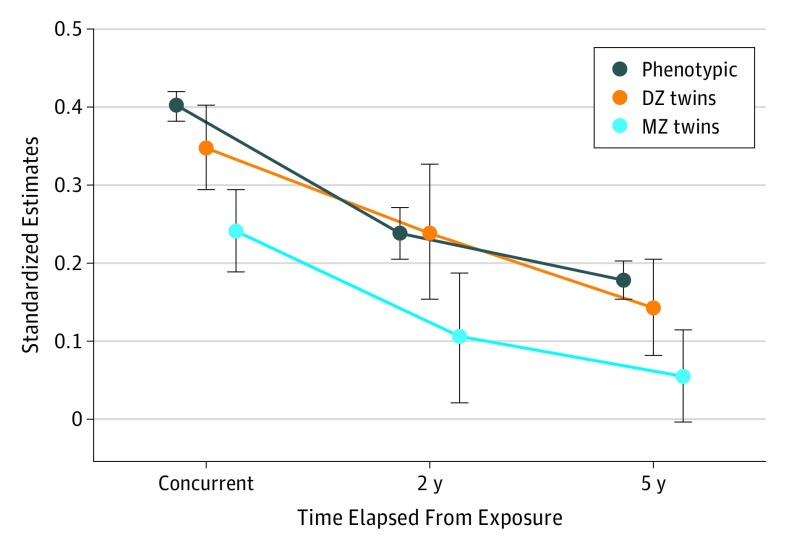
Results: The 11 108 twins included in the final sample (5894 girls and 5214 boys) were a mean age of 11.3 years at the first assessment and 16.3 years at the last assessment. The most stringent twin differences estimates (monozygotic) were consistent with causal contribution of exposure to bullying at 11 years to concurrent anxiety, depression, hyperactivity and impulsivity, inattention, and conduct problems. Effects decreased over time; that is, substantial concurrent contributions to anxiety (β = 0.27; 95% CI, 0.22-0.33) persisted for 2 years (β = 0.12; 95% CI, 0.04-0.20) but not 5 years. Direct contributions to paranoid thoughts and cognitive disorganization persisted for 5 years.
Conclusions and relevance: This study is the largest to date to characterize the contribution of exposure to bullying in childhood to mental health using a twin differences design and multi-informant, multiscale data. Stringent evidence of the direct detrimental contribution of exposure to bullying in childhood to mental health is provided. Findings also suggest that childhood exposure to bullying may partly be viewed as a symptom of preexisting vulnerabilities. Finally, the dissipation of effects over time for many outcomes highlights the potential for resilience in children who were bullied. In addition to programs that aim to reduce exposure to bullying, interventions may benefit from addressing preexisting vulnerabilities and focus on resilience.
Conflict of interest statement
Figures
Comment in
-
Causal and Noncausal Processes Underlying Being Bullied.JAMA Psychiatry. 2017 Nov 1;74(11):1091-1092. doi: 10.1001/jamapsychiatry.2017.2523. JAMA Psychiatry. 2017. PMID: 28979972 No abstract available.
References
-
- Currie C, Zanaotti C, Morgan A, et al. , eds; WHO Regional Office for Europe. Risk behaviours: being bullied and bullying others. In: Social Determinants of Health and Well-being Among Young People: Health Behaviour in School-Aged Children (HBSC) Study: International Report From the 2009/2010 Survey (Health Policy for Children and Adolescents, No. 6). Copenhagen, Denmark: Word Health Organization (WHO); 2012:191-200.
-
- Hawker DSJ, Boulton MJ. Twenty years’ research on peer victimization and psychosocial maladjustment: a meta-analytic review of cross-sectional studies. J Child Psychol Psychiatry. 2000;41(4):441-455. - PubMed
-
- Takizawa R, Maughan B, Arseneault L. Adult health outcomes of childhood bullying victimization: evidence from a five-decade longitudinal British birth cohort. Am J Psychiatry. 2014;171(7):777-784. - PubMed
Publication types
MeSH terms
Grants and funding
LinkOut - more resources
Full Text Sources
Other Literature Sources
Medical