


Post-exercise recovery of contractile function and endurance in humans and mice is accelerated by heating and slowed by cooling skeletal muscle
- PMID: 28980321
- PMCID: PMC5730848
- DOI: 10.1113/JP274870
Post-exercise recovery of contractile function and endurance in humans and mice is accelerated by heating and slowed by cooling skeletal muscle
Abstract
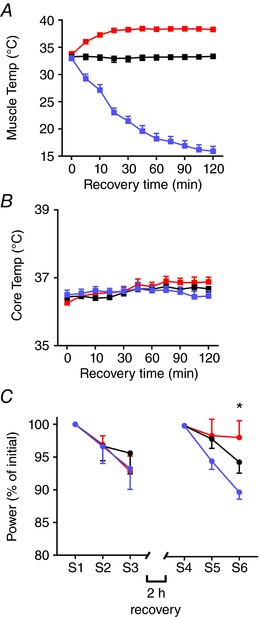
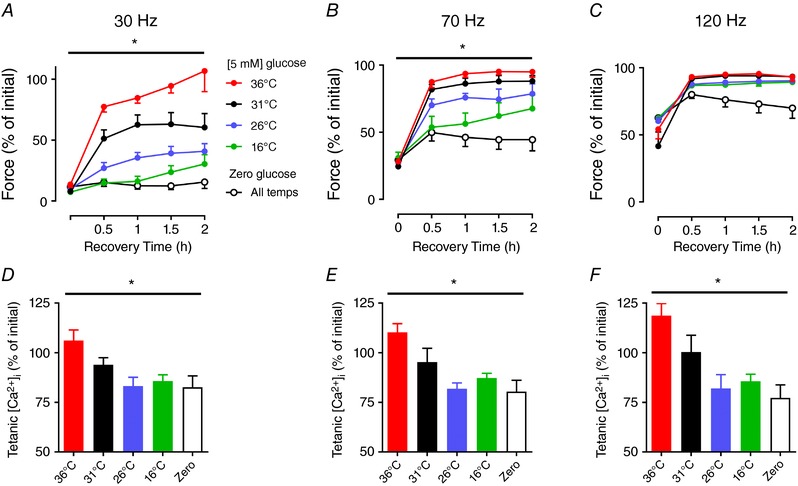
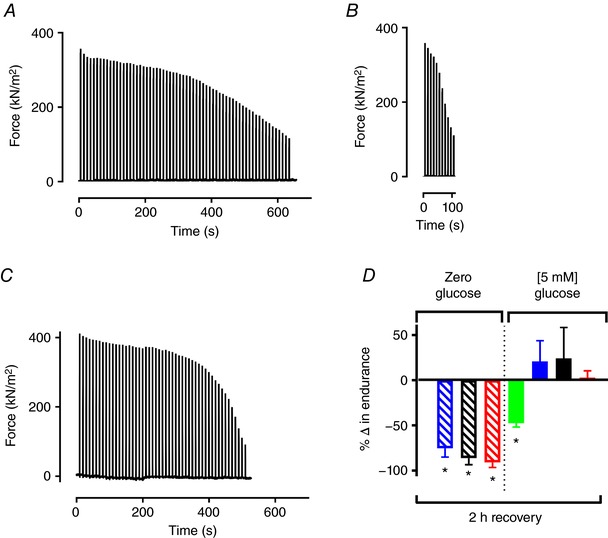
Key points: We investigated whether intramuscular temperature affects the acute recovery of exercise performance following fatigue-induced by endurance exercise. Mean power output was better preserved during an all-out arm-cycling exercise following a 2 h recovery period in which the upper arms were warmed to an intramuscular temperature of ̴ 38°C than when they were cooled to as low as 15°C, which suggested that recovery of exercise performance in humans is dependent on muscle temperature. Mechanisms underlying the temperature-dependent effect on recovery were studied in intact single mouse muscle fibres where we found that recovery of submaximal force and restoration of fatigue resistance was worsened by cooling (16-26°C) and improved by heating (36°C). Isolated whole mouse muscle experiments confirmed that cooling impaired muscle glycogen resynthesis. We conclude that skeletal muscle recovery from fatigue-induced by endurance exercise is impaired by cooling and improved by heating, due to changes in glycogen resynthesis rate.
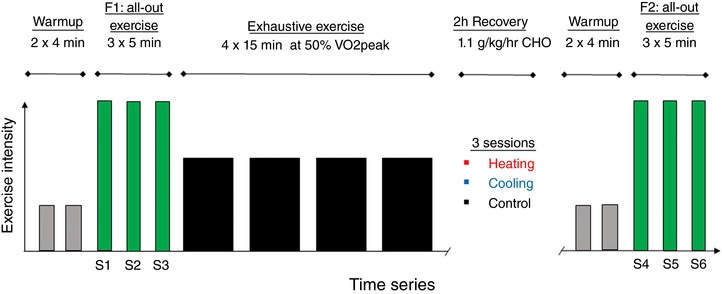
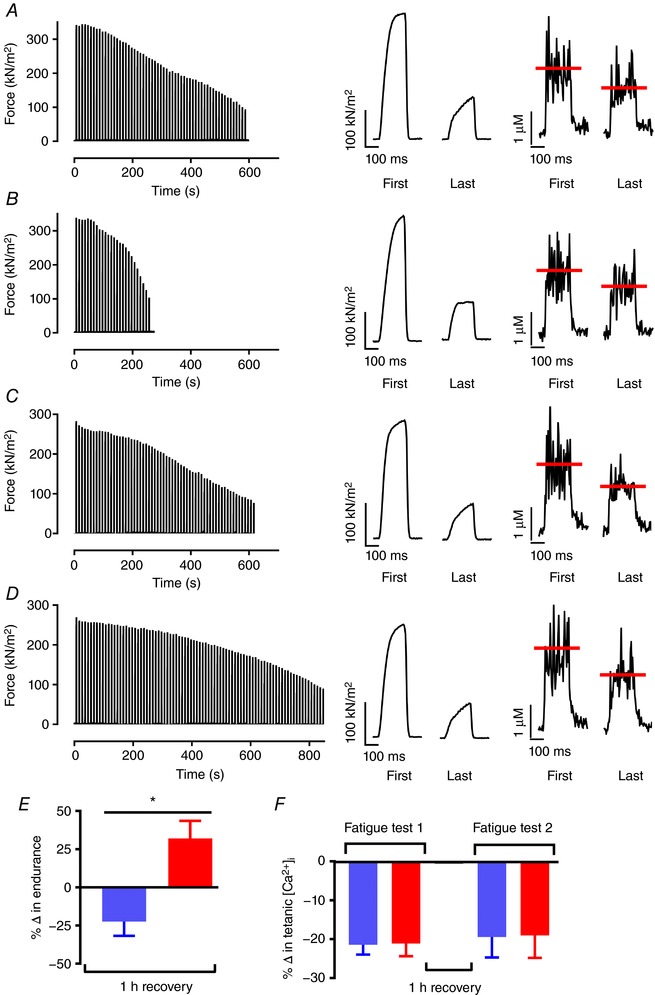
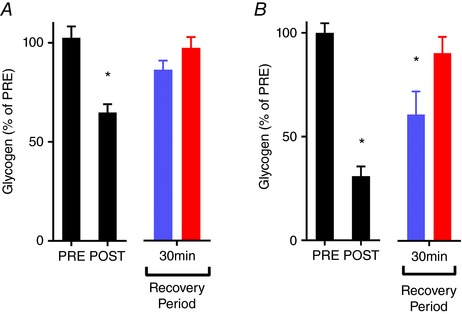
Abstract: Manipulation of muscle temperature is believed to improve post-exercise recovery, with cooling being especially popular among athletes. However, it is unclear whether such temperature manipulations actually have positive effects. Accordingly, we studied the effect of muscle temperature on the acute recovery of force and fatigue resistance after endurance exercise. One hour of moderate-intensity arm cycling exercise in humans was followed by 2 h recovery in which the upper arms were either heated to 38°C, not treated (33°C), or cooled to ∼15°C. Fatigue resistance after the recovery period was assessed by performing 3 × 5 min sessions of all-out arm cycling at physiological temperature for all conditions (i.e. not heated or cooled). Power output during the all-out exercise was better maintained when muscles were heated during recovery, whereas cooling had the opposite effect. Mechanisms underlying the temperature-dependent effect on recovery were tested in mouse intact single muscle fibres, which were exposed to ∼12 min of glycogen-depleting fatiguing stimulation (350 ms tetani given at 10 s interval until force decreased to 30% of the starting force). Fibres were subsequently exposed to the same fatiguing stimulation protocol after 1-2 h of recovery at 16-36°C. Recovery of submaximal force (30 Hz), the tetanic myoplasmic free [Ca2+ ] (measured with the fluorescent indicator indo-1), and fatigue resistance were all impaired by cooling (16-26°C) and improved by heating (36°C). In addition, glycogen resynthesis was faster at 36°C than 26°C in whole flexor digitorum brevis muscles. We conclude that recovery from exhaustive endurance exercise is accelerated by raising and slowed by lowering muscle temperature.
Keywords: cold-water immersion; fatigue; glycogen; recovery; skeletal muscle; temperature.
© 2017 The Authors. The Journal of Physiology © 2017 The Physiological Society.
Figures
Comment in
-
Cooling muscles following exercise.J Physiol. 2017 Dec 15;595(24):7269. doi: 10.1113/JP275370. Epub 2017 Nov 9. J Physiol. 2017. PMID: 29063623 Free PMC article. No abstract available.
-
Cryotherapy: not as cool as it seems.J Physiol. 2018 Feb 15;596(4):561-562. doi: 10.1113/JP275665. Epub 2018 Jan 19. J Physiol. 2018. PMID: 29315568 Free PMC article. No abstract available.
References
-
- Alghannam AF, Jedrzejewski D, Tweddle MG, Gribble H, Bilzon J, Thompson D, Tsintzas K & Betts JA (2016). Impact of muscle glycogen availability on the capacity for repeated exercise in man. Med Sci Sports Exerc 48, 123–131. - PubMed
-
- Allen DG, Lamb GD & Westerblad H (2008). Skeletal muscle fatigue: cellular mechanisms. Physiol Rev 88, 287–332. - PubMed
-
- Barnes M, Gibson LM & Stephenson DG (2001). Increased muscle glycogen content is associated with increased capacity to respond to T‐system depolarisation in mechanically skinned skeletal muscle fibres from the rat. Pflügers Archiv 442, 101–106. - PubMed
-
- Bruton J, Lännergren J & Westerblad H (1998). Effects of CO2‐induced acidification on the fatigue resistance of single mouse muscle fibers at 28 degrees C. J Appl Physiol 85, 478–483. - PubMed
Publication types
MeSH terms
Substances
LinkOut - more resources
Full Text Sources
Other Literature Sources
Medical
Research Materials
Miscellaneous
