


Association between green tea intake and risk of gastric cancer: a systematic review and dose-response meta-analysis of observational studies
- PMID: 28980522
- PMCID: PMC10261342
- DOI: 10.1017/S1368980017002208
Association between green tea intake and risk of gastric cancer: a systematic review and dose-response meta-analysis of observational studies
Abstract
Objective: To examine and quantify the potential dose-response relationship between green tea intake and the risk of gastric cancer.
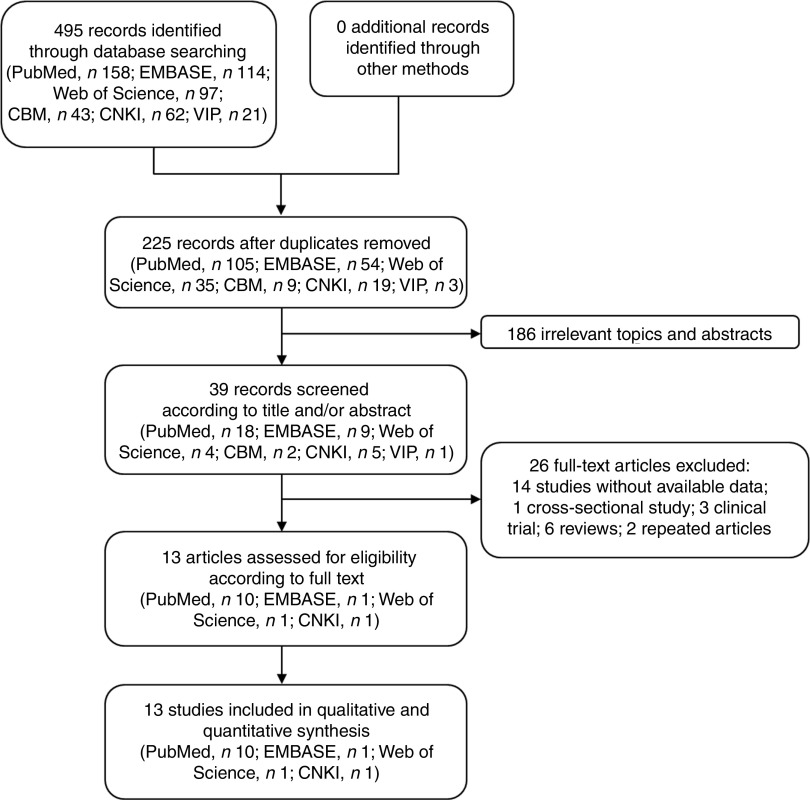
Design: We searched PubMed, EMBASE, Web of Science, CBM, CNKI and VIP up to December 2015 without language restrictions.
Setting: A systematic review and dose-response meta-analysis of observational studies.
Subjects: Five cohort studies and eight case-control studies.
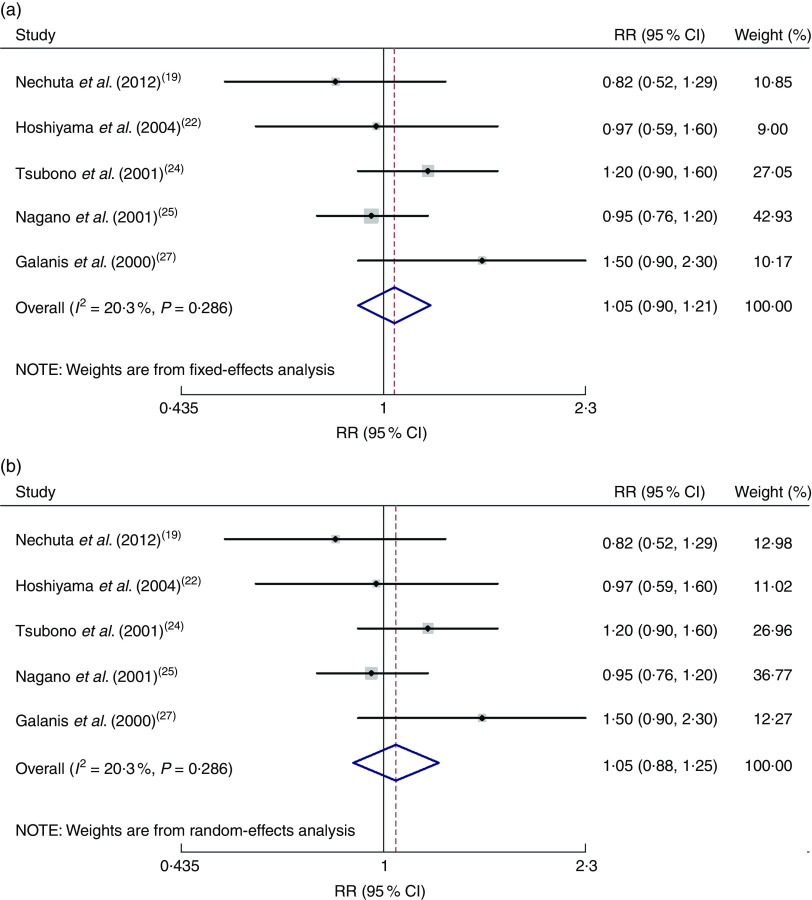
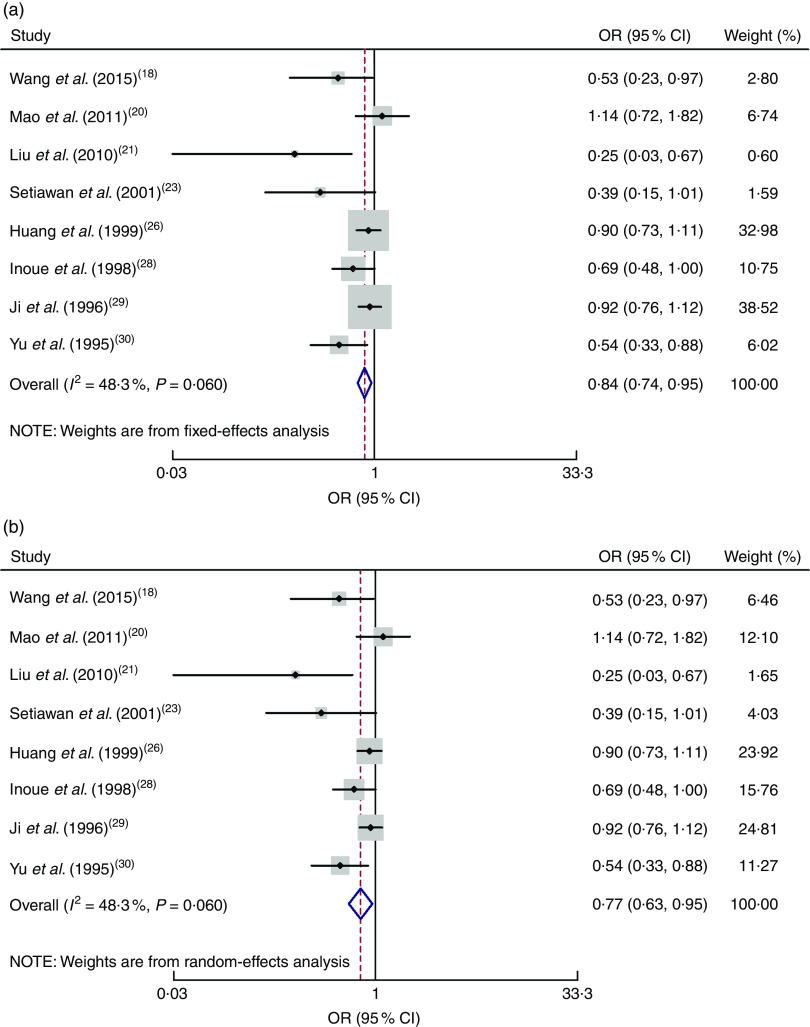
Results: Compared with the lowest level of green tea intake, the pooled relative risk (95 % CI) of gastric cancer was 1·05 (0·90, 1·21, I 2=20·3 %) for the cohort studies and the pooled OR (95 % CI) was 0·84 (0·74, 0·95, I 2=48·3 %) for the case-control studies. The pooled relative risk of gastric cancer was 0·79 (0·63, 0·97, I 2=63·8 %) for intake of 6 cups green tea/d, 0·59 (0·42, 0·82, I 2=1·0 %) for 25 years of green tea intake and 7·60 (1·67, 34·60, I 2=86·5 %) for drinking very hot green tea.
Conclusions: Drinking green tea has a certain preventive effect on reducing the risk of gastric cancer, particularly for long-term and high-dose consumption. Drinking too high-temperature green tea may increase the risk of gastric cancer, but it is still unclear whether high-temperature green tea is a risk factor for gastric cancer. Further studies should be performed to obtain more detailed results, including other gastric cancer risk factors such as smoking and alcohol consumption and the dose of the effective components in green tea, to provide more reliable evidence-based medical references for the relationship between green tea and gastric cancer.
Keywords: Dose–response; Gastric cancer; Green tea; Meta-analysis.
Figures
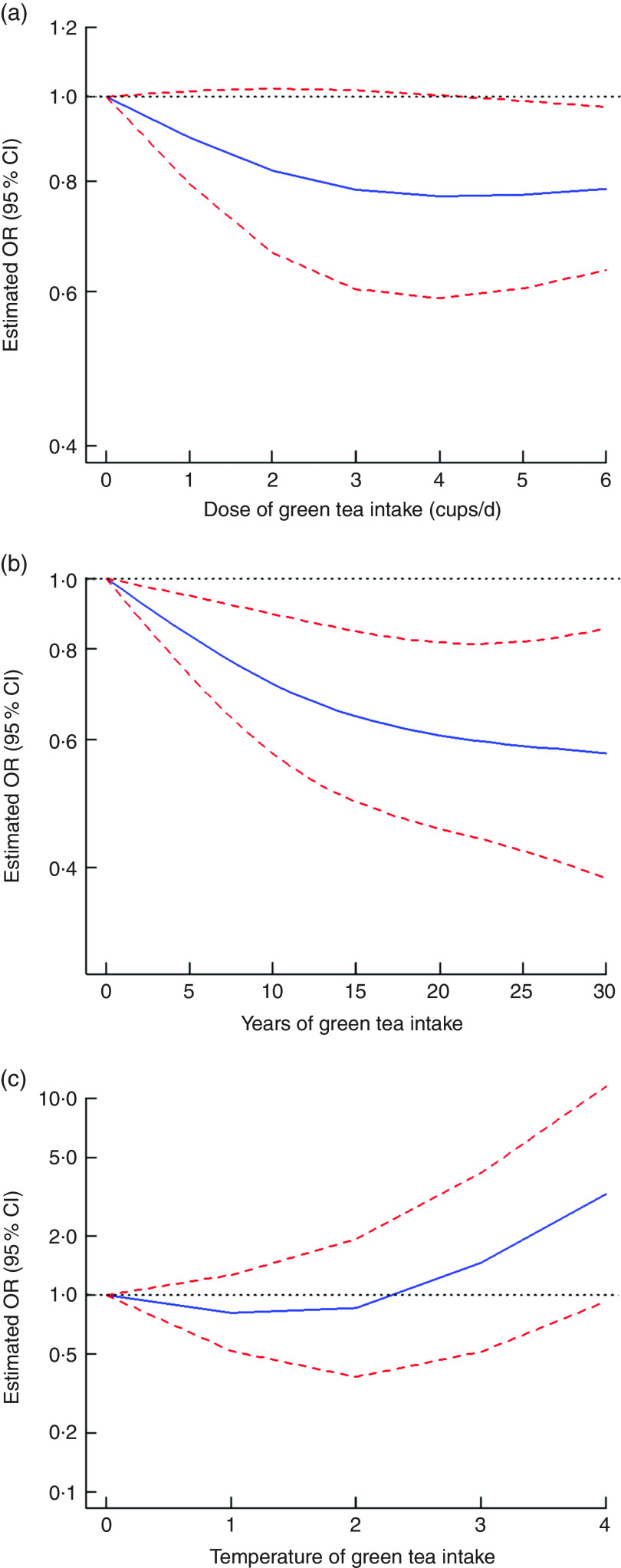
 , best-fitting fractional polynomial;
  , 95 % CI. For temperature of green tea intake, 0, 1, 2, 3 and 4 represent undrinkable, cool, warm, hot and very hot, respectively
References
-
- Hajra NG & Yang CWM (2015) Diversification of the tea products – global scenario. J Tea Sci Res 5, 1–10.
-
- Lin YS, Tsai YJ, Tsay JS et al.. (2003) Factors affecting the levels of tea polyphenols and caffeine in tea leaves. J Agric Food Chem 51, 1864–1873. - PubMed
-
- Zhang XM, Ni Y & Li XR (2013) Advances in study on pharmacological effects of tea polyphenol. Drug Eval Res 36, 157–160.
-
- Wang D, Wang Y, Wan X et al.. (2015) Green tea polyphenol (–)-epigallocatechin-3-gallate triggered hepatotoxicity in mice: responses of major antioxidant enzymes and the Nrf2 rescue pathway. Toxicol Appl Pharmacol 283, 65–74. - PubMed
Publication types
MeSH terms
Substances
LinkOut - more resources
Full Text Sources
Other Literature Sources
Medical
