


Explicit and implicit emotion regulation: a multi-level framework
- PMID: 28981910
- PMCID: PMC5647798
- DOI: 10.1093/scan/nsx096
Explicit and implicit emotion regulation: a multi-level framework
Abstract
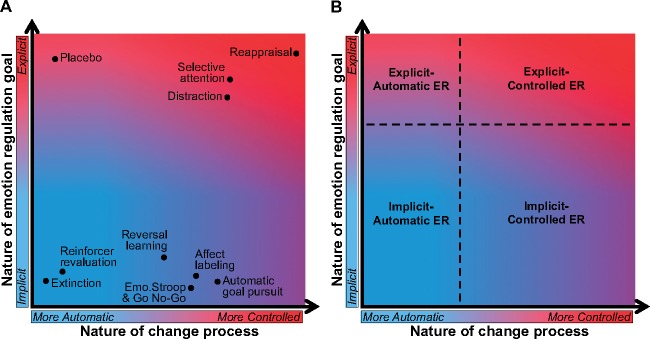
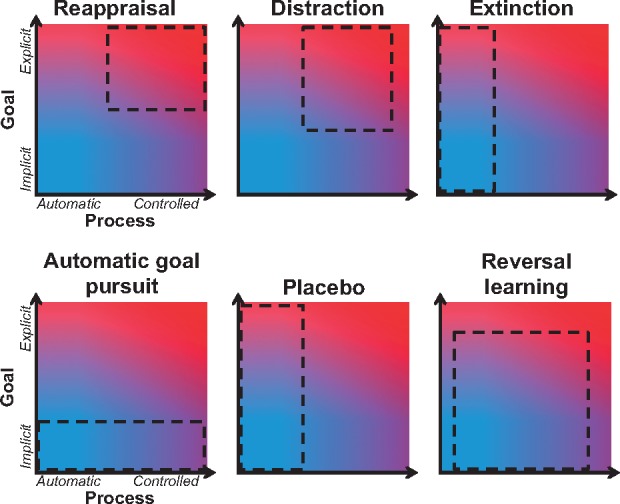
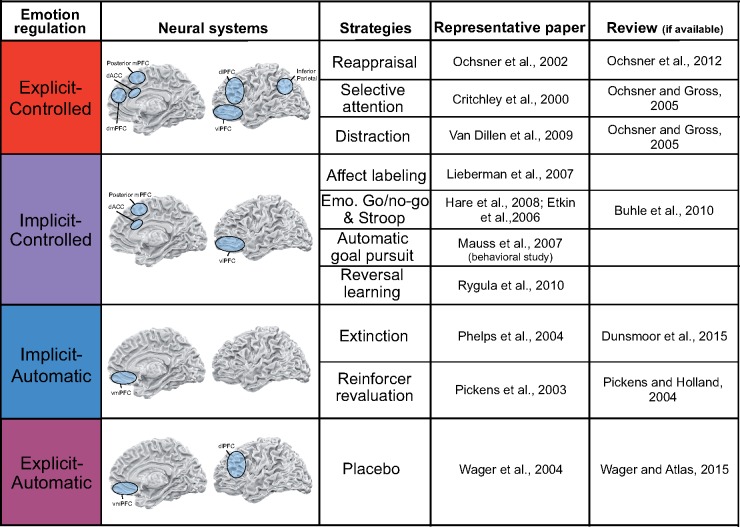
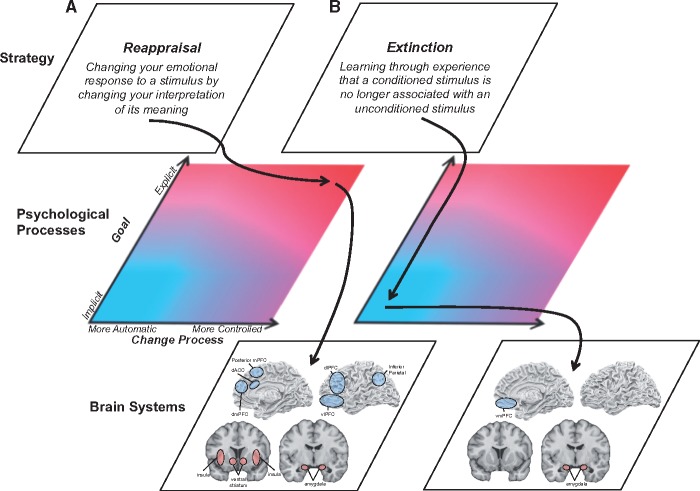
The ability to adaptively regulate emotion is essential for mental and physical well-being. How should we organize the myriad ways people attempt to regulate their emotions? We explore the utility of a framework that distinguishes among four fundamental classes of emotion regulation strategies. The framework describes each strategy class in terms their behavioral characteristics, underlying psychological processes and supporting neural systems. A key feature of this multi-level framework is its conceptualization of the psychological processes in terms of two orthogonal dimensions that describe (i) the nature of the emotion regulation goal (ranging from to implicit to explicit) and (ii) the nature of the emotion change process (ranging from more automatic to more controlled). After describing the core elements of the framework, we use it to review human and animal research on the neural bases of emotion regulation and to suggest key directions for future research on emotion regulation.
Keywords: amygdala; emotion regulation; explicit; implicit; prefrontal cortex.
© The Author (2017). Published by Oxford University Press.
Figures
References
-
- Amaral D.G., Price J.L. (1984). Amygdalo-cortical projections in the monkey (Macaca fascicularis). Journal of Comparative Neurology, 230, 465–96. - PubMed
-
- Aron A.R., Robbins T.W., Poldrack R.A. (2004). Inhibition and the right inferior frontal cortex. Trends in Cognitive Sciences, 8, 170–7. - PubMed
-
- Badre D., Wagner A.D. (2004). Selection, integration, and conflict monitoring: assessing the nature and generality of prefrontal cognitive control mechanisms. Neuron, 41, 473–87. - PubMed
-
- Bargh J.A. (1989). Conditional automaticity: varieties of automatic influence in social perception and cognition. Unintended Thought, 3, 51–69.
Publication types
MeSH terms
Grants and funding
LinkOut - more resources
Full Text Sources
Other Literature Sources
