


Active and resting motor threshold are efficiently obtained with adaptive threshold hunting
- PMID: 28982146
- PMCID: PMC5628904
- DOI: 10.1371/journal.pone.0186007
Active and resting motor threshold are efficiently obtained with adaptive threshold hunting
Abstract
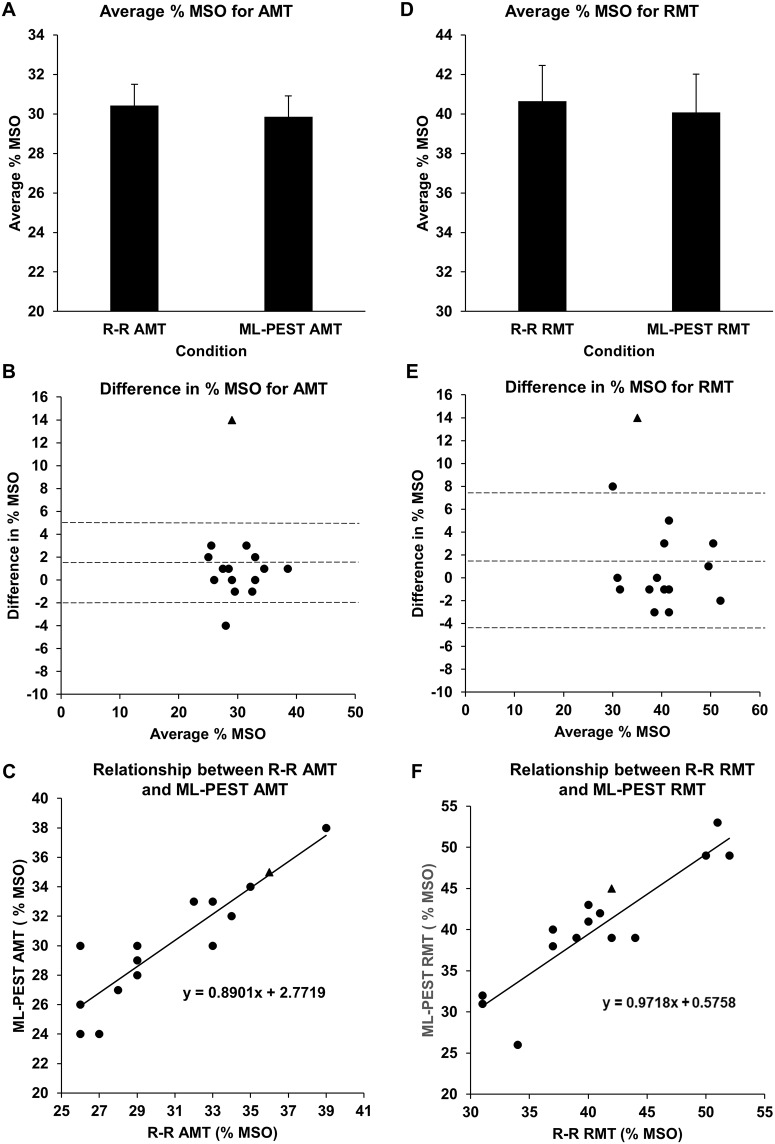
Transcranial magnetic studies typically rely on measures of active and resting motor threshold (i.e. AMT, RMT). Previous work has demonstrated that adaptive threshold hunting approaches are efficient for estimating RMT. To date, no study has compared motor threshold estimation approaches for measures of AMT, yet this measure is fundamental in transcranial magnetic stimulation (TMS) studies that probe intracortical circuits. The present study compared two methods for acquiring AMT and RMT: the Rossini-Rothwell (R-R) relative-frequency estimation method and an adaptive threshold-hunting method based on maximum-likelihood parameter estimation by sequential testing (ML-PEST). AMT and RMT were quantified via the R-R and ML-PEST methods in 15 healthy right-handed participants in an experimenter-blinded within-subject study design. AMT and RMT estimations obtained with both the R-R and ML-PEST approaches were not different, with strong intraclass correlation and good limits of agreement. However, ML-PEST required 17 and 15 fewer stimuli than the R-R method for the AMT and RMT estimation, respectively. ML-PEST is effective in reducing the number of TMS pulses required to estimate AMT and RMT without compromising the accuracy of these estimates. Using ML-PEST to estimate AMT and RMT increases the efficiency of the TMS experiment as it reduces the number of pulses to acquire these measures without compromising accuracy. The benefits of using the ML-PEST approach are amplified when multiple target muscles are tested within a session.
Conflict of interest statement
Figures
References
-
- Wassermann EM. Variation in the response to transcranial magnetic brain stimulation in the general population. Clin Neurophysiol. 2002;113(7):1165–71. Epub 2002/06/29. . - PubMed
-
- Rossi S, Hallett M, Rossini PM, Pascual-Leone A. Safety, ethical considerations, and application guidelines for the use of transcranial magnetic stimulation in clinical practice and research☆. Clin Neurophysiol. 2009;120(12):2008–39. doi: 10.1016/j.clinph.2009.08.016 - DOI - PMC - PubMed
-
- Groppa S, Oliviero A, Eisen A, Quartarone A, Cohen LG, Mall V, et al. A practical guide to diagnostic transcranial magnetic stimulation: report of an IFCN committee. Clin Neurophysiol. 2012;123(5):858–82. Epub 2012/02/22. doi: 10.1016/j.clinph.2012.01.010 - DOI - PMC - PubMed
-
- Rossini PM, Barker AT, Berardelli A, Caramia MD, Caruso G, Cracco RQ, et al. Non-invasive electrical and magnetic stimulation of the brain, spinal cord and roots: basic principles and procedures for routine clinical application. Report of an IFCN committee. Electroencephalogr Clin Neurophysiol. 1994;91(2):79–92. Epub 1994/08/01. . - PubMed
-
- Awiszus F, Feistner H, Urbach D, Bostock H. Characterisation of paired-pulse transcranial magnetic stimulation conditions yielding intracortical inhibition or I-wave facilitation using a threshold-hunting paradigm. Exp Brain Res. 1999;129(2):317–24. Epub 1999/12/11. . - PubMed
MeSH terms
LinkOut - more resources
Full Text Sources
Other Literature Sources
