


Ranking the Leading Risk Factors for Sudden Unexpected Death in Epilepsy
- PMID: 28983274
- PMCID: PMC5613169
- DOI: 10.3389/fneur.2017.00473
Ranking the Leading Risk Factors for Sudden Unexpected Death in Epilepsy
Abstract
Background: Sudden unexpected death in epilepsy (SUDEP) is rare in well-controlled epilepsy. However, SUDEP is a common cause of death in drug-resistant epilepsy. Over the last 30 years, multiple cohort and population studies have identified clinical risk factors associated with an increased risk for SUDEP.
Objective: To identify and rank the leading SUDEP risk factors from major cohort and population-based studies. The incidence of SUDEP is also evaluated in special clinical situations, including antiepileptic drug treatment, epilepsy surgery, devices, and assignment to placebo in clinical trials.
Methods: A PubMed search for English language human cohort studies for the terms Sudden, Death, and Epilepsy was performed for the years 1987-2017. Risk factors for SUDEP were identified and ranked by the weighted log adjusted odds ratio (OR)/relative risk ratio (RR).
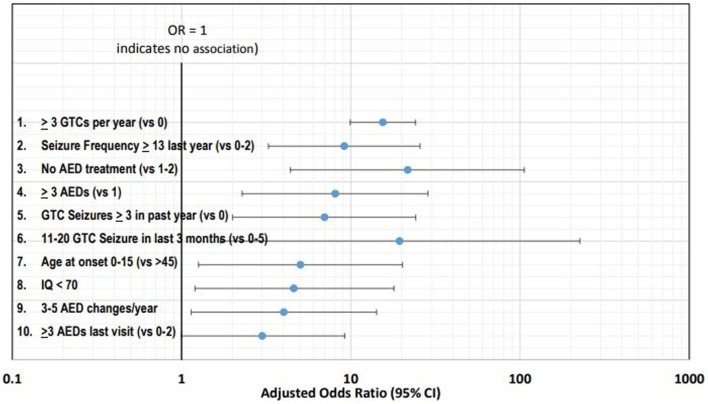
Findings: The top 10 leading risk factors ranked from highest to lowest log adjusted OR/RR are the following: ≥3 GTC seizures per year; ≥13 seizures in the last year; No Antiepileptic Drug (AED) treatment; ≥3 AEDs; ≥3 GTCs in the past year; 11-20 GTC seizures in the last 3 months; age of onset 0-15 years old; IQ < 70; 3-5 AED changes in the last year; ≥3 AEDs. Two risk factors from separate sources (≥3 GTC seizures and ≥3 AEDs) occur twice in the top 10 risk factors.
Conclusion: The top 10 risk factors for SUDEP are identified and ranked. A ranking of the top risk factors could help clinicians identify patients at highest risk for SUDEP.
Keywords: epilepsy; mortality; odds ratio; seizures; sudden death; sudden unexpected death in epilepsy.
Figures
References
-
- Harden C, Tomson T, Gloss D, Buchhalter J, Cross JH, Donner E, et al. Practice guideline summary: sudden unexpected death in epilepsy incidence rates and risk factors: report of the Guideline Development, Dissemination, and Implementation Subcommittee of the American Academy of Neurology and the American Epilepsy Society. Neurology (2017) 88:1674–80. 10.1212/WNL.0000000000003685 - DOI - PubMed
Publication types
LinkOut - more resources
Full Text Sources
Other Literature Sources
Miscellaneous
