


Biomedical Big Data: New Models of Control Over Access, Use and Governance
- PMID: 28983835
- PMCID: PMC5715037
- DOI: 10.1007/s11673-017-9809-6
Biomedical Big Data: New Models of Control Over Access, Use and Governance
Abstract
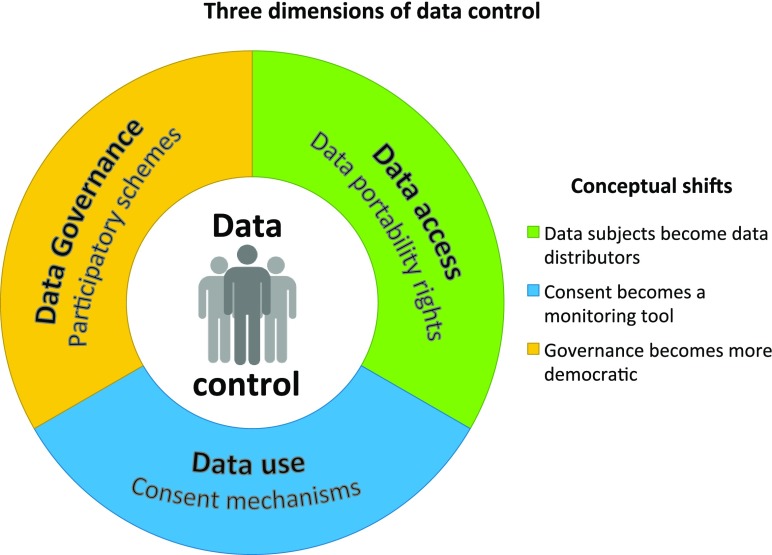
Empirical evidence suggests that while people hold the capacity to control their data in high regard, they increasingly experience a loss of control over their data in the online world. The capacity to exert control over the generation and flow of personal information is a fundamental premise to important values such as autonomy, privacy, and trust. In healthcare and clinical research this capacity is generally achieved indirectly, by agreeing to specific conditions of informational exposure. Such conditions can be openly stated in informed consent documents or be implicit in the norms of confidentiality that govern the relationships of patients and healthcare professionals. However, with medicine becoming a data-intense enterprise, informed consent and medical confidentiality, as mechanisms of control, are put under pressure. In this paper we explore emerging models of informational control in data-intense healthcare and clinical research, which can compensate for the limitations of currently available instruments. More specifically, we discuss three approaches that hold promise in increasing individual control: the emergence of data portability rights as means to control data access, new mechanisms of informed consent as tools to control data use, and finally, new participatory governance schemes that allow individuals to control their data through direct involvement in data governance. We conclude by suggesting that, despite the impression that biomedical big data diminish individual control, the synergistic effect of new data management models can in fact improve it.
Keywords: Big Data; Control; Ethics; Governance; Informed consent; Privacy.
References
-
- Allen AL. Privacy-as-data control: Conceptual, practical, and moral limits of the paradigm. Connecticut Law Review. 1999;32:861.
-
- Bennett SC. The right to be forgotten: Reconciling EU and US perspectives. Berkeley Journal of International Law. 2012;30:161.
MeSH terms
LinkOut - more resources
Full Text Sources
Other Literature Sources
