Review
. 2017 Dec;26(12):1341-1355.
doi: 10.1080/13543784.2017.1389895. Epub 2017 Oct 14.

Directing the use of DDR kinase inhibitors in cancer treatment

Affiliations
Review

Directing the use of DDR kinase inhibitors in cancer treatment

Inger Brandsma et al. Expert Opin Investig Drugs. 2017 Dec.

Abstract

Defects in the DNA damage response (DDR) drive the development of cancer by fostering DNA mutation but also provide cancer-specific vulnerabilities that can be exploited therapeutically. The recent approval of three different PARP inhibitors for the treatment of ovarian cancer provides the impetus for further developing targeted inhibitors of many of the kinases involved in the DDR, including inhibitors of ATR, ATM, CHEK1, CHEK2, DNAPK and WEE1. Areas covered: We summarise the current stage of development of these novel DDR kinase inhibitors, and describe which predictive biomarkers might be exploited to direct their clinical use. Expert opinion: Novel DDR inhibitors present promising candidates in cancer treatment and have the potential to elicit synthetic lethal effects. In order to fully exploit their potential and maximize their utility, identifying highly penetrant predictive biomarkers of single agent and combinatorial DDR inhibitor sensitivity are critical. Identifying the optimal drug combination regimens that could used with DDR inhibitors is also a key objective.

Keywords: Cancer; DNA damage response (DDR); cell cycle; kinase inhibitors; replication stress.


Figures
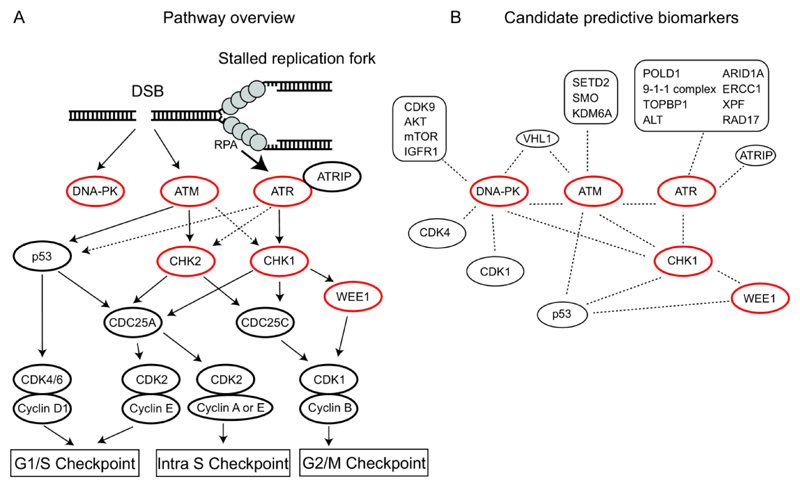
Figure 1
Figure 1. DDR pathway overview and candidate predictive biomarkers
A) Ataxia-telangiectasia mutated (ATM) is recruited to and activated at DNA Double Strand Breaks (DSBs). Once activated, ATM phosphorylates p53 and CHK2, resulting in a G1/S cell cycle arrest via CDC25A and Cyclin-CDK (Cyclin-dependent kinase) complexes. Ataxia-telangiectasia and Rad3-related (ATR) is activated at persistent stretches of single strand DNA (ssDNA) coated by Replication Protein A (RPA); such ssDNA stretches occur at sites of resection or stalled replication forks. ATR primarily activates CHK1. CHK1 can signal via CDC25A to activate the intra S checkpoint or via CDC25A and WEE1 to activate the G2/M checkpoint, depending on the phase of the cell cycle the damage is detected in. DNA dependent protein kinase (DNA-PK), activated at DSBs, does not play a role in the regulation of cell cycle progression after DNA damage. Kinases discussed in this review are highlighted in red. Dashed arrows indicate indirect regulation. B) Candidate predictive biomarkers for ATM, ATR, DNA-PK, CHK1 and WEE1 discussed in this review. ALT: Alternative lengthening of telomeres.
Figure 2
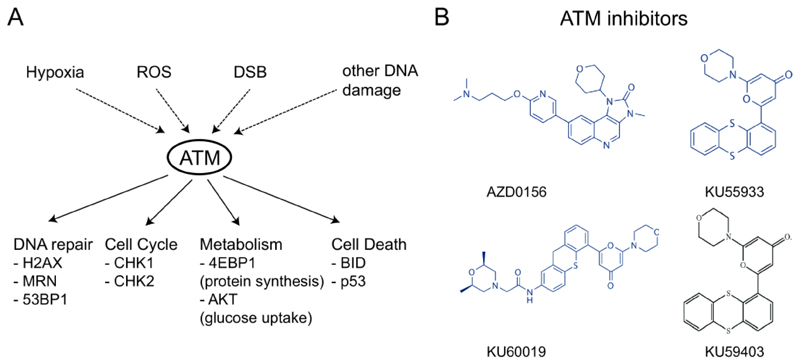
Figure 2. ATM function and ATM inhibitors.
A) ATM can be activated by hypoxia, reactive oxygen species (ROS), DNA double strand breaks (DSBs) or other types of DNA damage. Activated ATM phosphorylates multiple substrates and primary roles for ATM are illustrated, with key substrates indicated below. B) The structure of ATM inhibitors discussed in this review.
Figure 3
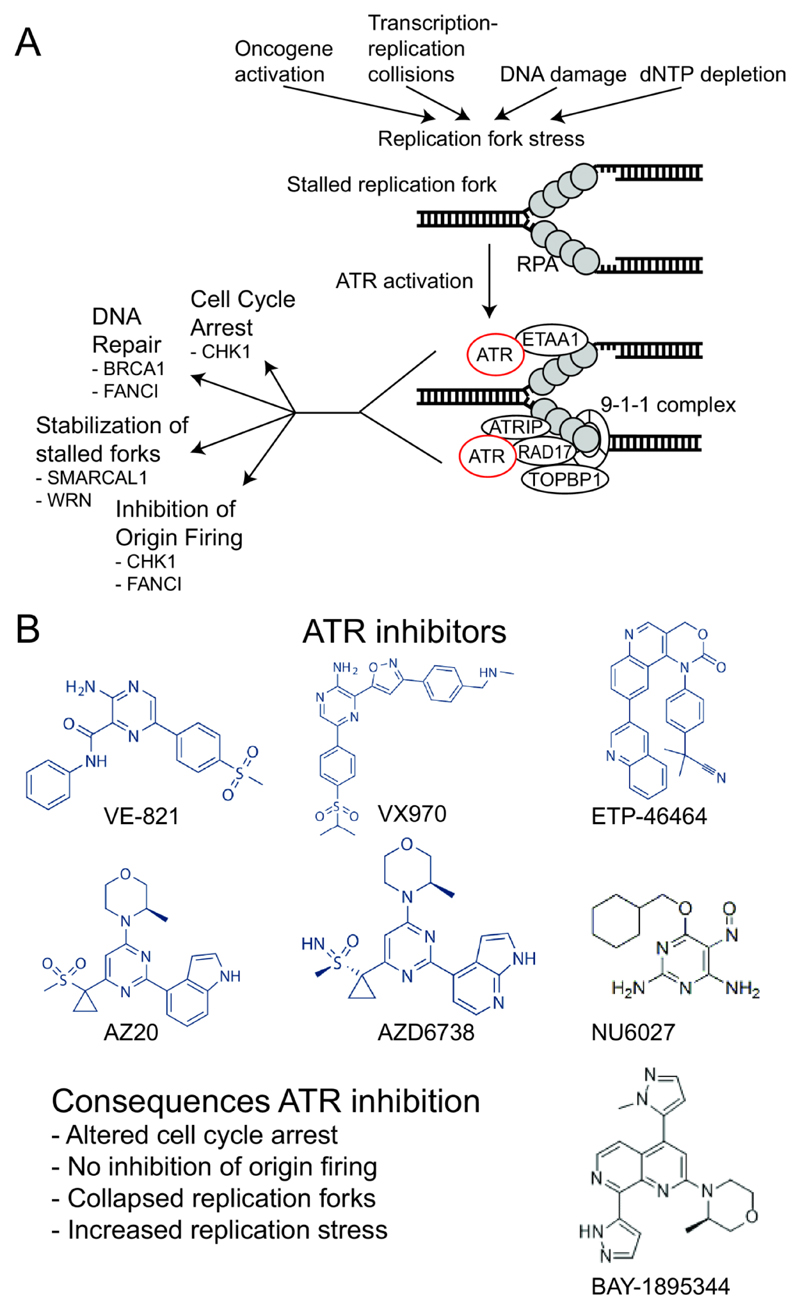
Figure 3. ATR function and ATR inhibitors.
A) Oncogene activation, collisions between the transcription and replication machinery, DNA damage and dNTP starvation are all causes of replication stress. A characteristic of replication stress is the presence of stalled replication forks. At these stalled forks the exposed ssDNA is covered by RPA. ATR interacting protein (ATRIP) binds to RPA coated ssDNA and recruits ATR to the site of ssDNA. RAD17, the Rad9–Rad1–Hus1 (9-1-1) complex and (DNA) topoisomerase II binding protein 1 (TOPBP1) are also recruited and all these proteins are required for ATR activation. ATR can also be activated via Ewing Tumour Associated Antigen 1 (ETAA1), which interacts directly with RPA coated ssDNA. Once activated, ATR can arrest the cell cycle via CHK1, initiate DNA repair, facilitate the stabilization of stalled forks and/or inhibit the firing of new origins to prevent further fork stalling. Below each function of ATR key substrates are shown. B) ATR inhibitors described in the main text are shown and the main consequences of ATR inhibition are listed.
Figure 4
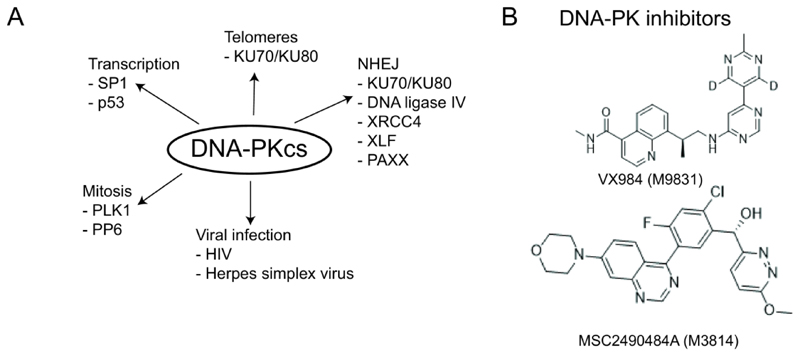
Figure 4. DNA-PKcs function and DNA-PK inhibitors.
A) DNA-PKcs primarily plays a role in non-homologous end joining (NHEJ). DNA-PKcs has also been shown to play a role in transcription via p53 and SP1. DNA-PKcs interacts with Polo-like kinase 1 (PLK1) and protein phosphatase 6 (PP6), both of which play a role in mitosis. Upon infection with Herpes Simplex virus, DNA-PKcs is degraded, while upon HIV infection, DNA-PKcs is activated to mediate p53-dependent apoptosis. DNA-PKcs is also required for telomere protection, together with KU70 and KU80. B) The structure of DNA-PK inhibitors discussed in the main text.

References

    1. Hoeijmakers JH. Genome maintenance mechanisms for preventing cancer. Nature. 2001;411:366–374. - PubMed
    1. Lord CJ, Ashworth A. The DNA damage response and cancer therapy. Nature. 2012;481:287–294. - PubMed
    1. Rundle S, Bradbury A, Drew Y, et al. Targeting the ATR-CHK1 Axis in Cancer Therapy. Cancers (Basel) 2017;9:41. - PMC - PubMed
    1. Otto T, Sicinski P. Cell cycle proteins as promising targets in cancer therapy. Nat Rev Cancer. 2017;17:93–115. - PMC - PubMed
    1. Shiloh Y, Ziv Y. The ATM protein kinase: regulating the cellular response to genotoxic stress, and more. Nat Rev Mol Cell Biol. 2013;14:197–210. - PubMed

MeSH terms