Review
. 2018 Jan;83(1-2):298-307.
doi: 10.1038/pr.2017.256. Epub 2017 Nov 22.

"Good things come in small packages": application of exosome-based therapeutics in neonatal lung injury

Affiliations
Review

"Good things come in small packages": application of exosome-based therapeutics in neonatal lung injury

Gareth R Willis et al. Pediatr Res. 2018 Jan.

Abstract

Infants born at very low gestational age contribute disproportionately to neonatal morbidity and mortality. Advancements in antenatal steroid therapies and surfactant replacement have favored the survival of infants with ever-more immature lungs. Despite such advances in medical care, cardiopulmonary and neurological impairment prevail in constituting the major adverse outcomes for neonatal intensive care unit survivors. With no single effective therapy for either the prevention or treatment of such neonatal disorders, the need for new tools to treat and reduce risk of further complications associated with extreme preterm birth is urgent. Mesenchymal stem/stromal cell (MSC)-based approaches have shown promise in numerous experimental models of lung injury relevant to neonatology. Recent studies have highlighted that the therapeutic potential of MSCs is harnessed in their secretome, and that the therapeutic vector therein is represented by the exosomes released by MSCs. In this review, we summarize the development and significance of stem cell-based therapies for neonatal diseases, focusing on preclinical models of neonatal lung injury. We emphasize the development of MSC exosome-based therapeutics and comment on the challenges in bringing these promising interventions to clinic.


Conflict of interest statement

Disclosure statement: The authors declare that the research was conducted in the absence of any commercial or financial relationships that could be construed as a potential conflict of interest.

Figures

Figure 1
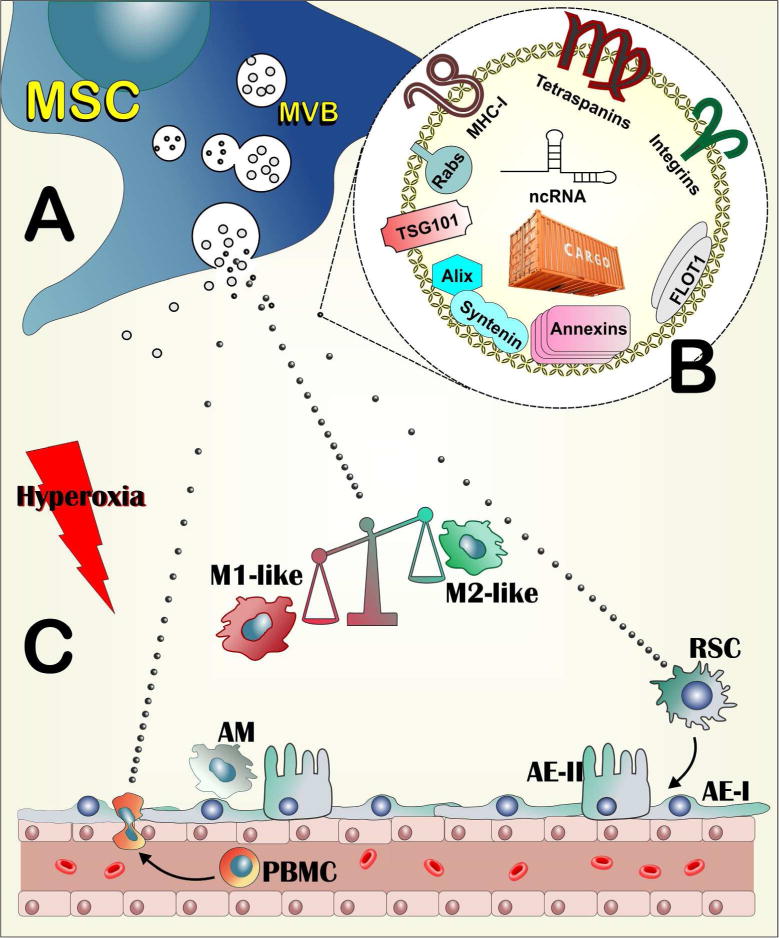
Figure 1. Schematic of postulated therapeutic action of MSC exosomes in hyperoxia-induced BPD
(A). MSCs routinely generate exosomes in multivesicular bodies (MVB) through the endocytic pathway. The majority of produced exosomes represent jettisoning of unwanted moieties by the cell and probably have no discernable function (larger grey symbols). Upon specific organismal or environmental cues, MSCs also produce a subpopulation of exosomes that harbor the therapeutic activity (small black symbols). (B). The therapeutic exosomes harbor cell surface components arguably involved in targeting recipient cells (Tetraspanins, Integrins) or immunomodulation, such as MHC-I. They also contain molecules associated with the pathways of their biogenesis, such as Rabs, TGS101, Alix Syntenin, Annexins and FLOT1. Their cargo includes small non-coding RNAs, but also macromolecular modules yet to be characterized. (C). The hyperoxic insult creates an inflammatory environment in the lung, which activates the alveolar macrophages (AM) and recruits circulating monocytes (PBMC) to the alveolar space. The main function of MSC exosomes is to induce a shift in macrophage polarization, tilting the balance from a destructive, M1-like inflammatory state to an anti-inflammatory, M2-like state. Additional actions of exogenously administered MSC exosomes could be the direct or indirect inhibition of PBMC recruitment to the injured lung and the direct or indirect enhancement of the activity of lung resident stem cells (RSC), leading to faster healing of injured tissue. AE-I and AE-II : Alveolar epithelial cells type I and type II respectively.

References

    1. Stoll BJ, Hansen NI, Bell EF, et al. Trends in care practices, morbidity, and mortality of extremely preterm neonates, 1993–2012. JAMA. 2015;314:1039–1051. - PMC - PubMed
    1. Manuck TA, Rice MM, Bailit JL, et al. Preterm neonatal morbidity and mortality by gestational age: A contemporary cohort. Am J Obstet Gynecol. 2016;215:103.e1–103.e14. - PMC - PubMed
    1. Fanaroff AA, Stoll BJ, Wright LL, et al. Trends in neonatal morbidity and mortality for very low birthweight infants. Am J Obstet Gynecol. 2007;196:147.e141–147.e148. - PubMed
    1. Zysman-Colman Z, Tremblay GM, Bandeali S, et al. Bronchopulmonary dysplasia – trends over three decades. Paediatr Child Health. 2013;18:86–90. - PMC - PubMed
    1. Baraldi E, Filippone M. Chronic lung disease after premature birth. N Engl J Med. 2007;357:1946–1955. - PubMed

Publication types

Substances