


Few Nuclear-Encoded Mitochondrial Gene Duplicates Contribute to Male Germline-Specific Functions in Humans
- PMID: 28985295
- PMCID: PMC5737092
- DOI: 10.1093/gbe/evx176
Few Nuclear-Encoded Mitochondrial Gene Duplicates Contribute to Male Germline-Specific Functions in Humans
Abstract
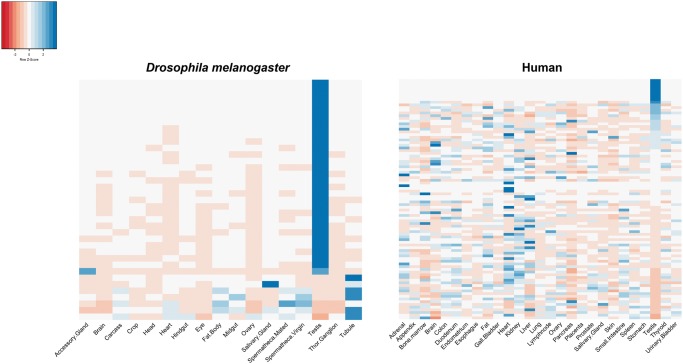
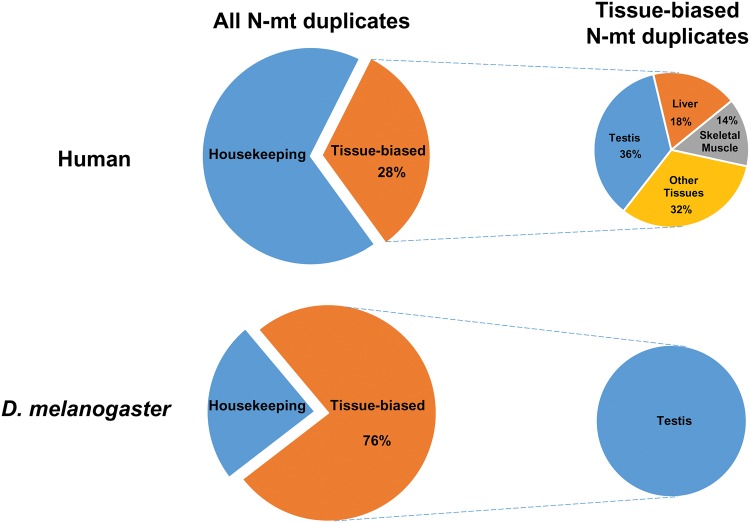
Most of the genes encoding proteins that function in the mitochondria are located in the nucleus and are called nuclear-encoded mitochondrial genes, or N-mt genes. In Drosophila melanogaster , about 23% of N-mt genes fall into gene families, and all duplicates with tissue-biased expression (76%) are testis biased. These genes are enriched for energy-related functions and tend to be older than other duplicated genes in the genome. These patterns reveal strong selection for the retention of new genes for male germline mitochondrial functions. The two main forces that are likely to drive changes in mitochondrial functions are maternal inheritance of mitochondria and male-male competition for fertilization. Both are common among animals, suggesting similar N-mt gene duplication patterns in different species. To test this, we analyzed N-mt genes in the human genome. We find that about 18% of human N-mt genes fall into gene families, but unlike in Drosophila , only 28% of the N-mt duplicates have tissue-biased expression and only 36% of these have testis-biased expression. In addition, human testis-biased duplicated genes are younger than other duplicated genes in the genome and have diverse functions. These contrasting patterns between species might reflect either differences in selective pressures for germline energy-related or other mitochondrial functions during spermatogenesis and fertilization, or differences in the response to similar pressures.
Keywords: gene duplication; human; male-biased expression; nuclear-encoded mitochondrial genes.
© The Author 2017. Published by Oxford University Press on behalf of the Society for Molecular Biology and Evolution.
Figures
References
-
- Al-Shahrour F, Díaz-Uriarte R, Dopazo J.. 2004. FatiGO: a web tool for finding significant associations of Gene Ontology terms with groups of genes. Bioinformatics 20(4):578–580. - PubMed
-
- Bar-Yaacov D, Blumberg A, Mishmar D.. 2012. Mitochondrial-nuclear co-evolution and its effects on OXPHOS activity and regulation. Biochim Biophys Acta 1819(9–10):1107–1111. - PubMed
-
- Berg OG, Kurland CG.. 2000. Why mitochondrial genes are most often found in nuclei. Mol Biol Evol. 17(6):951–961. - PubMed
Publication types
MeSH terms
Grants and funding
LinkOut - more resources
Full Text Sources
Other Literature Sources
Molecular Biology Databases
