


How entry inhibitors synergize to fight HIV
- PMID: 28986430
- PMCID: PMC5633111
- DOI: 10.1074/jbc.H117.791731
How entry inhibitors synergize to fight HIV
Abstract
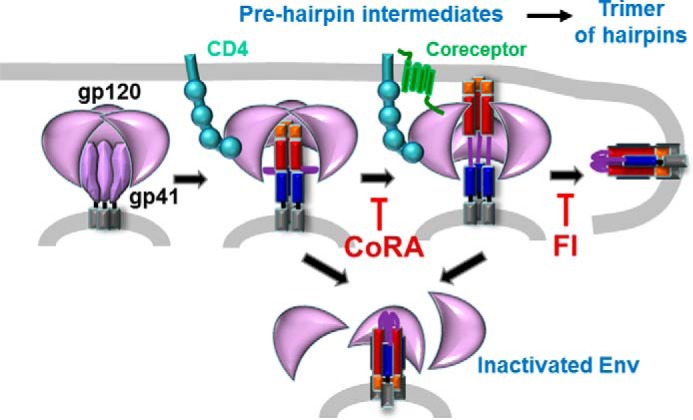
HIV fusion with the cell membrane can be inhibited by blocking coreceptor binding or by preventing fusion-inducing conformational changes in the Env protein. Logically, inhibitors that act by these two mechanisms should act synergistically, but previous studies have reported conflicting results. A new study by Ahn and Root reconciles these discordant reports by demonstrating that synergy emerges when Env engages multiple coreceptors prior to inducing fusion and when high-affinity inhibitory peptides are used, a condition that may not be satisfied in vivo.
© 2017 by The American Society for Biochemistry and Molecular Biology, Inc.
Conflict of interest statement
The author declares that he has no conflicts of interest with the contents of this article. The content is solely the responsibility of the author and does not necessarily represent the official views of the National Institutes of Health.
Figures
References
-
- Berger E. A., Doms R. W., Fenyö E. M., Korber B. T., Littman D. R., Moore J. P., Sattentau Q. J., Schuitemaker H., Sodroski J., and Weiss R. A. (1998) A new classification for HIV-1. Nature 391, 240. - PubMed
-
- Wilen C. B., Tilton J. C., and Doms R. W. (2012) Molecular mechanisms of HIV entry. Adv. Exp. Med. Biol. 726, 223–242 - PubMed
Publication types
MeSH terms
Substances
Grants and funding
LinkOut - more resources
Full Text Sources
Other Literature Sources
Medical
