


Baseline prevalence and longitudinal evolution of non-motor symptoms in early Parkinson's disease: the PPMI cohort
- PMID: 28986467
- PMCID: PMC5732865
- DOI: 10.1136/jnnp-2017-316213
Baseline prevalence and longitudinal evolution of non-motor symptoms in early Parkinson's disease: the PPMI cohort
Abstract
Objective: To examine the baseline prevalence and longitudinal evolution in non-motor symptoms (NMS) in a prospective cohort of, at baseline, patients with de novo Parkinson's disease (PD) compared with healthy controls (HC).
Methods: Parkinson's Progression Markers Initiative (PPMI) is a longitudinal, ongoing, controlled study of de novo PD participants and HC. NMS were rated using the Movement Disorder Society Unified Parkinson's Disease Rating Scale (MDS-UPDRS) Part I score and other validated NMS scales at baseline and after 2 years. Biological variables included cerebrospinal fluid (CSF) markers and dopamine transporter imaging.
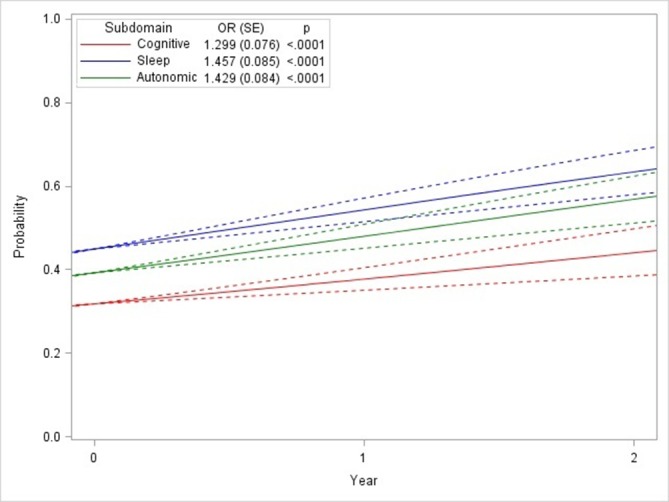
Results: 423 PD subjects and 196 HC were enrolled and followed for 2 years. MDS-UPDRS Part I total mean (SD) scores increased from baseline 5.6 (4.1) to 7.7 (5.0) at year 2 in PD subjects (p<0.001) versus from 2.9 (3.0) to 3.2 (3.0) in HC (p=0.38), with a significant difference between the groups (p<0.001). In the multivariate analysis, higher baseline NMS score was associated with female sex (p=0.008), higher baseline MDS-UPDRS Part II scores (p<0.001) and more severe motor phenotype (p=0.007). Longitudinal increase in NMS severity was associated with the older age (0.008) and lower CSF Aβ1-42 (0.005) at baseline. There was no association with the dose or class of dopaminergic therapy.
Conclusions: This study of NMS in early PD identified clinical and biological variables associated with both baseline burden and predictors of progression. The association of a greater longitudinal increase in NMS with lower baseline Aβ1-42 level is an important finding that will have to be replicated in other cohorts.
Trial registration: ClinicalTrials.gov identifier: NCT01141023.
Keywords: biomarkers; non-motor symptoms; parkinson’s disease.
© Article author(s) (or their employer(s) unless otherwise stated in the text of the article) 2018. All rights reserved. No commercial use is permitted unless otherwise expressly granted.
Conflict of interest statement
Competing interests: TS reports grants and non-financial support from Michael J Fox Foundation during the conduct of the study; personal fees from Acadia, Abbvie, Allergan, Anavex, Avid, GE Medical, Eli Lilly and Company, Harbor, Ibsen, IMPAX, Merz, Voyager, US World Meds, Pfizer and UCB; grants and personal fees from Lundbeck, National Parkinson’s Foundation, Navidea, Teva and Michael J Fox Foundation; grants from NINDS, Northwestern Foundation, NIH, Auspex, Biotie, Civitas, Acorda and Neuroderm, outside the submitted work. CC-G reports grants from The Michael J Fox Foundation, during the conduct of the study; grants and personal fees from Michael J Fox Foundation, outside the submitted work. CC reports grants from The Michael J Fox Foundation, during the conduct of the study; grants and personal fees from NIH/NINDS (NIH/NINDS, U01 NS077352, PI, 10/01/11-09/30/18 (2) NIH/NINDS, U01 NS077108, PI, 10/01/11-09/30/16(3) NIH/NHLBI, U01 HL091843, PI, 08/01/09-02/28/15(4) NIH/NHLBI, U01 NS038529, PI, 12/01/09-12/31/13 NIH/NINDS,(5) U01 NS079163, 08/05/2012-07/31/2015 (6) NIH/NINDS, U01 NS082329, 07/15/2013-06/30/2018 (7) NIH/NINDS, U01 NS084495, 09/15/2013-07/31/2018), personal fees from NIA, Rho Inc. and ZZ Biotech, outside the submitted work. DW reports grants from The Michael J Fox Foundation, during the conduct of the study; grants from Michael J Fox Foundation, NIH/NINDS, Dept. of Veterans Affairs, Avid Radiopharmaceuticals, Alzheimer’s Disease Cooperative Study, and International Parkinson’s Disease and Movement Disorder Society; grants and personal fees from Novartis; personal fees from AbbVie, Acadia, Biogen , Biotie (Acorda), Clintrex LLC, Eisai, Eli Lilly , Janssen, Merck, Pfizer, Takeda, Teva, UCB, CHDI Foundation, other from U Penn and Wolters Kluweland, outside the submitted work. Weintraub receives fees for legal consultation for lawsuits related to medication prescribing in patients with Parkinson’s disease. BM is employed by Parcacelsus Kliniken Germany and the University medical center Goettingen. BM reports grants and personal fees from Teva Pharma; grants from Desitin, Boehringer Ingelheim , GE Healthcare, BMBF, EU, Parkinson Fond Deutschland, Deutsche Parkinson Vereinigung and Stifterverband für die deutsche Wissenschaft; personal fees from Bayer Schering, Pharma AG, Roche, AbbVie, Glaxo Smith Kline, Orion Pharma and Michael J Fox Foundation; personal fees and scientific collaborations with Biogen; scientific collaborations with Roche, Bristol Myers Squibb, Eli Lilly and Covance, outside the submitted work. SL is employed by Molecular NeuroImaging, LLC. CMT is an employee of the San Francisco Veterans Affairs Medical Center and the University of California – San Francisco. CMT reports grants from Michael J Fox Foundation, during the conduct of the study; grants from Michael J Fox Foundation, Parkinson’s Disease Foundation, Dept. of Defence, Sage Bionetworks, NIH; personal fees from Biotie Therapeutics, Voyager Therapeutics, Neurocrine Biosciences, Adamas Pharmaceuticals , Intec Pharmaceuticals, outside the submitted work. DJ is an employee of Eli Lilly. KK reports personal fees from NIH/NIND, Acord, Astellas Pharma, AstraZeneca, Auspex, Biotie, Britannia, Cangene, CHDI, Civitas, Clearpoint Strategy Group, Clintrex, Cynapsus, INC Research, IntecIsis, Eli Lilly, Lundbeck, Medavante, Medivation , Melior Discovery , Neuroderm, Neurmedix, Omeros, Otsuka, Pfizer, Pharma2B, Prothena/Neotope/Elan Pharmaceutical, Raptor Pharmaceutical, Roche/Genentech, Sage Bionetworks, Stealth Peptides, Synagile, Teikoku Pharma, Titan, Turing Pharmaceuticals, Upsher-Smith, US WorldMeds, Vaccinex, Voyager and Westeon Brain Institut; grants from NIH, Micheal J Fox Foundation and Teva, outside the submitted work. LC reports grants from Michael J Fox Foundation, during the conduct of the study; grants from Michael J Fox Foundation, personal fees from Wolters Kluwel (for book authorship), outside the submitted work. KM reports grants from Michael J Fox Foundation, during the conduct of the study; personal fees from Pfizer, GE Healthcare, Merck, Lilly, BMS, Piramal, Prothena, Neurophage, nLife, Roche; grants from Michael J Fox Foundation, outside the submitted work; and ownership in Molecular NeuroImaging, LLC.
Figures
References
Publication types
MeSH terms
Substances
Associated data
Grants and funding
LinkOut - more resources
Full Text Sources
Other Literature Sources
Medical
Research Materials
Miscellaneous
