Review
. 2018 Mar;144(5):595-608.
doi: 10.1111/jnc.14234. Epub 2017 Nov 7.

Cerebral blood flow in normal aging adults: cardiovascular determinants, clinical implications, and aerobic fitness

Affiliations
Review

Cerebral blood flow in normal aging adults: cardiovascular determinants, clinical implications, and aerobic fitness

Takashi Tarumi et al. J Neurochem. 2018 Mar.

Abstract

Senescence is a leading cause of mortality, disability, and non-communicable chronic diseases in older adults. Mounting evidence indicates that the presence of cardiovascular disease and risk factors elevates the incidence of both vascular cognitive impairment and Alzheimer's disease (AD). Age-related declines in cardiovascular function may impair cerebral blood flow (CBF) regulation, leading to the disruption of neuronal micro-environmental homeostasis. The brain is the most metabolically active organ with limited intracellular energy storage and critically depends on CBF to sustain neuronal metabolism. In patients with AD, cerebral hypoperfusion, increased CBF pulsatility, and impaired blood pressure control during orthostatic stress have been reported, indicating exaggerated, age-related decline in both cerebro- and cardiovascular function. Currently, AD lacks effective treatments; therefore, the development of preventive strategy is urgently needed. Regular aerobic exercise improves cardiovascular function, which in turn may lead to a better CBF regulation, thus reducing the dementia risk. In this review, we discuss the effects of aging on cardiovascular regulation of CBF and provide new insights into the vascular mechanisms of cognitive impairment and potential effects of aerobic exercise training on CBF regulation. This article is part of the Special Issue "Vascular Dementia".

Keywords: cardiovascular function; cerebral autoregulation; cerebral blood flow; cerebral vasomotor reactivity; pulsatility.


Conflict of interest statement

Conflict of Interest/Disclosure: None

Figures

Figure 1
Figure 1
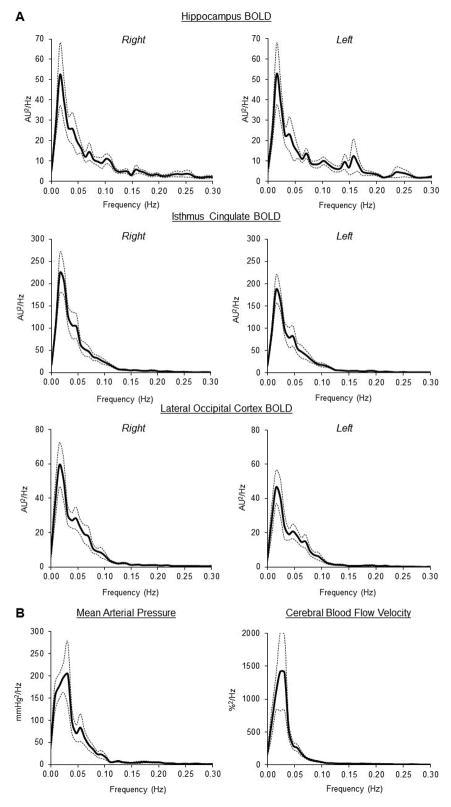
(A) Power spectra of regional BOLD signals measured by functional MRI. (B) Power spectra of beat-by-beat mean arterial pressure and cerebral blood flow velocity recorded from the same study participants (n=12). Cerebral blood flow velocity was measured from the middle cerebral artery. Solid line: mean. Dotted lines: standard error. AU=arbitrary unit and BOLD=blood-oxygen-level dependent. [Adapted from Zhu DC, Tarumi T, Khan MA, Zhang R. Vascular Coupling in Resting-State fMRI: Evidence from Multiple Modalities. J Cereb Blood Flow Metab. 2015 Dec;35 (12):1910–20. Copyright © 2015 SAGE Publications]
Figure 2
Figure 2
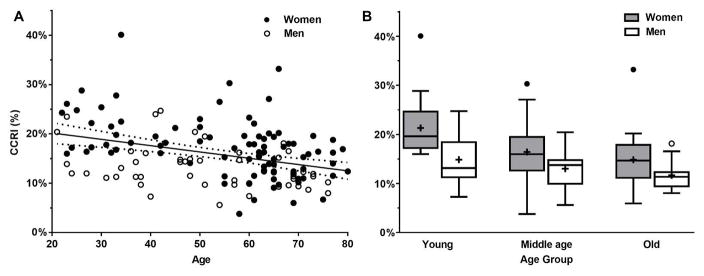
Association between age and the proportion of cardiac output distributed to the brain (n=139). The CCRI represents the cerebral blood flow to cardiac output ratio index. Panel A shows the linear decline of CCRI with increasing age (CCRI=−0.127%×age+22.72% with R2=0.13, P<0.001). Panel B shows the association between age and CCRI in men and women separately (P<0.001 for age group, P<0.001 for sex, and P=0.26 for age and sex interaction). Young=21–45 years; middle age=45–65 years; and old=66–80 years. Error bars represent standard deviation. [Reprinted from Xing CY, Tarumi T, Liu J, Zhang Y, Turner M, Riley J, Tinajero CD, Yuan LJ, Zhang R. Distribution of Cardiac Output to the Brain across the Adult Lifespan. J Cereb Blood Flow Metab. 2016 Jan 1 (doi: 10.1177/0271678X16676826). Copyright © 2016 SAGE Publications]
Figure 3
Figure 3
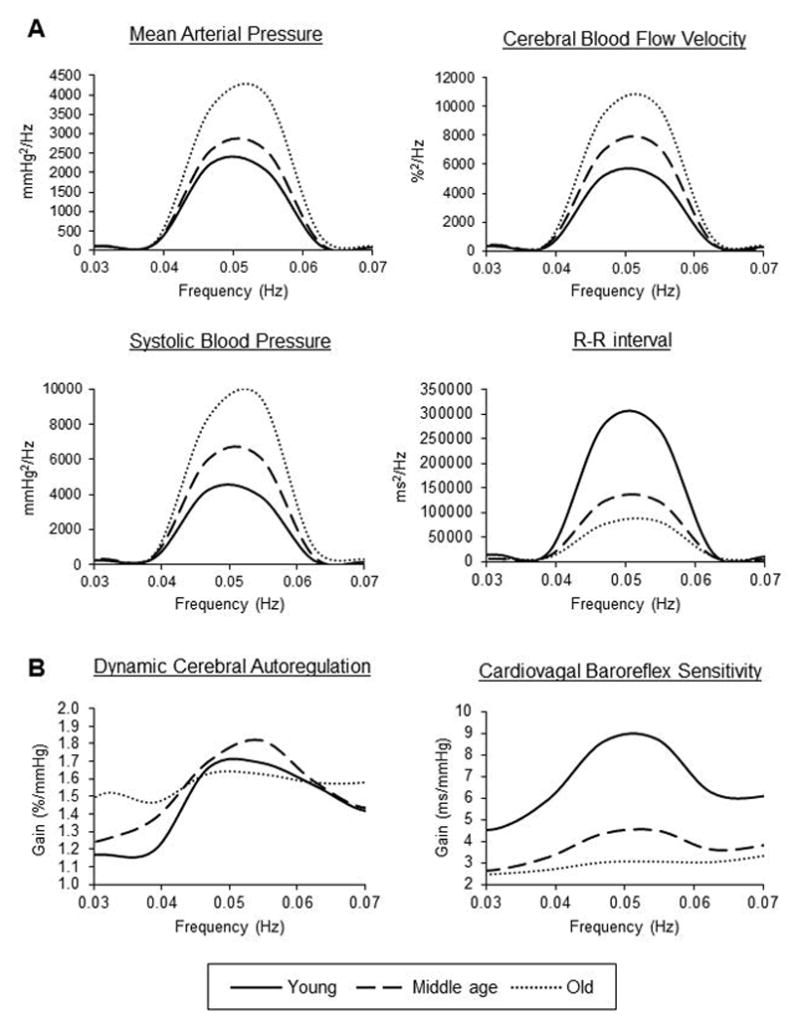
Age-related differences in (A) power spectra of cardio- and cerebrovascular hemodynamics and (B) transfer function gain of dynamic cerebral autoregulation and cardiovagal baroreflex sensitivity. All variables were recorded during repeated sit-stand maneuvers performed at 0.05 Hz. CBF velocity was recorded from the middle cerebral artery and normalized to the mean value before analysis. Young=21–44 years (n=41); middle age=45–64 years (n=50); and old=65–80 years (n=45). Group-averaged means are presented. [Adapted from Xing CY, Tarumi T, Meijers RL, Turner M, Repshas J, Xiong L, Ding K, Vongpatanasin W, Yuan LJ, Zhang R. Arterial Pressure, Heart Rate, and Cerebral Hemodynamics Across the Adult Life Span. Hypertension. 2017 Apr;69 (4):712–720. Copyright © 2017 Lippincott Williams & Wilkins. Used with permission]
Figure 4
Figure 4
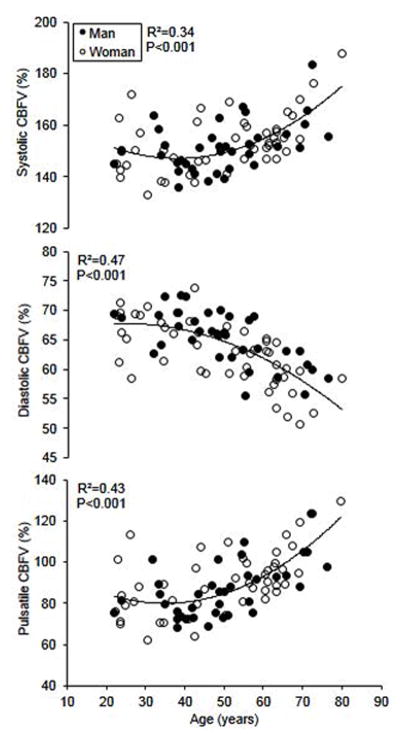
Association between age and pulsatile indices of cerebral blood flow (CBF) (n=83). The CBF pulsatile indices were calculated by normalizing the absolute systolic, diastolic, and pulsatile CBF velocity to the mean value and expressed in percentage. CBF velocity was recorded from the middle cerebral artery. [Reprinted from Tarumi T, Ayaz Khan M, Liu J, Tseng BY, Parker R, Riley J, Tinajero C, Zhang R. Cerebral Hemodynamics in Normal Aging: Central Artery Stiffness, Wave Reflection, and Pressure Pulsatility. J Cereb Blood Flow Metab. 2014 Jun;34 (6):971–8. Copyright © 2015 SAGE Publications]
Figure 5
Figure 5
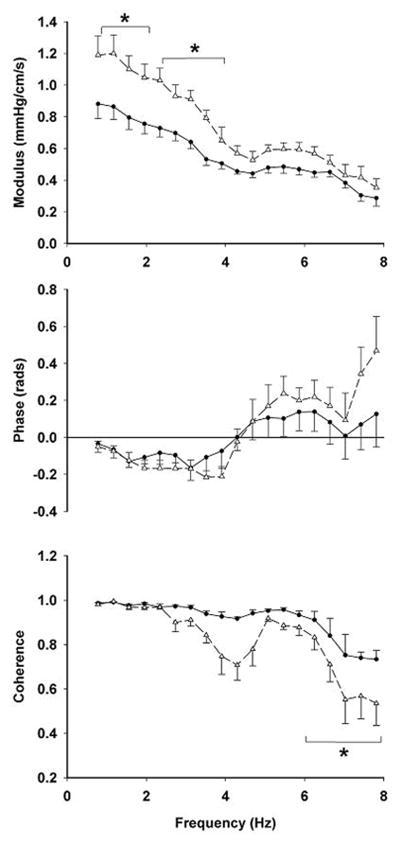
Comparison of cerebrovascular impedance between young (circle with solid line, n=6) and older (triangle with dashed line, n=9) adults. The modulus, phase, and coherence of cerebrovascular impedance were calculated by transfer function analysis of carotid blood pressure and cerebral blood flow velocity that were recorded simultaneously. cerebral blood flow velocity was recorded from the middle cerebral artery. *P<0.05 vs. young group. Error bars represent standard error. [Reprinted from Zhu YS, Tseng BY, Shibata S, Levine BD, Zhang R. Increases in cerebrovascular impedance in older adults. J Appl Physiol. 2011 Aug;111 (2):376–81. Copyright © 2011 American Physiological Society]
Figure 6
Figure 6
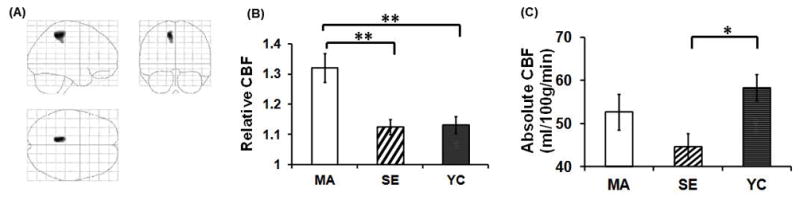
Comparison of cerebral blood flow (CBF) among endurance Masters Athletes (MA, n=10), sedentary elderly adults (SE, n=10), and young control subjects (YC, n=9). (A) Brain regions showing greater CBF in MA compared with SE (P<0.005, cluster size=250). These voxels are located in the posterior cingulate cortex and precuneus. (B) Relative CBF (normalized against whole-brain value) in the cluster highlighted in (A). (C) Absolute CBF in the cluster highlighted in (A). CBF was measured by arterial spin labeling using MRI. *P<0.05, **P<0.005. Error bars represent standard error. [Reprinted from Thomas BP, Yezhuvath US, Tseng BY, Liu P, Levine BD, Zhang R, Lu H. Life-long aerobic exercise preserved baseline cerebral blood flow but reduced vascular reactivity to CO2. J Magn Reson Imaging. 2013; 38(5): 1177–83. Copyright © 2013 Wiley Online Library. Used with permission.]
Figure 7
Figure 7
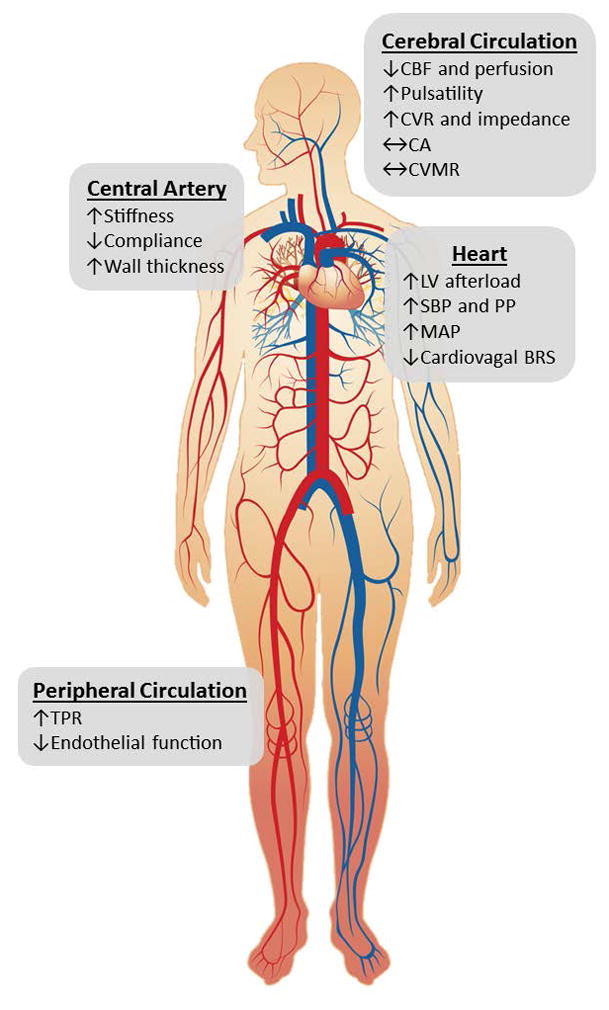
A summary schematic illustrating the effect of normal aging on cerebral and cardiovascular circulation. BRS=baroreflex sensitivity, CA=cerebral autoregulation, CBF=cerebral blood flow, CVR=cerebrovascular resistance, CVMR=cerebral vasomotor reactivity, LV=left ventricular, MAP=mean arterial pressure, PP=pulse pressure, SBP=systolic blood pressure, and TPR=total peripheral resistance

References

    1. Aaslid R, Lindegaard KF, Sorteberg W, Nornes H. Cerebral autoregulation dynamics in humans. Stroke. 1989;20:45–52. - PubMed
    1. Aengevaeren VL, Claassen JA, Levine BD, Zhang R. Cardiac baroreflex function and dynamic cerebral autoregulation in elderly Masters athletes. J Appl Physiol (1985) 2013;114:195–202. - PubMed
    1. Alfini AJ, Weiss LR, Leitner BP, Smith TJ, Hagberg JM, Smith JC. Hippocampal and Cerebral Blood Flow after Exercise Cessation in Master Athletes. Front Aging Neurosci. 2016;8:184. - PMC - PubMed
    1. Attwell D, Buchan AM, Charpak S, Lauritzen M, Macvicar BA, Newman EA. Glial and neuronal control of brain blood flow. Nature. 2010;468:232–243. - PMC - PubMed
    1. Barnes JN, Schmidt JE, Nicholson WT, Joyner MJ. Cyclooxygenase inhibition abolishes age-related differences in cerebral vasodilator responses to hypercapnia. J Appl Physiol (1985) 2012;112:1884–1890. - PMC - PubMed

Publication types