


Heated air humidification versus cold air nebulization in newly tracheostomized patients
- PMID: 28990261
- PMCID: PMC5698730
- DOI: 10.1002/hed.24917
Heated air humidification versus cold air nebulization in newly tracheostomized patients
Abstract
Background: After tracheostomy, the airway lacks an essential mechanism for warming and humidifying the inspired air with the consequent functional impairment and discomfort. The purpose of this study was to compare airway hydration with cold-air nebulization versus heated high-flow humidification on medical interventions and tracheal ciliary beat frequency (CBF).
Methods: Newly tracheostomized patients (n = 20) were treated either with cold-air nebulization or heated humidification. The number of required tracheal suctioning procedures to clean the trachea and tracheal CBF were assessed.
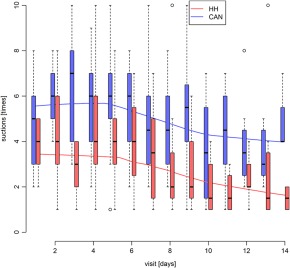
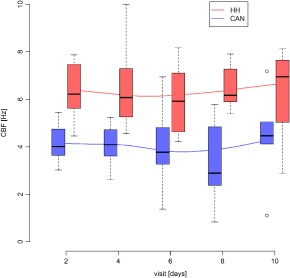
Results: The number of required suctions per day was significantly lower in the heated humidification group with medians 3 versus 5 times per day. Mean CBF was significantly higher in the heated humidification group (6.36 ± 1.49 Hz) compared to the cold-air nebulization group (3.99 ± 1.39 Hz).
Conclusion: The data suggest that heated humidification enhanced mucociliary transport leading to a reduced number of required suctioning procedures in the trachea, which may improve postoperative patient care.
Keywords: humidification; nurse care; tracheostomy; tracheostomy care ciliary beat frequency (CBF).
© 2017 The Authors Head & Neck Published by Wiley Periodicals, Inc.
Figures
References
-
- Rankin N. What is optimum humidity? Respir Care Clin N Am. 1998;4(2):321‐328. - PubMed
-
- Sahin‐Yilmaz A, Naclerio RM. Anatomy and physiology of the upper airway. Proc Am Thorac Soc. 2011;8(1):31‐39. - PubMed
-
- Heffner JE, Hess D. Tracheostomy management in the chronically ventilated patient. Clin Chest Med. 2001;22(1):55‐69. - PubMed
-
- Jorissen M, Bessems A. Influence of culture duration and ciliogenesis on the relationship between ciliary beat frequency and temperature in nasal epithelial cells. Eur Arch Otorhinolaryngol. 1995;252(8):451‐454. - PubMed
Publication types
MeSH terms
LinkOut - more resources
Full Text Sources
Other Literature Sources
Medical
