Framework for Evaluating the Health Impact of the Scale-Up of Malaria Control Interventions on All-Cause Child Mortality in Sub-Saharan Africa
- PMID: 28990923
- PMCID: PMC5619929
- DOI: 10.4269/ajtmh.15-0363
Framework for Evaluating the Health Impact of the Scale-Up of Malaria Control Interventions on All-Cause Child Mortality in Sub-Saharan Africa
Abstract
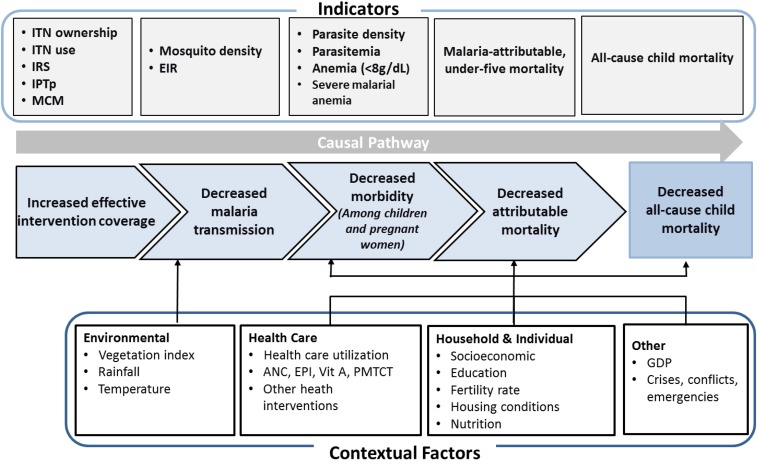
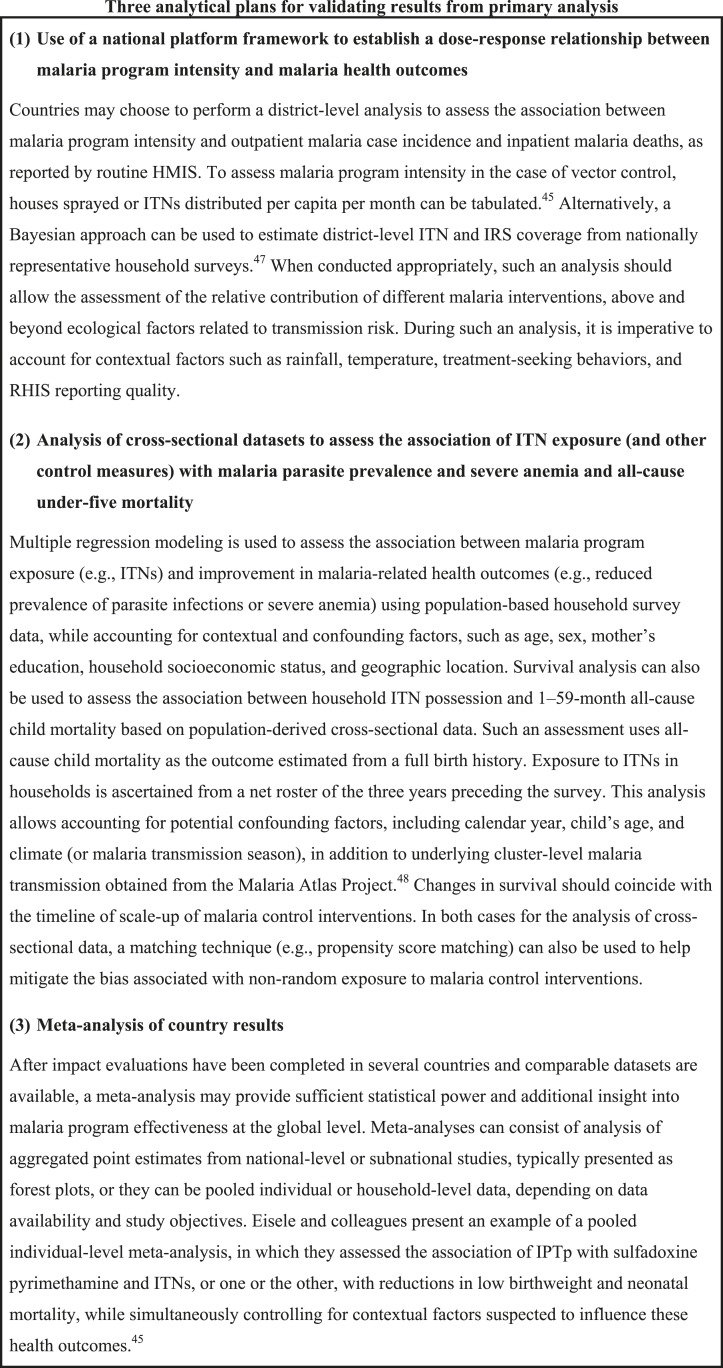
Concerted efforts from national and international partners have scaled up malaria control interventions, including insecticide-treated nets, indoor residual spraying, diagnostics, prompt and effective treatment of malaria cases, and intermittent preventive treatment during pregnancy in sub-Saharan Africa (SSA). This scale-up warrants an assessment of its health impact to guide future efforts and investments; however, measuring malaria-specific mortality and the overall impact of malaria control interventions remains challenging. In 2007, Roll Back Malaria's Monitoring and Evaluation Reference Group proposed a theoretical framework for evaluating the impact of full-coverage malaria control interventions on morbidity and mortality in high-burden SSA countries. Recently, several evaluations have contributed new ideas and lessons to strengthen this plausibility design. This paper harnesses that new evaluation experience to expand the framework, with additional features, such as stratification, to examine subgroups most likely to experience improvement if control programs are working; the use of a national platform framework; and analysis of complete birth histories from national household surveys. The refined framework has shown that, despite persisting data challenges, combining multiple sources of data, considering potential contributions from both fundamental and proximate contextual factors, and conducting subnational analyses allows identification of the plausible contributions of malaria control interventions on malaria morbidity and mortality.
Figures
References
-
- WHO, 2014. World Malaria Report. Geneva, Switzerland: World Health Organization.
-
- Division of Malaria Control, Ministry of Health, Republic of Kenya, National Malaria Strategy 2001–2010, April 2001, Nairobi, Kenya.
-
- Programme National de Lutte contre le Paludisme, Ministère de la Santé Publique, 2012. Le plan stratégique de lutte contre le paludisme Madagascar 2013–2017. Antananarivo, Madagascar.
-
- Craig P, Dieppe P, Macintyre S, Michi S, Nazareth I, Petticrew M, 2008. Developing and evaluating complex interventions: new guidance. Medical Research Council Available at: http://www.mrc.ac.uk/documents/pdf/complex-interventions-guidance. Accessed April 23, 2015.
-
- Khandker RS, Koolwal GB, Samad HA, 2010. Handbook on Impact Evaluation: Quantitative Methods and Practices (World Bank Training Series). Washington, DC: The International Bank for Reconstruction and Development, The World Bank. eISBN: 978-0-8213-8029-1.
MeSH terms
Substances
Grants and funding
LinkOut - more resources
Full Text Sources
Other Literature Sources
Medical
Research Materials