Review
. 2018 Feb 1;37(5):566-577.
doi: 10.1038/onc.2017.374. Epub 2017 Oct 9.

DNA methylation aberrancies delineate clinically distinct subsets of colorectal cancer and provide novel targets for epigenetic therapies

Affiliations
Review

DNA methylation aberrancies delineate clinically distinct subsets of colorectal cancer and provide novel targets for epigenetic therapies

D J Weisenberger et al. Oncogene. .

Abstract

Colorectal cancer (CRC) is a worldwide health concern with respect to both incidence and mortality, and as a result, CRC tumorigenesis, progression and metastasis have been heavily studied, especially with respect to identifying genetic, epigenetic, transcriptomic and proteomic profiles of disease. DNA methylation alterations are hallmarks of CRC, and epigenetic driver genes have been identified that are thought to be involved in early stages of tumorigenesis. Moreover, distinct CRC patient subgroups are organized based on DNA methylation profiles. CRC tumors displaying CpG island methylator phenotypes (CIMPs), defined as DNA hypermethylation at specific CpG islands in subsets of tumors, show high concordance with specific genetic alterations, disease risk factors and patient outcome. This review details the DNA methylation alterations in CRC, the significance of CIMP status, the development of treatments based on specific molecular profiles and the application of epigenetic therapies for CRC patient treatment.


Conflict of interest statement

CONFLICT OF INTEREST

DJW is a consultant for Zymo Research Corporation. Zymo did not contribute to this report, nor has an interest in this research.

Figures
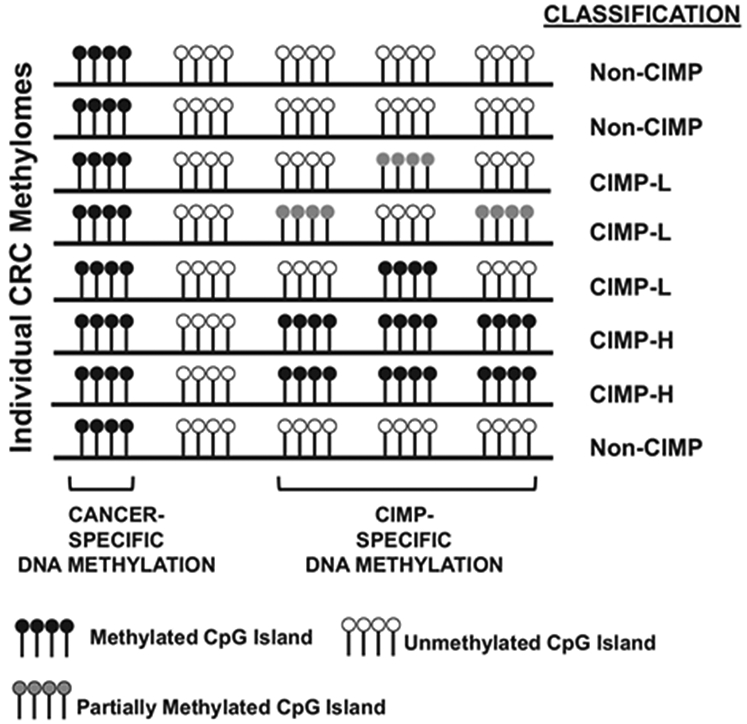
Figure 1.
Figure 1.
Description of CIMP-H, CIMP-L and non-CIMP CpG island DNA methylation in CRCs. Each row represents a CRC methylome, and lollipop clusters indicate CpG islands. Black lollipops indicate methylated CpG islands, white lollipops indicate unmethylated CpG islands and gray lollipops indicate partially methylated CpG islands. Classification of each methylome as CIMP-H, CIMP-L or non-CIMP are indicated to the right of each methylome. Tumor and CIMP-specific DNA methylation profiles are indicated in the figure.
Figure 2.
Figure 2.
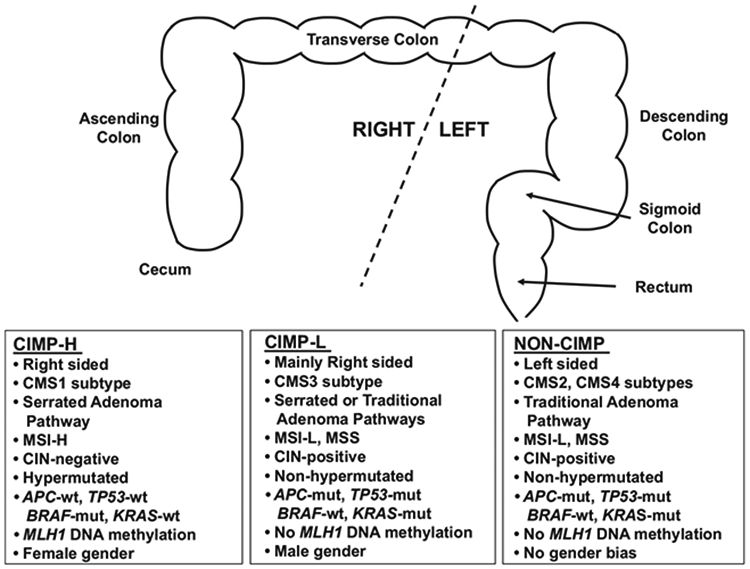
Description of CIMP-H, CIMP-L and non-CIMP tumors. Top section, graphic representation of the colorectum, stratified by location as left or right sides. Bottom section, correlations of each CIMP subgroup with location, CMS subtype, adenoma pathway, mutation status, MLH1 DNA methylation status and gender bias.
Figure 3.
Figure 3.
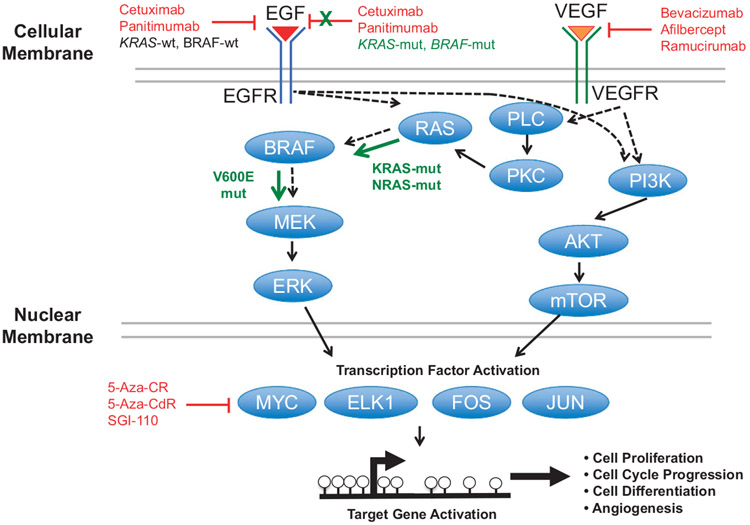
EGFR and VEGFR signaling in CRCs. Protein signaling from EGF and VEGF binding to their respective receptors. Black arrows indicate traditional signaling, whereas green arrows indicate constitutive signaling. Red indicates inhibition of specific aspects of the pathways.
Figure 4.
Figure 4.
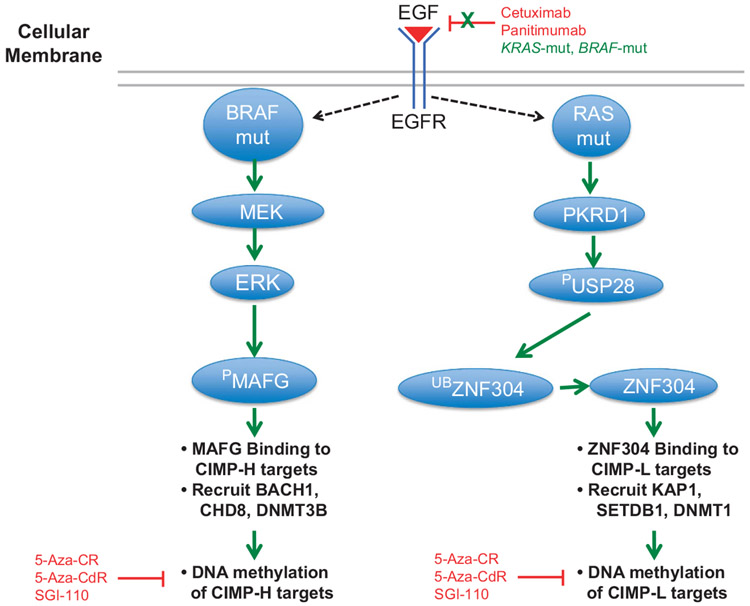
Effects of KRAS-mut and BRAF-mut on EGFR signaling. Models are based on previously described reports., Left panel: BRAF-mut constitutively activates MEK and ERK signaling. The ERK enzyme phosphorylates MAFG, stabilizing the protein and allowing MAFG to bind to CIMP-H target regions. MAFG recruits BACH1 and CHD8 co-repressors, as well as DNMT3B to place DNA methylation marks at CIMP-H loci. Right panel: KRAS-mut activates PKRD1, which phosphorylates USP28 (PUSP28), thereby activating the protein. PUSP28 removes ubiquitin moieties from ZNF304, thus allowing ZNF304 to bind to CIMP-L-defining loci. ZNF304 binding recruits KAP1, SETDB1 co-repressors, as well as DNMT1, which is thought to methylate CIMP-L loci. Black arrows indicate traditional signaling, whereas green arrows indicate constitutive signaling. Red indicates inhibition of specific aspects of the pathways.
Figure 5.
Figure 5.
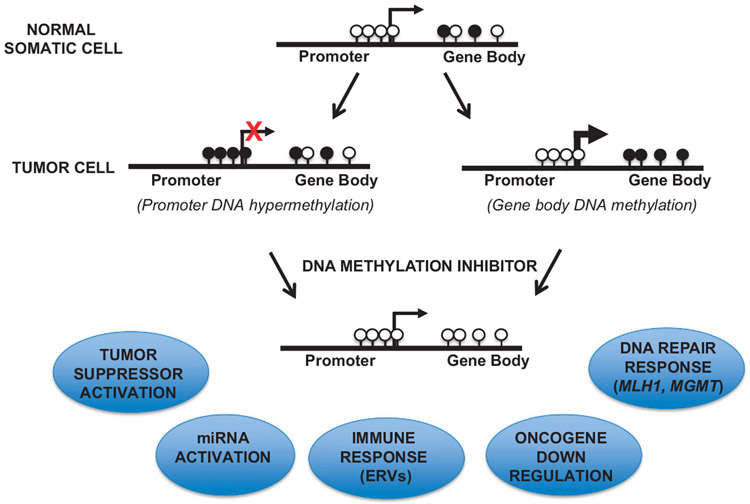
Potential efficacy of DNA methylation inhibition for CRC therapy. Top, promoter and gene body DNA methylation in normal somatic cells. Black lollipops indicate methylated CpG islands, white lollipops indicate unmethylated CpG islands. Middle, promoter (left) or gene body (right) DNA hypermethylation in human cancers. Bottom, promoter DNA hypermethylation may correlate with gene silencing, whereas gene body DNA methylation is associated with actively expressed genes. Treatment with DNA methylation inhibitors results in demethylation of gene promoters and gene body regions, resulting in activation of tumor suppressors, DNA repair response, miRNAs and ERVs, with suppression of oncogenes.

References

    1. Torre LA, Bray F, Siegel RL, Ferlay J, Lortet-Tieulent J, Jemal A. Global cancer statistics, 2012. CA Cancer J Clin 2015; 65: 87–108. - PubMed
    1. Heinemann V, Stintzing S. FOLFIRI with cetuximab or bevacizumab: FIRE-3-authors' reply. Lancet Oncol 2014; 15: e583–584. - PubMed
    1. Loupakis F, Cremolini C, Masi G, Lonardi S, Zagonel V, Salvatore L et al. Initial therapy with FOLFOXIRI and bevacizumab for metastatic colorectal cancer. N Engl J Med 2014; 371: 1609–1618. - PubMed
    1. Lynch HT, Snyder CL, Shaw TG, Heinen CD, Hitchins MP. Milestones of Lynch syndrome: 1895-2015. Nat Rev Cancer 2015; 15: 181–194. - PubMed
    1. Fearon ER, Vogelstein B. A genetic model for colorectal tumorigenesis. Cell 1990; 61: 759–767. - PubMed

Publication types

MeSH terms