


Pediatric Sepsis Endotypes Among Adults With Sepsis
- PMID: 28991828
- PMCID: PMC5693699
- DOI: 10.1097/CCM.0000000000002733
Pediatric Sepsis Endotypes Among Adults With Sepsis
Abstract
Objectives: Recent transcriptomic studies describe two subgroups of adults with sepsis differentiated by a sepsis response signature. The implied biology and related clinical associations are comparable with recently reported pediatric sepsis endotypes, labeled "A" and "B." We classified adults with sepsis using the pediatric endotyping strategy and the sepsis response signature and determined how endotype assignment, sepsis response signature membership, and age interact with respect to mortality.
Design: Retrospective analysis of publically available transcriptomic data representing critically ill adults with sepsis from which the sepsis response signature groups were derived and validated.
Setting: Multiple ICUs.
Patients: Adults with sepsis.
Interventions: None.
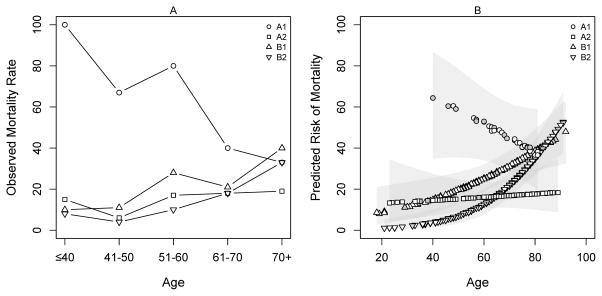
Measurements and main results: Transcriptomic data were conormalized into a single dataset yielding 549 unique cases with sepsis response signature assignments. Each subject was assigned to endotype A or B using the expression data for the 100 endotyping genes. There were 163 subjects (30%) assigned to endotype A and 386 to endotype B. There was a weak, positive correlation between endotype assignment and sepsis response signature membership. Mortality rates were similar between patients assigned endotype A and those assigned endotype B. A multivariable logistic regression model fit to endotype assignment, sepsis response signature membership, age, and the respective two-way interactions revealed that endotype A, sepsis response signature 1 membership, older age, and the interactions between them were associated with mortality. Subjects coassigned to endotype A, and sepsis response signature 1 had the highest mortality.
Conclusions: Combining the pediatric endotyping strategy with sepsis response signature membership might provide complementary, age-dependent, biological, and prognostic information.
Figures
References
MeSH terms
Grants and funding
LinkOut - more resources
Full Text Sources
Other Literature Sources
Medical
