


Does Kidney Donor Risk Index implementation lead to the transplantation of more and higher-quality donor kidneys?
- PMID: 28992075
- PMCID: PMC5837419
- DOI: 10.1093/ndt/gfx257
Does Kidney Donor Risk Index implementation lead to the transplantation of more and higher-quality donor kidneys?
Abstract
Background: The Kidney Donor Risk Index (KDRI) is a quantitative evaluation of the quality of donor organs and is implemented in the US allocation system. This single-centre study investigates whether the implementation of the KDRI in our decision-making process to accept or decline an offered deceased donor kidney, increases our acceptance rate.
Methods: From April 2015 until December 2016, we prospectively calculated the KDRI for all deceased donor kidney offers allocated by Eurotransplant to our centre. The number of the transplanted versus declined kidney offers during the study period were compared to a historical set of donor kidney offers.
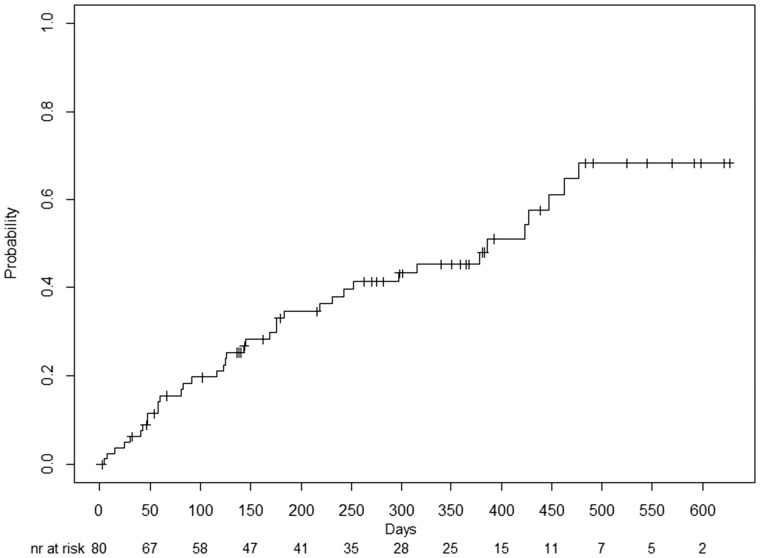
Results: After implementation of the KDRI, 26.1% (75/288) of all offered donor kidneys were transplanted, compared with 20.7% (136/657) in the previous period (P < 0.001). The median KDRI of all transplanted donor kidneys during the second period was 0.97 [Kidney Donor Profile Index (KDPI) 47%], a value significantly higher than the median KDRI of 0.85 (KDPI 34%) during the first period (P = 0.047). A total of 68% of patients for whom a first-offered donor kidney was declined during this period were transplanted after a median waiting time of 386 days, mostly with a lower KDRI donor kidney.
Conclusions: Implementing the KDRI in our decision-making process increased the transplantation rate by 26%. The KDRI can be a supportive tool when considering whether to accept or decline a deceased donor kidney offer. More data are needed to validate this score in other European centres.
Keywords: Kidney Donor Profile Index (KDPI); Kidney Donor Risk Index (KDRI); graft survival; kidney transplantation.
© The Author 2017. Published by Oxford University Press on behalf of ERA-EDTA.
Figures
References
-
- Wolfe RA, Ashby VB, Milford EL. et al. Comparison of mortality in all patients on dialysis, all patients on dialysis awaiting transplantation, and recipients of a first cadaveric transplant. N Engl J Med 1999; 341: 1725–1730 - PubMed
-
- Port FK, Bragg-Gresham JL, Metzger RA. et al. Donor characteristics associated with reduced graft survival: an approach to expanding the pool of kidney donors. Transplantation 2002; 74: 1281–1286 - PubMed
-
- Rao PS, Schaubel DE, Guidinger MK. et al. A comprehensive risk quantification score for deceased donor kidneys: the kidney donor risk index. Transplantation 2009; 88: 231–236 - PubMed
-
- Online KDRI calculator of the OPTN. https://optn.transplant.hrsa.gov/resources/allocation-calculators/kdpi-c...
MeSH terms
LinkOut - more resources
Full Text Sources
Other Literature Sources
Medical
Miscellaneous
