


Blood Pressure and Arterial Stiffness in Kenyan Adolescents With the Sickle Cell Trait
- PMID: 28992220
- PMCID: PMC5860135
- DOI: 10.1093/aje/kwx232
Blood Pressure and Arterial Stiffness in Kenyan Adolescents With the Sickle Cell Trait
Abstract
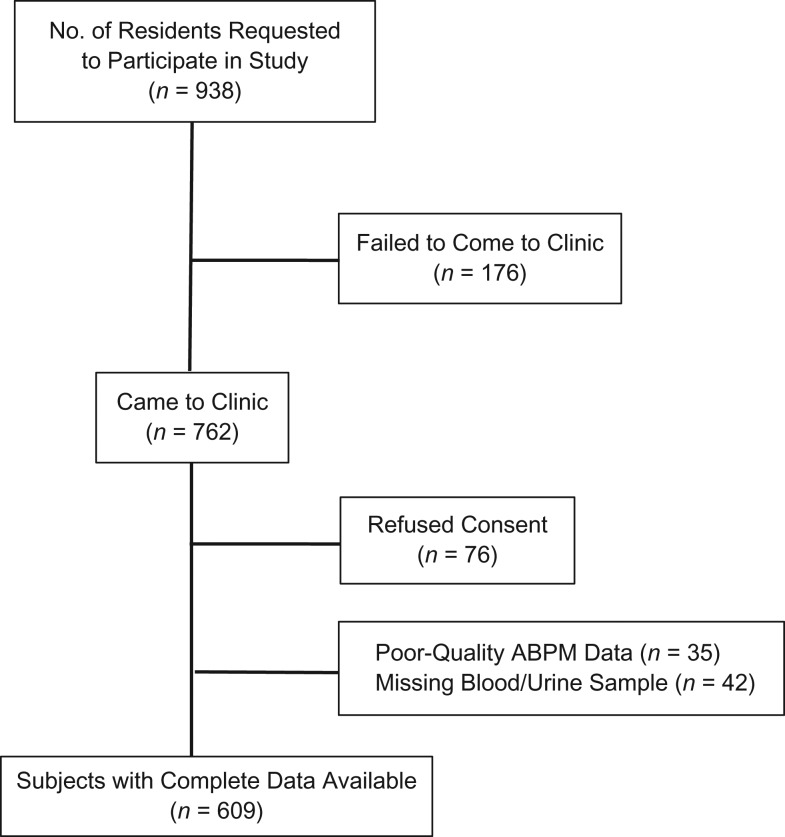
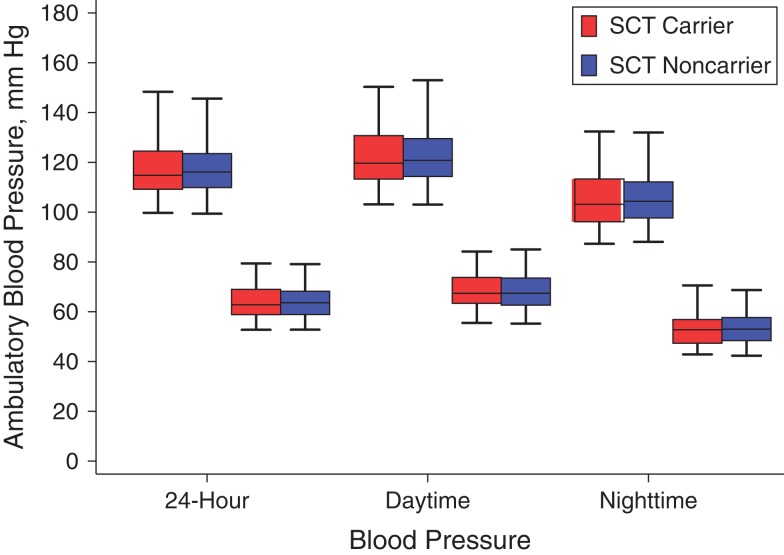
The potential association between sickle cell trait (SCT) and increased arterial stiffness/blood pressure (BP) has not been evaluated in detail despite its association with stroke, sudden death, and renal disease. We performed 24-hour ambulatory BP monitoring and arterial stiffness measurements in adolescents raised in a malaria-free environment in Kenya. Between December 2015 and June 2016, 938 randomly selected adolescents (ages 11-17 years) who had been continuous residents of Nairobi from birth were invited to participate in the study. Standard clinic BP measurement was performed, followed by 24-hour ambulatory BP monitoring and arterial stiffness measurement using an Arteriograph24 (TensioMed Ltd., Budapest, Hungary) device. SCT status was determined using DNA genotyping in contemporaneously collected blood samples. Of the 938 adolescents invited to participate, 609 (65%) provided complete data for analysis. SCT was present in 103 (15%). Mean 24-hour systolic and diastolic BPs were 116 (standard deviation (SD), 11.5) mm Hg and 64 (SD, 7) mm Hg, respectively, in children with SCT and 117 (SD, 11.4) mm Hg and 64 (SD, 6.8) mm Hg, respectively, in non-SCT children. Mean pulse wave velocity (PWV) was 7.1 (SD, 0.8) m/second and 7.0 (SD, 0.8) m/second in SCT and non-SCT children, respectively. We observed no differences in PWV or in any clinic or ambulatory BP-derived measures between adolescents with and without SCT. These data suggest that SCT does not independently influence BP or PWV.
Keywords: arterial stiffness; blood pressure; hypertension; sickle cell trait.
© The Author(s) 2017. Published by Oxford University Press on behalf of the Johns Hopkins Bloomberg School of Public Health.
Figures
References
-
- Hill AV, Allsopp CE, Kwiatkowski D, et al. Common West African HLA antigens are associated with protection from severe malaria. Nature. 1991;352(6336):595–600. - PubMed
Publication types
MeSH terms
Grants and funding
LinkOut - more resources
Full Text Sources
Other Literature Sources
