Review
. 2017 Nov 19;372(1734):20160252.
doi: 10.1098/rstb.2016.0252.

Timing avian long-distance migration: from internal clock mechanisms to global flights

Affiliations
Review

Timing avian long-distance migration: from internal clock mechanisms to global flights

Susanne Åkesson et al. Philos Trans R Soc Lond B Biol Sci. .

Abstract

Migratory birds regularly perform impressive long-distance flights, which are timed relative to the anticipated environmental resources at destination areas that can be several thousand kilometres away. Timely migration requires diverse strategies and adaptations that involve an intricate interplay between internal clock mechanisms and environmental conditions across the annual cycle. Here we review what challenges birds face during long migrations to keep track of time as they exploit geographically distant resources that may vary in availability and predictability, and summarize the clock mechanisms that enable them to succeed. We examine the following challenges: departing in time for spring and autumn migration, in anticipation of future environmental conditions; using clocks on the move, for example for orientation, navigation and stopover; strategies of adhering to, or adjusting, the time programme while fitting their activities into an annual cycle; and keeping pace with a world of rapidly changing environments. We then elaborate these themes by case studies representing long-distance migrating birds with different annual movement patterns and associated adaptations of their circannual programmes. We discuss the current knowledge on how endogenous migration programmes interact with external information across the annual cycle, how components of annual cycle programmes encode topography and range expansions, and how fitness may be affected when mismatches between timing and environmental conditions occur. Lastly, we outline open questions and propose future research directions.This article is part of the themed issue 'Wild clocks: integrating chronobiology and ecology to understand timekeeping in free-living animals'.

Keywords: circannual programmes; clock; environment; migration strategies; orientation; photoperiod.


Conflict of interest statement

We have no competing interests.

Figures
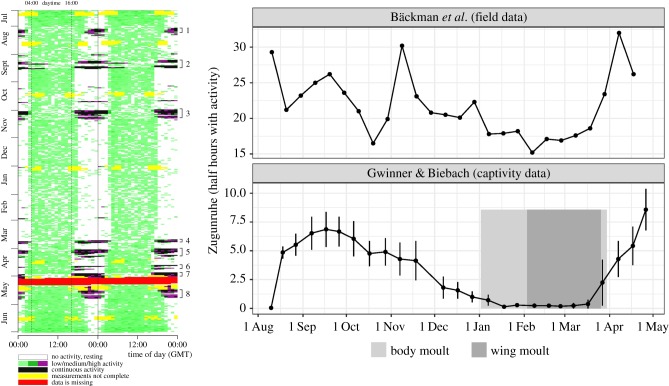
Figure 1.
Figure 1.
Activity profiles of red-backed shrikes (Lanius collurio) in the wild and in captivity. Left: movement and nocturnal migratory flight of a single, free-flying Danish shrike monitored from July 2014 until July 2015 by Bäckman et al. [20]. Right: comparison of nocturnal activity of the same free-flying shrike (top) with mean activity of 10 hand-raised conspecifics recorded in captivity (bottom) [21]. Shrikes originated from Gribskov, Denmark (top, 56°N) and Lemsjoeholm, South Finland (bottom, 60°N), respectively. On the left, each horizontal line represents accelerometer data from 2 consecutive days, where the second day is repeated as the first day on the next line. Colours encode mean activity level for each hour ranging from no activity (white) to continuous flight (black) with intermediary levels in colour. On the right, data are approximately monthly average numbers ±s.e. of half-hour periods between 18.00 and 06.00 h when birds were active during dark hours, plotted against time of year. Captive birds were kept under constant photoperiodic conditions (LD 12 : 12 h) [21]. For captive birds, vertical shadings indicate the timing of prenuptial (prealternate) moult (light grey: body moult, embedded in it, in dark grey: wing moult).
Figure 2.
Figure 2.
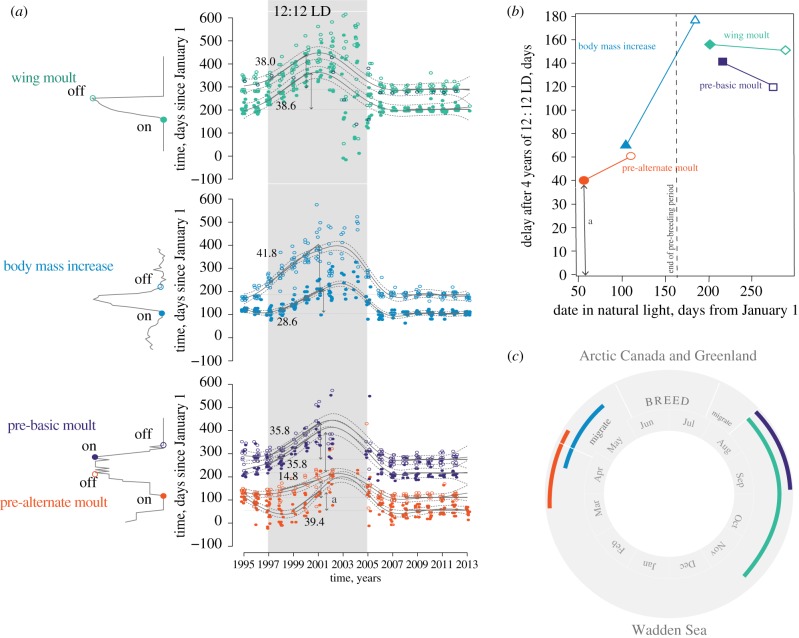
Timing of life-cycle stages in captive red knots under natural (wintering site) and constant (LD 12 : 12 h) photoperiodic conditions. (a) Timing of wing moult, spring body mass increase, and pre-alternate and pre-basic plumage moult in red knots across their stay in captivity. The period of treatment with 12 : 12 LD is shown in grey shade. Onsets (closed dots) and offsets (open dots) of each stage for each individual red knot are plotted together with predicted mean values (curved solid grey lines) and 95% confidence intervals (curved dotted lines). Horizontal solid black lines represent predicted means of onsets and offsets in natural photoperiod during 2008–2013 and in LD 12 : 12 h during 1997–2001. The numbers next to the lines stand for the predicted mean values of the rate (days/year) of linear drift in timing. Two-sided vertical arrows represent cumulative delay after 4 years in LD 12 : 12 h. One of the arrows (marked with ‘a’) is projected on panel (b). (b) Annual-cycle overview of the free-running timing of life-cycle stages of knots maintained under unvarying LD 12 : 12 h conditions. Cumulative delays in onsets (closed symbols) and offsets (open symbols) of spring body mass increase (triangles), pre-alternate (circles), pre-basic (squares) and wing-moult (diamonds) are plotted against median dates (days since January 1). Delays in the phases of the same life-cycle stage are connected with lines. (c) Annual cycle of the islandica Red Knot. Adapted from Karagicheva et al. [14]. Colours represent the life-cycle stages, as in (a) and (b).
Figure 3.
Figure 3.
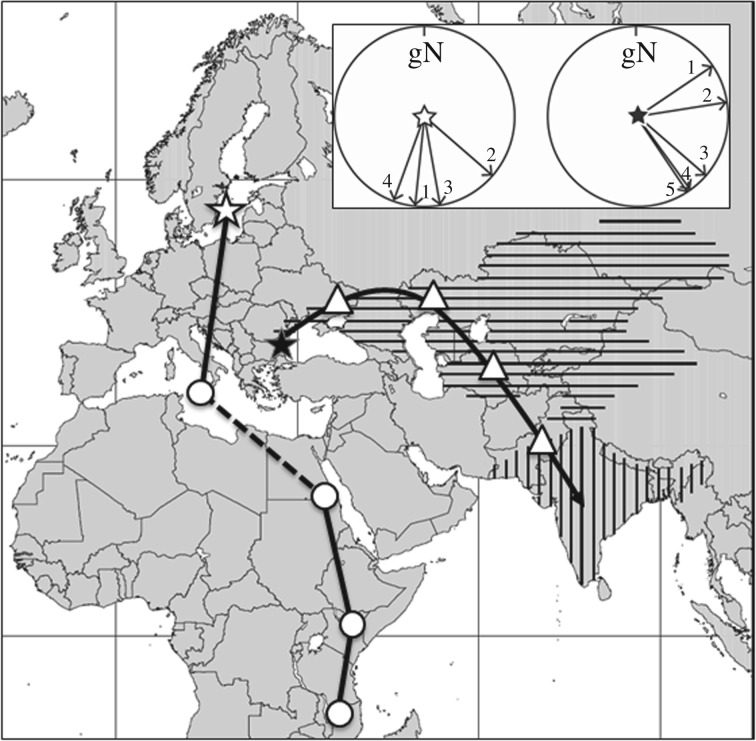
Hypothetical migration route of the westernmost population of the paddyfield warbler, Acrocephalus agricola, in autumn, compared to a migration route including stopovers of one adult thrush nightingale, Luscinia luscinia tracked by light-level geolocation by Stach et al. [140]. The broken line indicates equinox period when the route is unknown, stars indicate the breeding areas (filled star: paddyfield warbler, open star: thrush nightingale). Open circles indicate recorded locations of stopover sites for the thrush nightingale, while open triangles show hypothetical stopover sites for the paddyfield warbler. The stopover locations have been used for calculations of day length shifts presented in case study 2. Flight directions along the routes of the species are presented in the two circular inlay diagrams. Breeding range and wintering distribution of the paddyfield warbler are marked by horizontal and vertical hatching, respectively.
Figure 4.
Figure 4.
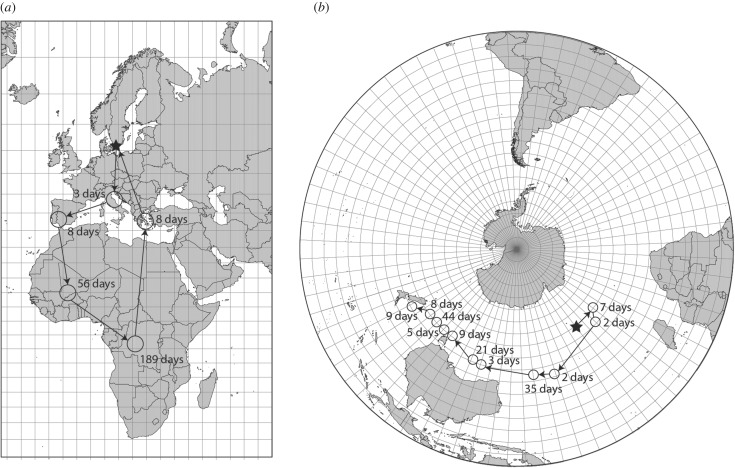
Examples of complete and partial migration routes of (a) an adult common swift tracked by light-level geolocation for 1 year, and (b) a juvenile wandering albatross tracked by satellite telemetry, illustrating periods of residency (open circles) during migration and migration routes. Stars illustrate starting points corresponding to breeding locations in South Sweden and at Crozet Islands, for the respective species. Data presented modified after Åkesson et al. [138] (a) and Åkesson & Weimerskirch [152] (b).

References

    1. Rowan W. 1926. On photoperiodism, reproductive periodicity, and the annual migrations of birds and certain fishes. Proc. Boston Soc. Nat. Hist. 38, 147–189.
    1. Aschoff J. 1955. Jahresperiodik der Fortpflanzung bei Warmblütern. Stud. Gen. 8, 742–776.
    1. Stanley CQ, MacPherson M, Fraser KC, McKinnon EA, Stutchbury BJM. 2012. Repeat tracking of individual songbirds reveals consistent migration timing but flexibility in route. PLoS ONE 7, e40688 ( 10.1371/journal.pone.0040688) - DOI - PMC - PubMed
    1. Gwinner E. 1996. Circannual clocks in avian reproduction and migration. Ibis 138, 47–63. ( 10.1111/j.1474-919X.1996.tb04312.x) - DOI
    1. Berthold P. 1996. Control of bird migration. Berlin, Germany: Springer.