


Time is honey: circadian clocks of bees and flowers and how their interactions may influence ecological communities
- PMID: 28993499
- PMCID: PMC5647282
- DOI: 10.1098/rstb.2016.0256
Time is honey: circadian clocks of bees and flowers and how their interactions may influence ecological communities
Abstract
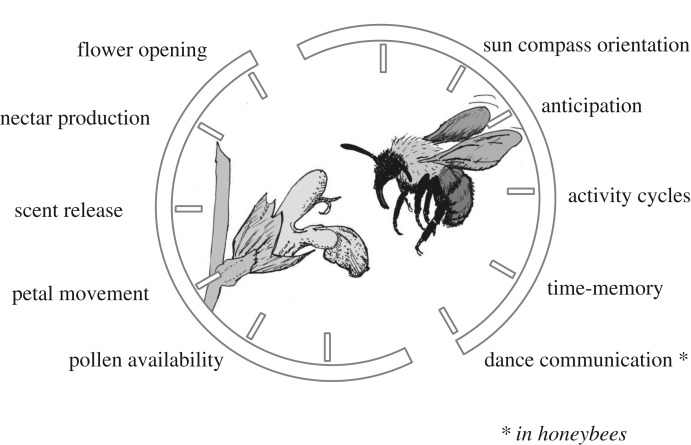
The interactions between flowering plants and insect pollinators shape ecological communities and provide one of the best examples of coevolution. Although these interactions have received much attention in both ecology and evolution, their temporal aspects are little explored. Here we review studies on the circadian organization of pollination-related traits in bees and flowers. Research, mostly with the honeybee, Apis mellifera, has implicated the circadian clock in key aspects of their foraging for flower rewards. These include anticipation, timing of visits to flowers at specified locations and time-compensated sun-compass orientation. Floral rhythms in traits such as petal opening, scent release and reward availability also show robust daily rhythms. However, in only few studies was it possible to adequately determine whether these oscillations are driven by external time givers such as light and temperature cycles, or endogenous circadian clocks. The interplay between the timing of flower and pollinator rhythms may be ecologically significant. Circadian regulation of pollination-related traits in only few species may influence the entire pollination network and thus affect community structure and local biodiversity. We speculate that these intricate chronobiological interactions may be vulnerable to anthropogenic effects such as the introduction of alien invasive species, pesticides or environmental pollutants.This article is part of the themed issue 'Wild clocks: integrating chronobiology and ecology to understand timekeeping in free-living animals'.
Keywords: bee; circadian rhythms; flower; foraging behaviour; network; pollination.
© 2017 The Author(s).
Conflict of interest statement
We declare we have no competing interests.
Figures
References
-
- Crepet WL. 1979. Insect pollination: a paleontological perspective. Bioscience 29, 102–108. ( 10.2307/1307746) - DOI
-
- Crepet WL. 1984. Advanced (constant) insect pollination mechanisms: pattern of evolution and implications vis-à-vis angiosperm diversity. Ann. MO Bot. Gar. 71, 607–630. ( 10.2307/2399041) - DOI
Publication types
MeSH terms
LinkOut - more resources
Full Text Sources
Other Literature Sources
