


Geometry Optimization with Machine Trained Topological Atoms
- PMID: 28993674
- PMCID: PMC5634454
- DOI: 10.1038/s41598-017-12600-3
Geometry Optimization with Machine Trained Topological Atoms
Abstract
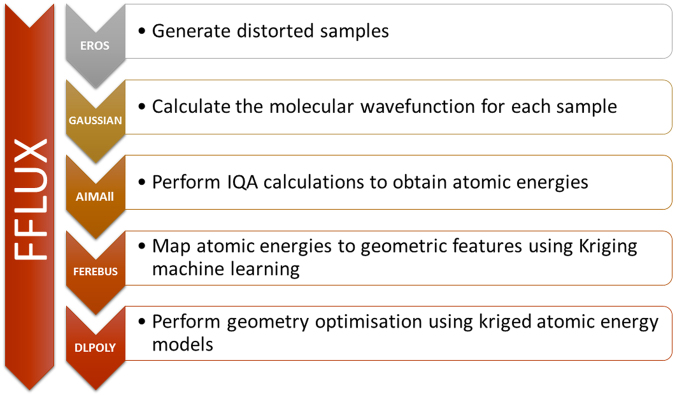
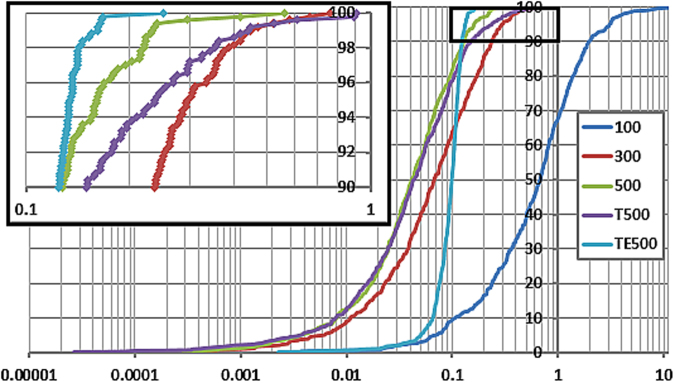
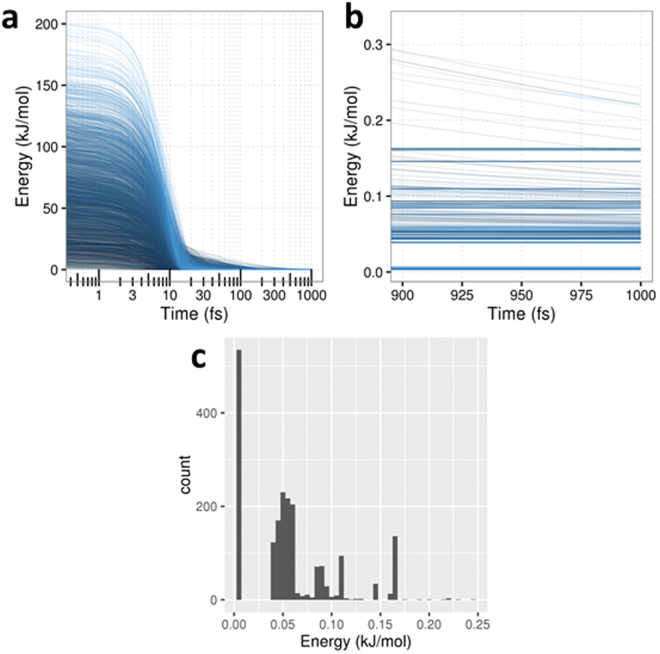
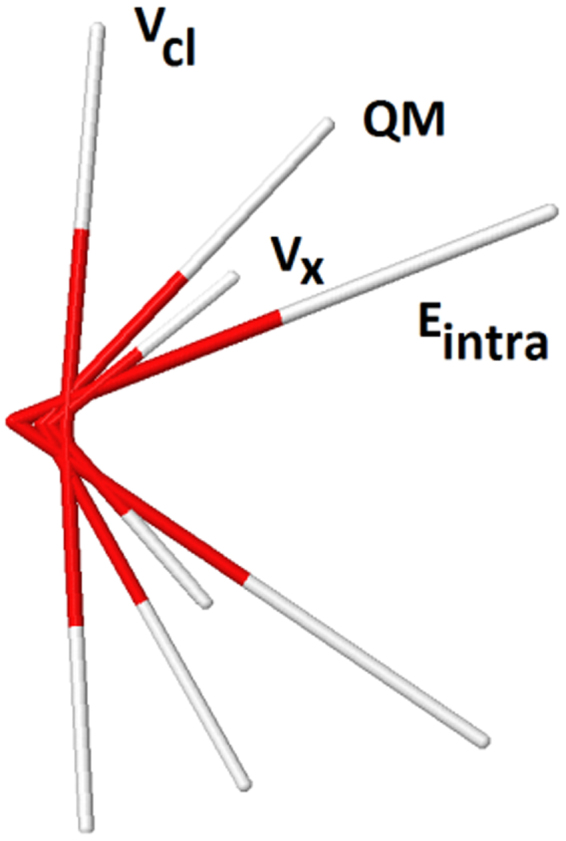
The geometry optimization of a water molecule with a novel type of energy function called FFLUX is presented, which bypasses the traditional bonded potentials. Instead, topologically-partitioned atomic energies are trained by the machine learning method kriging to predict their IQA atomic energies for a previously unseen molecular geometry. Proof-of-concept that FFLUX's architecture is suitable for geometry optimization is rigorously demonstrated. It is found that accurate kriging models can optimize 2000 distorted geometries to within 0.28 kJ mol-1 of the corresponding ab initio energy, and 50% of those to within 0.05 kJ mol-1. Kriging models are robust enough to optimize the molecular geometry to sub-noise accuracy, when two thirds of the geometric inputs are outside the training range of that model. Finally, the individual components of the potential energy are analyzed, and chemical intuition is reflected in the independent behavior of the three energy terms [Formula: see text](intra-atomic), [Formula: see text] (electrostatic) and [Formula: see text] (exchange), in contrast to standard force fields.
Conflict of interest statement
The authors declare that they have no competing interests.
Figures
References
-
- Bader, R. F. W. Atoms in Molecules. A Quantum Theory. (Oxford Univ. Press, Oxford, Great Britain, 1990).
-
- Popelier, P. L. A. The Quantum Theory of Atoms in Molecules. In The Nature of the Chemical Bond Revisited (eds Frenking, G. & Shaik, S.) 271–308 (Wiley-VCH, Chapter 8, 2014).
-
- Matta, C. F. & Boyd, R. J. The Quantum Theory of Atoms in Molecules. From Solid State to DNA and Drug Design. (Wiley-VCH, Weinheim, Germany, 2007).
Publication types
LinkOut - more resources
Full Text Sources
Other Literature Sources
