


Clinical presentations, treatments and risk factors for mortality in cats with tick paralysis caused by Ixodes holocyclus: 2077 cases (2008-2016)
- PMID: 28994630
- PMCID: PMC11104066
- DOI: 10.1177/1098612X17733628
Clinical presentations, treatments and risk factors for mortality in cats with tick paralysis caused by Ixodes holocyclus: 2077 cases (2008-2016)
Abstract
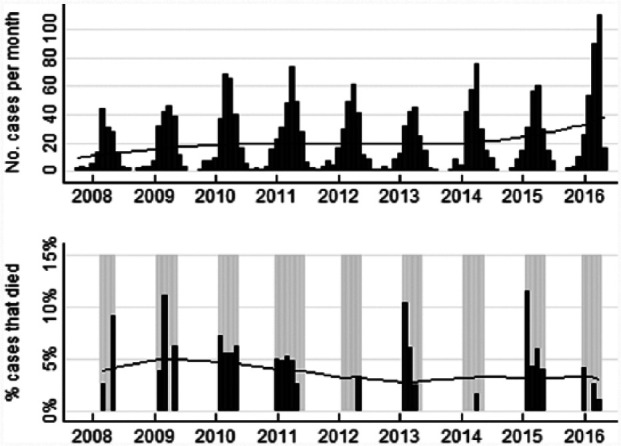
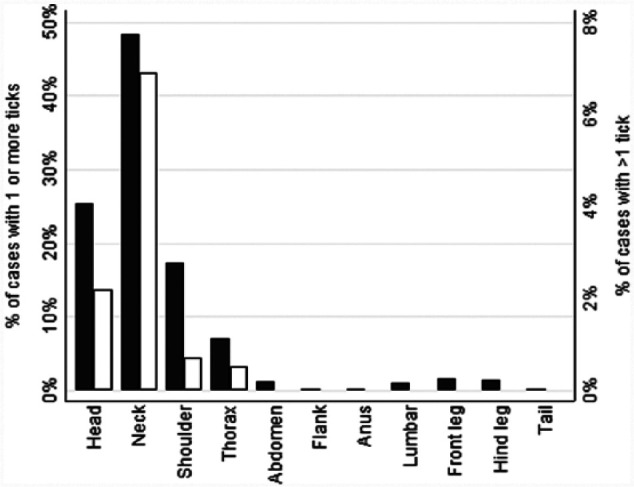
Objectives The objective of this study was to describe seasonality, demographics, presentations, treatments, complications and outcomes for cats with Ixodes holocyclus causing tick paralysis, and to identify risk factors for mortality. Methods This was a retrospective single cohort study with 2077 cases occurring between 2008 and 2016, and presenting to one of four emergency clinics in south-eastern Queensland, Australia. Case mortality at 5 days post-presentation could be determined for 1742 cases, and potential risk factors for mortality were assessed using random-effects logistic regression. Results Cases occurred all year round, but there was a marked seasonal pattern with more cases presenting in spring than any other season. Overall, 54/1742 cases (3%) died by 5 days after presentation. Five day mortality incidence for cases that received polyclonal canine tick antitoxin serum (TAS) and recommended treatment was 28/1410 (2%) vs 4/52 (8%) for cases that did not receive TAS ( P <0.001). Mechanical ventilation was recommended for 131/2077 cases (6%). Where mechanical ventilation was recommended but not implemented, mortality incidence was 15/17 (88%), whereas 4/22 cases (18%) that received mechanical ventilation died by day 5. From multivariable analyses, initial gait score (overall P = 0.047) and body temperature on presentation (overall P <0.001) were independently associated with mortality; cases with higher gait scores and those with body temperatures <35°C were at greater risk of death. Cases that had an adverse reaction to TAS were also more likely to die ( P = 0.002). Additional ticks were detected at coat clipping for 80/872 (9%) the cases that were clipped, and coat clipping was associated with a reduced risk of mortality ( P = 0.020). Risk of mortality did not differ significantly by time of year, clinic location, breed, sex, neuter status, age, weight, coat length or number of ticks found. Conclusions and relevance The overall mortality risk for cats treated for tick paralysis caused by I holocyclus is low. Risk factors for mortality include advanced gait and respiratory scores, and hypothermia at presentation. Coat clipping and TAS reduce the risk of mortality, whereas the occurrence of a TAS reaction increases the risk. Mechanical ventilation reduces mortality risk in cats with respiratory failure due to tick paralysis.
Conflict of interest statement
The authors declared no potential conflicts of interest with respect to the research, authorship, and/or publication of this article.
Figures
References
-
- Clunies-Ross I. Tick paralysis: a fatal disease of dogs and other animals in eastern Australia. J Counc Sci Ind Res 1935; 8: 8–13.
-
- Stone BF, Aylward JH. Tick toxicosis and the causal toxins: tick paralysis. In: Gopalakhrishnakone P, Tan C. (eds). Progress in venom and toxin research. Singapore: National University of Singapore Press, 1987, pp 594–682.
-
- Padula A. Tick paralysis of animals in Australia. In: Gopalakrishnakone P, Faiz S, Gnanathasan C. (eds). Clinical toxinology: clinical toxinology. Dordrecht: Springer Netherlands, 2016, pp 1–20.
-
- Atwell RB. Laryngeal paresis caused by I holocyclus. Aust Vet Pract 2002; 32: 44.
MeSH terms
LinkOut - more resources
Full Text Sources
Other Literature Sources
Miscellaneous
