doi: 10.4269/ajtmh.17-0350.
Epub 2017 Aug 31.
Characterization of Three New Insect-Specific Flaviviruses: Their Relationship to the Mosquito-Borne Flavivirus Pathogens
Affiliations
- PMID: 29016330
- PMCID: PMC5929187
- DOI: 10.4269/ajtmh.17-0350
Item in Clipboard
Characterization of Three New Insect-Specific Flaviviruses: Their Relationship to the Mosquito-Borne Flavivirus Pathogens
Am J Trop Med Hyg.
2018 Feb.
Abstract
Three novel insect-specific flaviviruses, isolated from mosquitoes collected in Peru, Malaysia (Sarawak), and the United States, are characterized. The new viruses, designated La Tina, Kampung Karu, and Long Pine Key, respectively, are antigenically and phylogenetically more similar to the mosquito-borne flavivirus pathogens, than to the classical insect-specific viruses like cell fusing agent and Culex flavivirus. The potential implications of this relationship and the possible uses of these and other arbovirus-related insect-specific flaviviruses are reviewed.
Figures
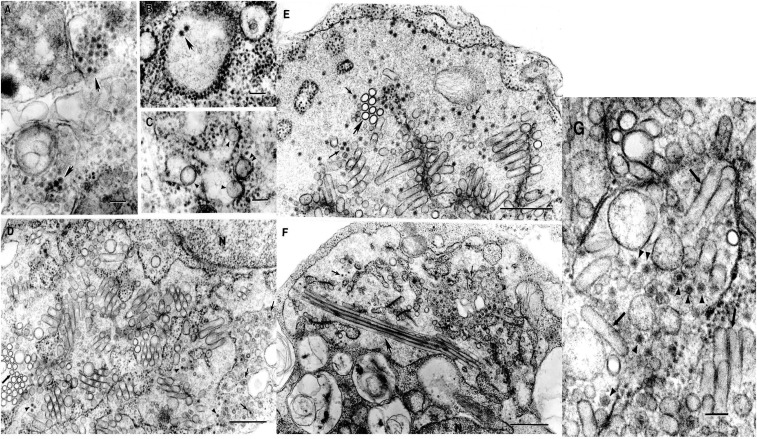
Ultrastructure of Kampung Karu (KPKV), Long Pine Key (LPKV) and La Tina (LTNV) viruses in C6/36 cells. (A) KPKV. Accumulations of virions ∼40 nm in diameter inside cytoplasmic vacuoles (arrows). Bar = 100 nm. (B) KPKV. Two virions inside a cistern of granular endoplasmic reticulum (arrow). Bar = 100 nm. (C) KPKV. Smooth membrane structures (SMS) inside an expanded cistern of granular endoplasmic reticulum (arrowheads) or in a tightly apposed cistern (double arrowhead). Bar = 100 nm. (D) LPKV. Virions (arrowheads) and SMS inside an enormous expansion of a cistern of granular endoplasmic reticulum. Thick arrow indicates cross sections of the SMSs. Virions can also be found inside individual small vacuoles (thin arrows). N-fragment of host cell nucleus. Bar = 0.5 µm. (E) LPKV. Virions (thin arrows) and SMS inside an enormous expansion of granular endoplasmic reticulum. Thick arrow indicates cross sections of SMSs. Bar = 0.5 µm. (F) LPKV. Virions (thin arrows) and SMS inside an enormous expansion of granular endoplasmic reticulum. Virions can be also observed inside individual vacuoles (arrowheads). Some SMS can be very long, up to 2.2 µm (thick arrow). N-fragment of the host cell nucleus. Bar = 0.5 µm. (G) LTNV. Virions (arrowheads) and SMS (arrows) inside an expanded cistern of granular endoplasmic reticulum. Bar = 100 nm.
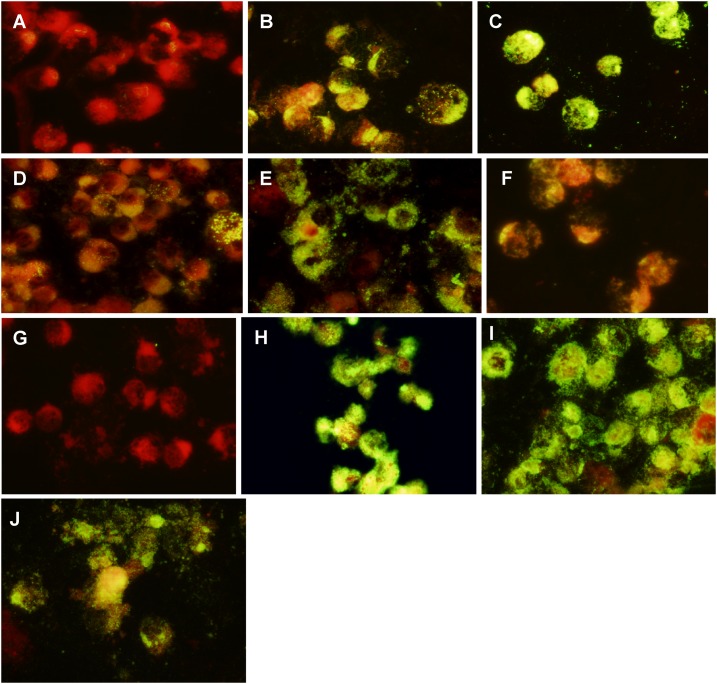
Results of indirect fluorescent antibody tests with C6/36 cells infected with various insect-specific viruses (antigen), using heterologous hyperimmune polyclonal antibodies prepared against West Nile (WNV), Dengue-2 (DENV-2) and Zika (ZIKV) viruses. Antibody dilutions 1:20. (A) Mercadeo virus X WNV antibody. (B) Long Pine Key virus X WNV antibody, (C) Marisma mosquito virus X WNV antibody. (D) La Tina virus X WNV antibody. (E) Nanay virus X ZIKV antibody. (F) Nhumirim virus X DENV-2 antibody. (G) Uninfected (control) C6/36 cells X WNV antibody. (H) WNV X WNV antibody. (I) DENV-2 X DENV-2 antibody. (J) ZIKV X ZIKV antibody.
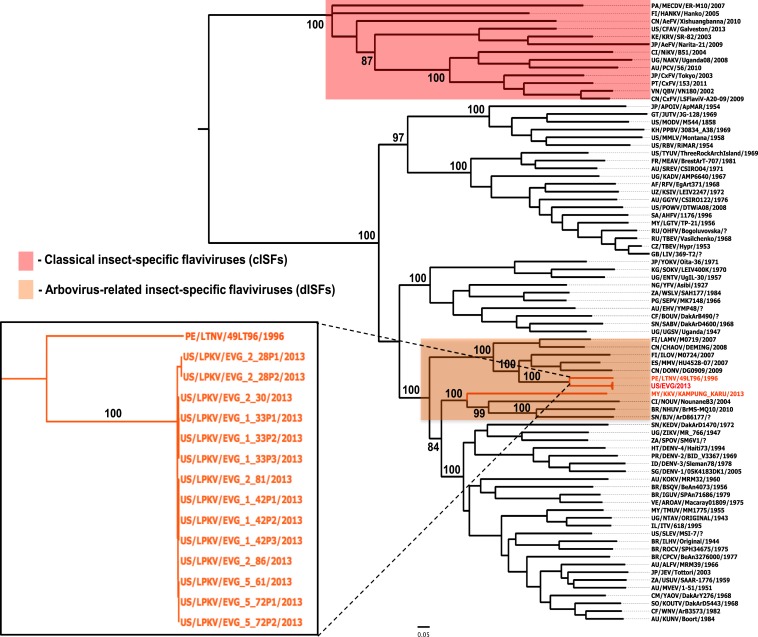
Maximum-likelihood (ML) phylogenetic tree of representative members of the genus Flavivirus. Highlighted in red are classical insect-specific flaviviruses (cISFs) and in orange are the arbovirus-related insect-specific flaviviruses (dISFs). Insert: Close-up of the dISFs described in this study. Bootstrap values are shown for most clades. All horizontal branch lengths are drawn to scale bar 0.05 nucleotide substitutions per site. The tree is midpoint-rooted for purposes of clarity only.
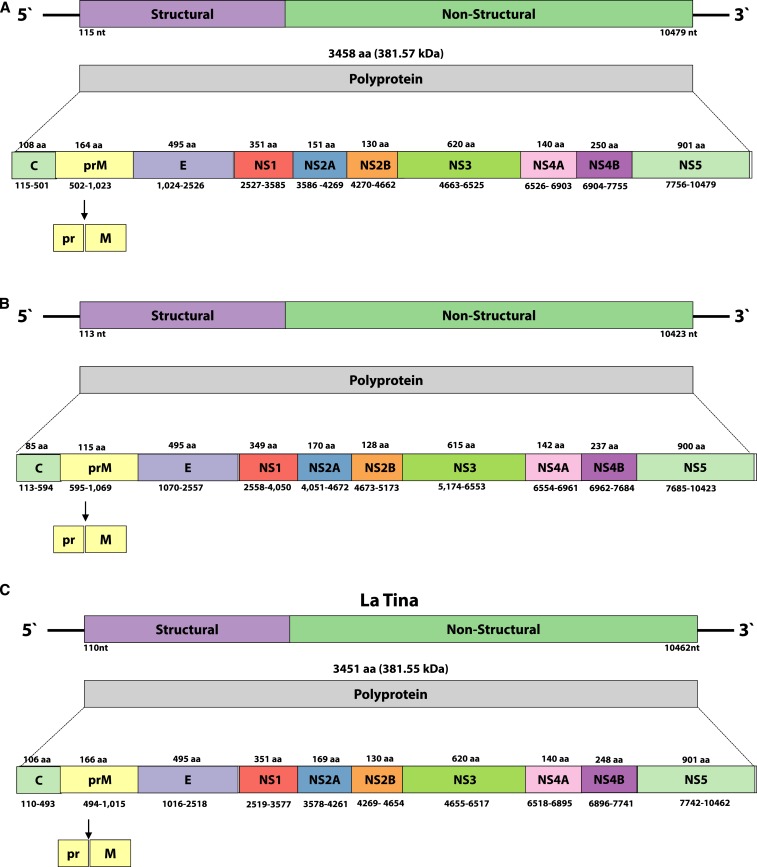
Genomic organization of Long Pine Key (A), Kampung Karu (B) and LaTina (C) viruses. Long grey boxes represent the polyproteins that after the cotransduction cleavage process form the three structural (C = capsid; prM = pre membrane; E = envelope) and seven non-structural (NS) proteins (NS1 to NS5) (represented by colored boxes). Numbers under the boxes correspond to the polyprotein genes. Start and stop codons expressed in nucleotides (nt) over the boxes represent the functional proteins, excluding the cleavage sites, and are expressed in aminoacids (aa). Arrow indicates the cleavage junction for pr and M proteins.
References
-
- World Health Organization , 1985. Arthropod-Borne and Rodent-Borne Viral Diseases. WHO Technical Report Series. Geneva, Switzerland: WHO, 719. - PubMed
-
- Datta S, Gopalakrishnan R, Chatterjee S, Veer V, 2015. Phylogenetic characterization of a novel insect-specific flavivirus detected in a Culex pool, collected from Assam, India. Intervirology 58: 149–154. - PubMed
Publication types
MeSH terms
Grants and funding
LinkOut - more resources
Full Text Sources
Other Literature Sources
Medical