Prevalence of Clinical and Subclinical Plasmodium falciparum and Plasmodium vivax Malaria in Two Remote Rural Communities on the Myanmar-China Border
- PMID: 29016341
- PMCID: PMC5817756
- DOI: 10.4269/ajtmh.17-0167
Prevalence of Clinical and Subclinical Plasmodium falciparum and Plasmodium vivax Malaria in Two Remote Rural Communities on the Myanmar-China Border
Abstract
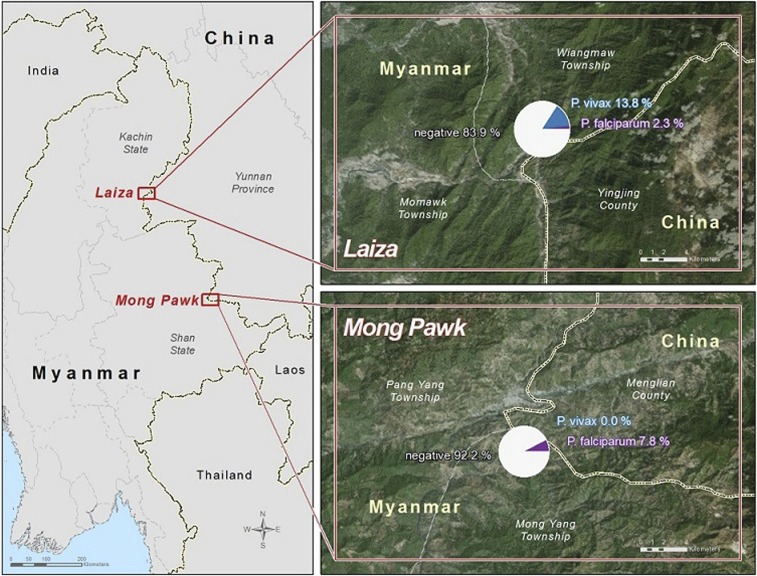
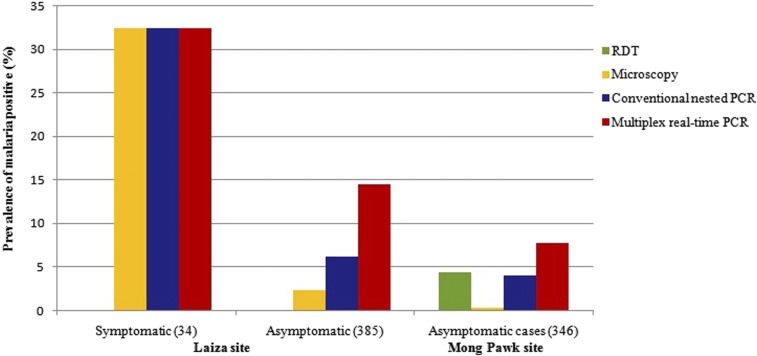
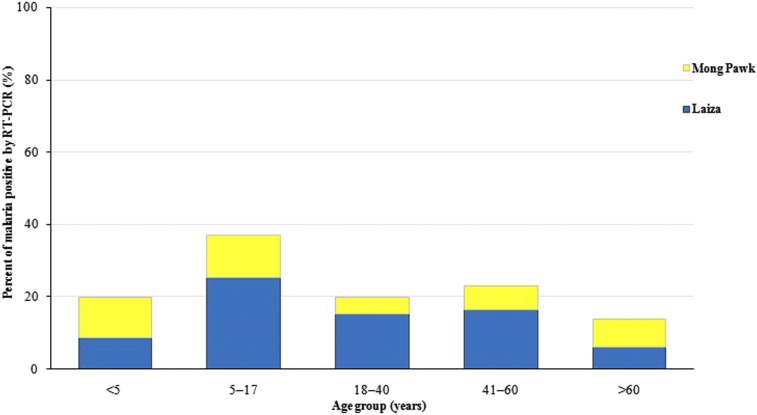
Malaria infections may be symptomatic, leading to treatment, or "asymptomatic," typically detected through active surveillance, and not leading to treatment. Malaria elimination may require purging both types of infection. Using detection methods with different sensitivities, we conducted a cross-sectional study in two rural communities located along the border between China's Yunnan Province and Myanmar's Shan and Kachin States, to estimate the prevalence of asymptomatic and symptomatic malaria. In Mong Pawk, all infections detected were asymptomatic, and the prevalence of Plasmodium falciparum was 0.3%, 4.3%, 4.0%, and 7.8% by light microscopy, rapid diagnostic test (RDT), conventional polymerase chain reaction (cPCR), and multiplexed real-time PCR (RT-PCR), respectively, and Plasmodium vivax prevalence was 0% by all detection methods. In Laiza, of 385 asymptomatic participants, 2.3%, 4.4%, and 12.2% were positive for P. vivax by microscopy, cPCR, and RT-PCR, respectively, and 2.3% were P. falciparum-positive only by RT-PCR. Of 34 symptomatic participants in Laiza, 32.4% were P. vivax-positive by all detection methods. Factors associated with infection included gender (males higher than females, P = 0.014), and young age group (5-17 age group compared with others, P = 0.0024). Although the sensitivity of microscopy was adequate to detect symptomatic infections, it missed the vast majority (86.5%) of asymptomatic infections. Although molecular detection methods had no advantage over standard microscopy or RDT diagnosis for clinically apparent infections, malaria elimination along the Myanmar-China border will likely require highly sensitive surveillance tools to identify asymptomatic infections and guide targeted screen-and-treat interventions.
Figures
References
-
- World Health Organization, 2015. Global Technical Strategy for Malaria 2016–2030. Geneva, Switzerland: WHO.
-
- Qi G, 2011. Opportunities and challenges of malaria elimination in China. Zhongguo Xue Xi Chong Bing Fang Zhi Za Zhi 23: 347–349. - PubMed
-
- Yang WZ, Zhou XN, 2016. New challenges of malaria elimination in China. Zhonghua Yu Fang Yi Xue Za Zhi 50: 289–291. - PubMed
-
- Xu J, Liu H, 2012. The challenges of malaria elimination in Yunnan Province, People’s Republic of China. Southeast Asian J Trop Med Public Health 43: 819–824. - PubMed
MeSH terms
LinkOut - more resources
Full Text Sources
Other Literature Sources