


The Role of the Mineralocorticoid Receptor in Inflammation: Focus on Kidney and Vasculature
- PMID: 29017166
- PMCID: PMC6863172
- DOI: 10.1159/000480652
The Role of the Mineralocorticoid Receptor in Inflammation: Focus on Kidney and Vasculature
Abstract
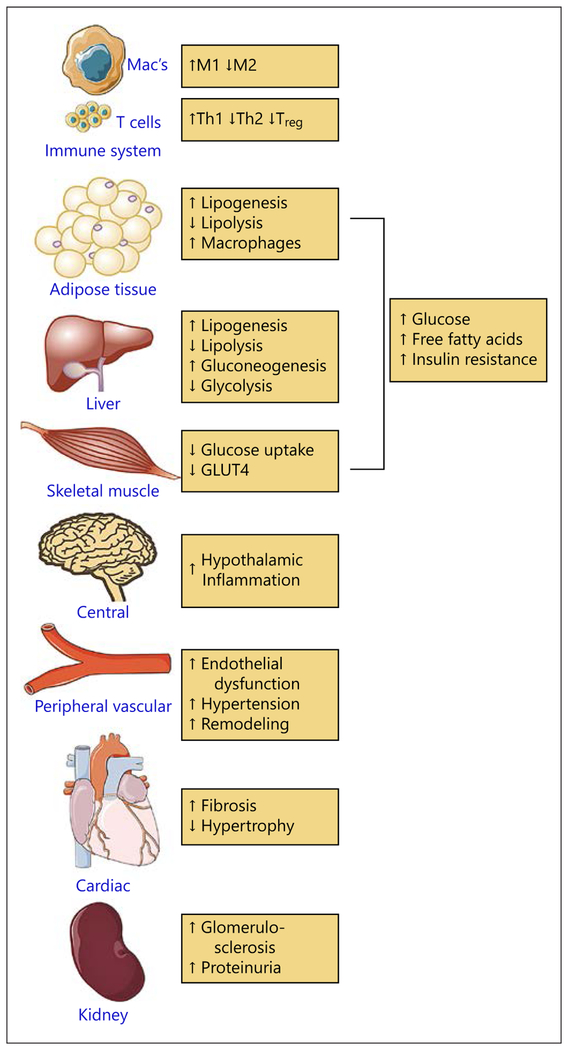
Background: The remarkable success of clinical trials in mineralocorticoid receptor (MR) inhibition in heart failure has driven research on the physiological and pathological role(s) of nonepithelial MR expression. MR is widely expressed in the cardiovascular system and is a major determinant of endothelial function, smooth muscle tone, vascular remodeling, fibrosis, and blood pressure. An important new dimension is the appreciation of the role MR plays in immune cells and target organ damage in the heart, kidney and vasculature, and in the development of insulin resistance.
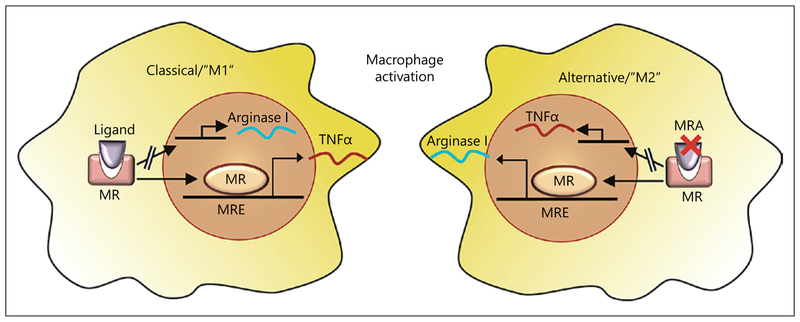
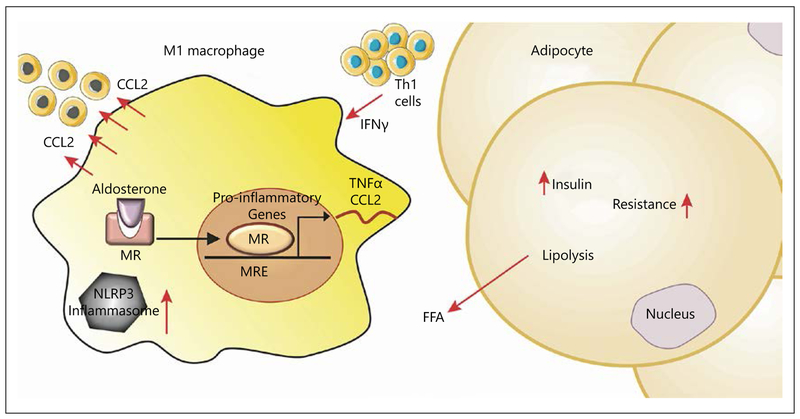
Summary: The mechanism for MR activation in tissue injury continues to evolve with the evidence to date suggesting that activation of MR results in a complex repertoire of effects involving both macrophages and T cells. MR is an important transcriptional regulator of macrophage phenotype and function. Another important feature of MR activation is that it can occur even with normal or low aldosterone levels in pathological conditions. Tissue-specific conditional models of MR expression in myeloid cells, endothelial cells, smooth muscle cells and cardiomyocytes have been very informative and have firmly demonstrated a critical role of MR as a key pathophysiologic variable in cardiac hypertrophy, transition to heart failure, adipose inflammation, and atherosclerosis. Finally, the central nervous system activation of MR in permeable regions of the blood-brain barrier may play a role in peripheral inflammation. Key Message: Ongoing clinical trials will help clarify the role of MR blockade in conditions, such as atherosclerosis and chronic kidney disease.
Keywords: Atherosclerosis; Cardiac hypertrophy; Central nervous system inflammation; Kidney fibrosis; Macrophage inflammation; Vascular remodeling.
© 2017 S. Karger AG, Basel.
Figures
References
-
- Selye H: Anticortisol action of aldosterone. Science 1955;121:368–369. - PubMed
-
- Arriza JL, Weinberger C, Cerelli G, Glaser TM, Handelin BL, Housman DE, et al. : Cloning of human mineralocorticoid receptor complementary DNA: structural and functional kinship with the glucocorticoid receptor. Science 1987;237:268–275. - PubMed
-
- Brilla CG, Pick R, Tan LB, Janicki JS, Weber KT: Remodeling of the rat right and left ventricles in experimental hypertension. Circ Res 1990;67:1355–1364. - PubMed
-
- Pitt B, Zannad F, Remme WJ, Cody R, Castaigne A, Perez A, et al. : The effect of spironolactone on morbidity and mortality in patients with severe heart failure. Randomized Aldactone Evaluation Study Investigators. N Engl J Med 1999;341:709–717. - PubMed
-
- Zannad F, McMurray JJ V, Krum H, van Veldhuisen DJ, Swedberg K, Shi H, et al. : EMPHASIS-HF (eplerenone CHF). N Engl J Med 2011;364:11–21.
Publication types
MeSH terms
Substances
Grants and funding
LinkOut - more resources
Full Text Sources
Other Literature Sources
Medical
