Thyroid Fine-Needle Aspiration Cytology Practice in Korea
- PMID: 29017314
- PMCID: PMC5700884
- DOI: 10.4132/jptm.2017.09.26
Thyroid Fine-Needle Aspiration Cytology Practice in Korea
Abstract
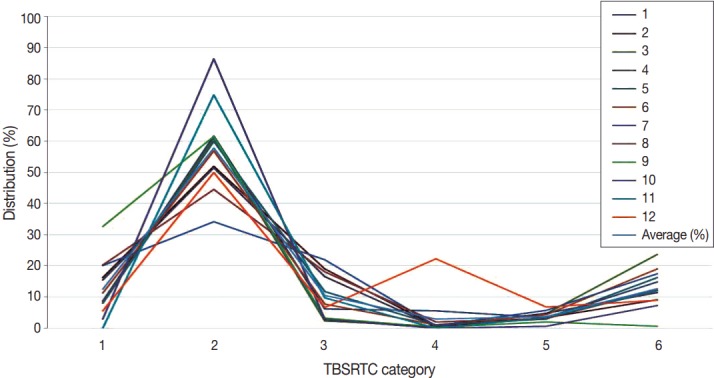
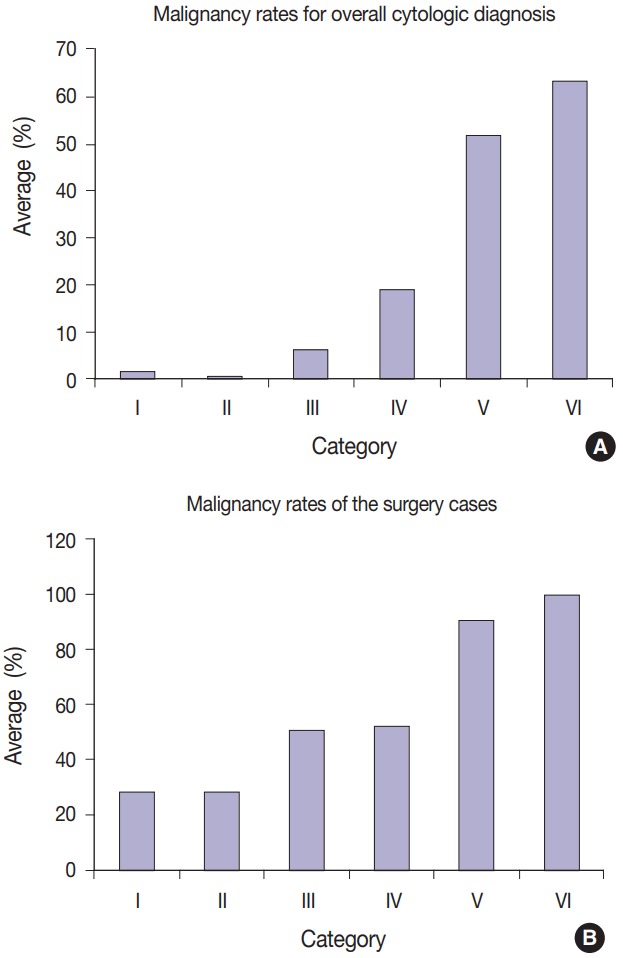
We reviewed the current status of thyroid fine-needle aspiration cytology (FNAC) in Korea. Thyroid aspiration biopsy was first introduced in Korea in 1977. Currently, radiologists aspirate the thyroid nodule under the guidance of ultrasonography, and cytologic interpretation is only legally approved when a cytopathologist makes the diagnosis. In 2008, eight thyroid-related societies came together to form the Korean Thyroid Association. The Korean Society for Cytopathology and the endocrine pathology study group of the Korean Society for Pathologists have been updating the cytologic diagnostic guidelines. The Bethesda System for Reporting Thyroid Cytopathology was first introduced in 2009, and has been used by up to 94% of institutions by 2016. The average diagnosis rates are as follows for each category: I (12.4%), II (57.9%), III (10.4%), IV (2.9%), V (3.7%), and VI (12.7%). The malignancy rates in surgical cases are as follows for each category: I (28.7%), II (27.8%), III (50.6%), IV (52.3%), V (90.7%), and VI (100.0%). Liquid-based cytology has been used since 2010, and it was utilized by 68% of institutions in 2016. The categorization of thyroid lesions into "atypia of undetermined significance" or "follicular lesion of undetermined significance" is necessary to draw consensus in our society. Immunocytochemistry for galectin-3 and BRAF is used. Additionally, a molecular test for BRAF in thyroid FNACs is actively used. Core biopsies were performed in only 44% of institutions. Even the institutions that perform core biopsies only perform them for less than 3% of all FNACs. However, only 5% of institutions performed core biopsies up to three times more than FNAC.
Keywords: Bethesda; Fine needle aspiration cytology; Korea; Thyroid neoplasms.
Conflict of interest statement
No potential conflict of interest relevant to this article was reported.
Figures
References
-
- Lipton RF, Abel MS. Aspiration biopsy and the thyroid in evaluation of thyroid dysfunction. Am J Med Sci. 1944;208:736–42.
-
- Crile G, Jr, Hawk WA., Jr Aspiration biopsy of thyroid nodules. Surg Gynecol Obstet. 1973;136:241–5. - PubMed
-
- Lee MH. Thyroid biopsy. Korean J Med. 1977;20:731–6.
-
- Park HS. Cytohistopathologic comparative study of aspiration biopsy cytology from various sites. Korean J Cytopathol. 1991;2:8–19.
Publication types
LinkOut - more resources
Full Text Sources
Other Literature Sources
Research Materials